Table of contents
Understanding what is considered a good ACT score is essential for setting realistic goals and building a competitive college application. With many colleges reinstating standardized testing requirements, achieving a strong ACT score has become increasingly important. The short answer is that a "good" ACT score depends on your individual goals and target colleges. A score that opens doors to one university might fall short at another. This guide will help you understand score ranges, percentiles, and strategies to achieve your best possible result.
Understanding ACT Score Ranges and Calculations
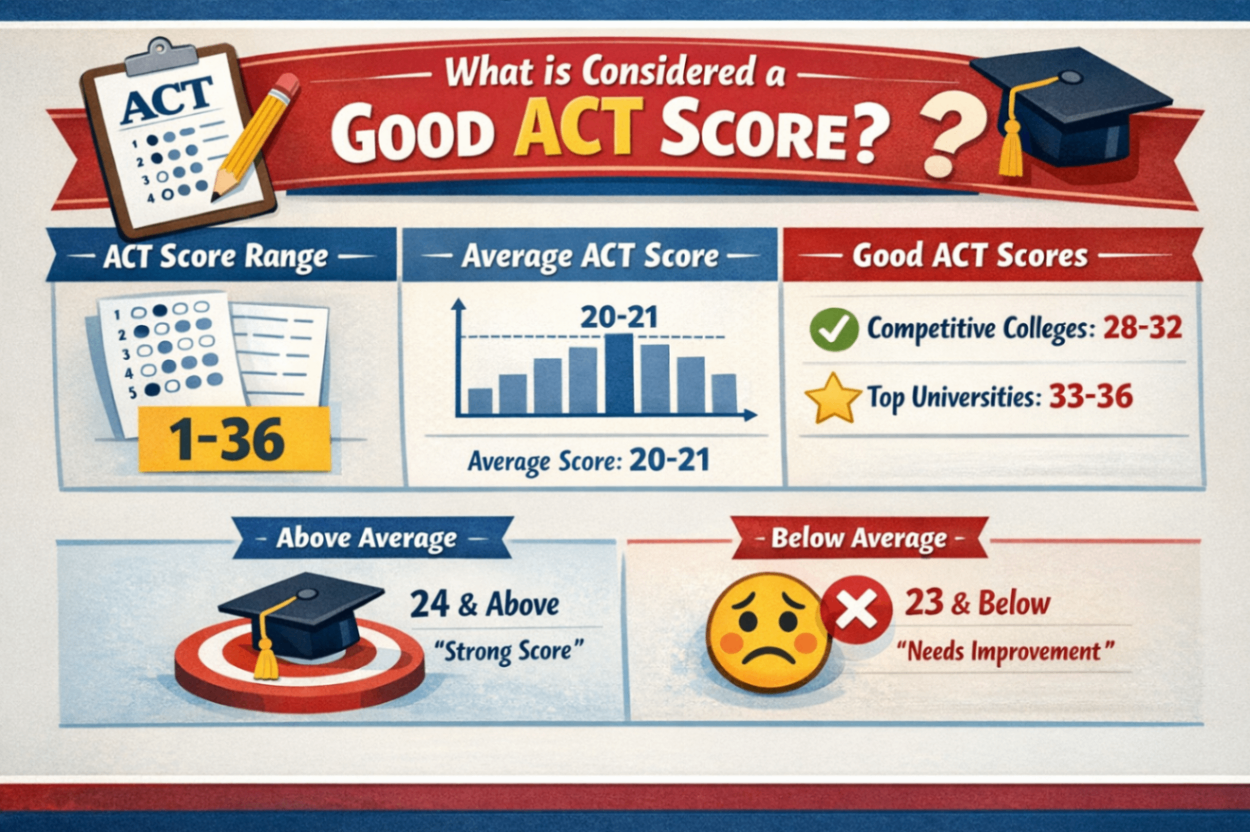
The ACT is scored on a scale of 1 to 36 for each section. Your composite score represents the average of your section scores, rounded to the nearest whole number.
How ACT Scores Are Classified
Scores between 1-18 indicate gaps in content understanding, 19-20 approaches the national average, 21-23 demonstrate solid knowledge, 24-30 are competitive for reputable universities, and 31-36 place you among top performers.
Composite Score Calculation
Your composite score is calculated by averaging your English, Math, Reading, and Science section scores. Starting in 2025, Science becomes optional on the digital ACT, with the composite based on the three required sections.
Section Score Breakdown
Each section tests specific skills: English measures grammar and rhetoric, Math covers algebra through pre-calculus, Reading assesses comprehension and analysis, and Science evaluates data interpretation and scientific reasoning.
What is Considered a Good Score on the ACT for Average Students?
The national average ACT composite score is approximately 19.4, meaning any score above 20 puts you ahead of most test-takers.
Percentile Rankings Explained
Scoring in the 21-26 range is considered above average and demonstrates college readiness. A composite score of 24 typically falls around the 74th percentile, while a score of 30 reaches the 94th percentile.
Above Average Score Benchmarks
Students scoring between 21-23 demonstrate solid foundational knowledge suitable for many four-year institutions. Scores from 24-26 place you in approximately the 74th to 83rd percentile, making you competitive at numerous public and private universities.
Elite Score Thresholds
Achieving a score of 30 or higher places you in the top 6% of all test-takers nationally. These elite scores open doors to highly selective institutions and significantly increase merit scholarship opportunities.
What is Considered a Good ACT Score for College Admissions?
What is considered a good ACT score for college depends largely on which institutions you're targeting.
Score Expectations by College Type
For community colleges and less selective institutions, scores in the 18-20 range often meet minimum requirements. Public universities and mid-tier colleges look for 21-24. Competitive state schools expect 25-29, while Ivy League and top-tier universities report middle 50% ranges between 33-36.
Understanding Middle 50% Ranges
When researching colleges, pay attention to their published middle 50% ACT score ranges. Scores at or above the 75th percentile make you a strong candidate, while scores within the middle 50% keep you competitive.
Minimum Score Requirements
Most four-year colleges require minimum scores between 18-20 for admission consideration. However, meeting minimum requirements doesn't guarantee acceptance, as admissions committees evaluate your complete application profile.
Competitive Scores for Selective Schools
Top-tier universities like Stanford, MIT, and Ivy League schools typically admit students with ACT scores between 33-36. Even scoring at the lower end of these ranges requires exceptional performance in other application areas.
How ACT Scores Impact Your Application
While what is considered a good score for the ACT matters, standardized test scores represent just one component of your application. Colleges also evaluate your GPA, extracurricular activities, essays, and recommendation letters.
Beyond Admission Eligibility
Strong ACT scores serve multiple purposes: qualifying students for merit-based scholarships, helping with course placement, and validating academic potential. Many students are discovering the benefits of AI in education for test preparation, using technology-driven tools for personalized practice sessions.
Merit Scholarship Opportunities
Many universities offer automatic merit scholarships based on ACT score thresholds. Achieving scores in the 28-32 range can unlock thousands of dollars in renewable scholarships, significantly reducing your overall college costs.
Course Placement Decisions
Colleges use ACT section scores to determine appropriate course placement for incoming freshmen. Strong Math and English scores may allow you to skip introductory courses and begin with advanced classes.
Holistic Review Context
Even at test-optional schools, submitting a strong ACT score strengthens your application. Admissions officers view competitive scores as evidence of academic preparedness and ability to succeed in rigorous coursework.
Strategies for Improving Your ACT Score
If your current score falls below your target, dedicated preparation can make a significant difference.
Effective Preparation Methods
Start by taking a full-length practice test to establish your baseline. Create a study schedule beginning at least three months before your test date. Consider using an AI Tutor for instant feedback and adaptive practice questions tailored to your skill level. Focus on understanding mistakes and practice time management rigorously.
Retaking the ACT
Most students who retake the ACT improve their scores with targeted preparation. Many colleges superscore, combining your highest section scores across test dates. Consider retaking if your score falls below target schools' 25th percentile.
Time Management Techniques
The ACT requires efficient pacing across all sections. Practice answering questions within time limits, learn when to skip difficult questions, and develop strategies for quick elimination of wrong answers.
Content Area Focus
Identify your weakest sections through practice tests and concentrate your study efforts accordingly. Targeted improvement in one section can significantly boost your composite score.
Setting Your Personal Target Score
The most meaningful way to define what is considered a good ACT score is aligning it with your college goals.
Researching Your Target Schools
Research score ranges for schools on your list and aim for the 75th percentile or above for top choices. Check each college's Common Data Set or admissions statistics page for accurate score ranges.
Creating a Balanced College List
Build a list including reach schools where your score falls below the 50th percentile, match schools where you're within the middle 50%, and safety schools where you exceed the 75th percentile.
Setting Realistic Improvement Goals
Based on your baseline practice test score, set achievable improvement targets. Most students can improve 2-4 points with dedicated preparation, though larger gains are possible with intensive study.
Conclusion
Determining what is considered a good ACT score requires understanding both national benchmarks and your target colleges' expectations. While the national average hovers around 19-20, competitive applicants to selective universities typically score 30 or higher. Research your specific target schools and aim for scores within or above their middle 50% ranges. Remember that your ACT score is just one factor in the admissions equation. A well-rounded application featuring strong grades, meaningful extracurriculars, compelling essays, and solid test scores creates the best foundation for success. Start preparing early and approach the test with confidence.
Frequently asked questions
What ACT score do I need for Ivy League schools?
Ivy League schools typically expect ACT composite scores between 33-36 for admitted students. While there's no absolute minimum, scoring within a school's middle 50% range significantly strengthens your application. These highly selective institutions use holistic review, so other factors matter alongside your test score.
Can I get into college with a low ACT score?
Yes, college admission is possible with below-average ACT scores. Many schools practice holistic review, considering your GPA, extracurriculars, essays, and recommendation letters. Additionally, hundreds of test-optional schools don't require ACT scores, allowing you to apply based on other strengths.
How many times should I take the ACT?
Most experts recommend two to three attempts maximum. Since many colleges superscore, multiple attempts can work in your favor by combining your highest section scores across test dates. Plan retakes strategically with sufficient preparation time.
Is a 25 ACT score good enough for scholarships?
A score of 25 places you in the 79th percentile and can qualify you for merit scholarships at many institutions. Scholarship criteria vary between schools, with some offering automatic awards at certain thresholds. Higher scores unlock more financial aid opportunities.
What's the difference between ACT and SAT scores?
The ACT uses a 1-36 composite scale while the SAT ranges from 400-1600. Both are accepted equally by all colleges. The ACT emphasizes curriculum-based knowledge with an optional science section, while the SAT focuses on reasoning skills. Take practice tests for both to determine which suits you best.