Table of contents
- What Does It Mean to Isolate a Variable
- The Step-by-Step Process for How to Isolate a Variable
- How to Isolate a Variable in Simple Linear Equations
- How to Isolate a Variable in a Fraction
- How to Isolate a Variable When It Appears Multiple Times
- Isolating Variables in Equations with Exponents and Roots
- Common Mistakes and How to Avoid Them
- Practical Applications and Real-World Examples
- Conclusion
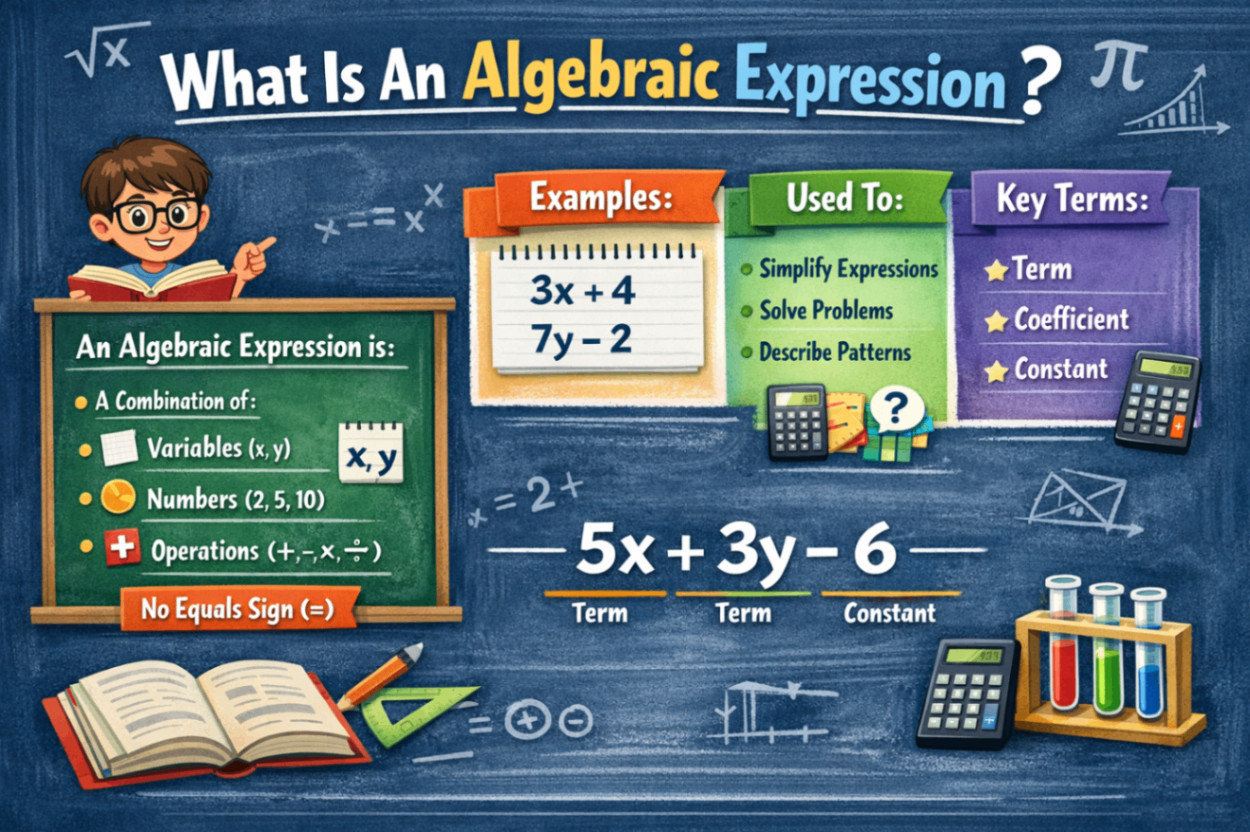
Isolating variables represents one of the most fundamental skills in algebra, serving as the key technique for solving equations across mathematics, science, engineering, and countless practical applications. Whether you're solving for unknown quantities in physics formulas, rearranging business equations to find profit margins, or determining unknown values in everyday calculations, the ability to manipulate equations to get a variable alone on one side proves essential. This algebraic skill transforms complex relationships into solvable problems. The process of how to isolate a variable in an equation involves systematically performing inverse operations to both sides of an equation until the variable stands alone, typically on the left side with everything else on the right. This technique requires understanding what is an algebraic expression, recognizing which operations affect your target variable, and knowing how to undo those operations while maintaining equation balance. Whether working with simple linear equations or complex formulas involving fractions, denominators, and multiple variables, mastering isolation techniques enables you to solve virtually any algebraic problem systematically and confidently.
What Does It Mean to Isolate a Variable
Isolating a variable means rearranging an algebraic equation so that a different variable is on its own, typically appearing alone on one side of the equal sign. The goal is to choose a sequence of operations that will leave the variable of interest on one side and put all other terms on the other side.
The Fundamental Concept
To isolate a variable means to get it alone on one side of an equation, usually the left side, using inverse operations. When you isolate the variable, you're finding out what makes both sides equal by performing operations that undo what's being done to the variable. The end result shows the variable equal to some expression or value, such as x = 5 or y = 3a + 2. Think of an equation like a balanced scale—whatever you do to one side, you must do to the other to keep it balanced. This golden rule of algebraic operations ensures equations remain true throughout the manipulation process. If you subtract 5 from the left side, you must subtract 5 from the right side as well.
Why Isolating Variables Matters
This fundamental technique helps us solve equations and find unknown values, enabling practical problem-solving across disciplines. In physics, you might need to isolate time in a distance formula to calculate duration. In chemistry, isolating concentration from a solution equation determines substance amounts. In business, isolating profit in a revenue equation reveals expected earnings. Beyond finding specific numerical answers, isolating variables allows you to rearrange formulas for different purposes. The same formula can be reorganized to solve for different quantities depending on what information you have and what you need to find. For instance, the distance formula d = rt can be rearranged to solve for rate (r = d/t) or time (t = d/r).
The Step-by-Step Process for How to Isolate a Variable
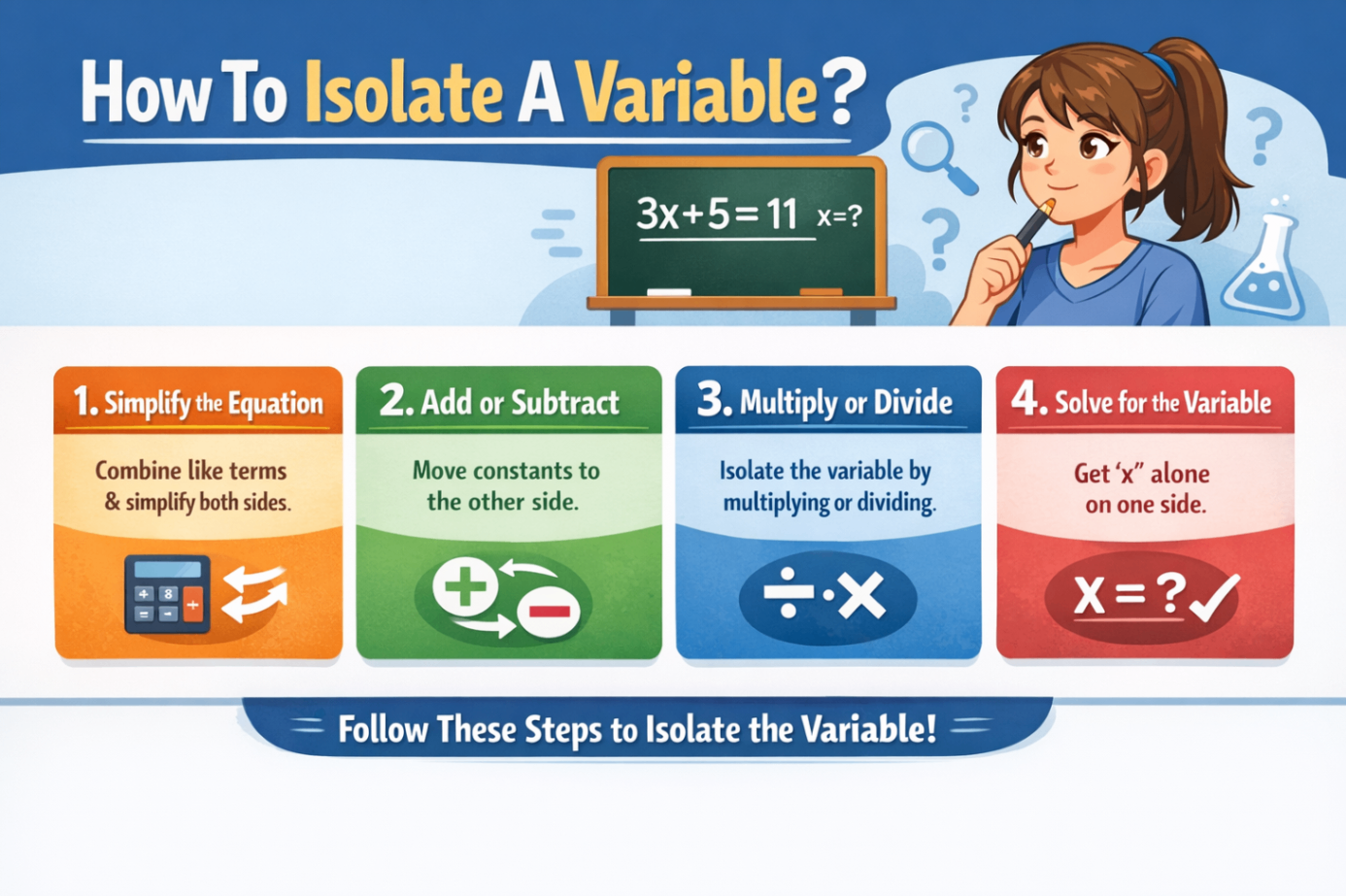
How to rearrange an equation to isolate a variable follows a systematic approach using inverse operations applied in a specific order. Mastering this process enables you to tackle equations of any complexity level.
Identify the Variable to Isolate
Begin by clearly identifying which variable you need to isolate. In multi-variable equations, this determines your entire strategy. If solving 2x + 3y = 12 for y, your goal is getting y alone on one side. If solving for x instead, you'll use different steps even though the equation is identical.
Simplify Both Sides First
Before attempting isolation, simplify each side of the equation as much as possible. Combine like terms—terms with identical variables raised to identical powers. Distribute any multiplication over addition or subtraction. Clear parentheses by applying distributive properties. This preparation reduces complexity and makes subsequent steps clearer. For example, if starting with 3x + 2x - 5 = 15 + 7, first simplify to 5x - 5 = 22 before proceeding. Similarly, 2(x + 3) - 4 = 10 should be expanded to 2x + 6 - 4 = 10, then simplified to 2x + 2 = 10 before isolating x.
Use Inverse Operations
Inverse operations undo each other, allowing you to remove unwanted terms from the variable's side. Addition and subtraction are inverse operations—adding 5 undoes subtracting 5, and vice versa. Multiplication and division are inverse operations—multiplying by 3 undoes dividing by 3, and vice versa. Squaring and taking square roots are inverses, as are raising to a power and taking corresponding roots. To isolate the variable, cancel out operations on the same side of the equation as the variable of interest while maintaining equation equality. For instance, if x + 7 = 12, the +7 is added to x. Use the inverse operation (subtract 7) from both sides: x + 7 - 7 = 12 - 7, simplifying to x = 5.
Follow Reverse Order of Operations
When equations involve multiple operations, use reverse PEMDAS (or reverse BODMAS) to determine which operations to undo first. Normally, PEMDAS guides simplification order: Parentheses, Exponents, Multiplication and Division (left to right), Addition and Subtraction (left to right). When isolating variables, reverse this order, working from the outermost operations inward. Start by undoing addition and subtraction first, then address multiplication and division, followed by exponents and roots, and finally handle any parentheses. Think of it as peeling an onion—work from the outside in, removing layers of operations until the variable stands alone.
Verify Your Solution
After isolating the variable, verify correctness by substituting the solution back into the original equation. Both sides should equal the same value if your isolation process was correct. This check catches algebraic mistakes and confirms your answer's validity.
How to Isolate a Variable in Simple Linear Equations
Linear equations with variables appearing to the first power represent the most straightforward isolation scenarios. These fundamental examples build skills applicable to more complex situations.
Addition and Subtraction Equations
When variables are combined with constants through addition or subtraction, use the opposite operation to isolate them. For the equation x + 4 = 12, subtract 4 from both sides: x + 4 - 4 = 12 - 4, yielding x = 8. The +4 term is eliminated on the left, while the right simplifies to 8. Similarly, for x - 7 = 3, add 7 to both sides: x - 7 + 7 = 3 + 7, resulting in x = 10. The subtraction is undone by addition, isolating x cleanly. Always perform the same operation on both sides to maintain equation balance.
Multiplication and Division Equations
When variables are multiplied or divided by constants, use the inverse operation. For 5x = 20, divide both sides by 5: 5x/5 = 20/5, simplifying to x = 4. The multiplication by 5 is undone through division. For x/3 = 7, multiply both sides by 3: (x/3) × 3 = 7 × 3, yielding x = 21. Division by 3 is undone through multiplication. Note that multiplying by the denominator is often called "clearing the denominator" or "cross-multiplying" in certain contexts.
Multi-Step Linear Equations
Most practical equations involve multiple operations requiring several steps to isolate variables. For 3x + 7 = 22, first subtract 7 from both sides: 3x + 7 - 7 = 22 - 7, simplifying to 3x = 15. Then divide both sides by 3: 3x/3 = 15/3, yielding x = 5. Notice how operations are undone in reverse order—first addressing addition (outermost), then multiplication (innermost). For equations like 2x - 5 = 11, add 5 to both sides first: 2x - 5 + 5 = 11 + 5, giving 2x = 16. Then divide by 2: 2x/2 = 16/2, resulting in x = 8. Always work systematically from outermost to innermost operations. For students working through complex isolation problems, tools like Algebra AI Solver can provide step-by-step guidance showing each operation and explaining why it's performed.
How to Isolate a Variable in a Fraction
Fractions add complexity to isolation since variables can appear in numerators, denominators, or both. Understanding how to handle fractional equations expands your problem-solving capabilities significantly.
How to Isolate a Variable in the Numerator
When the variable appears in a fraction's numerator, the process resembles standard linear equations. For x/5 = 3, multiply both sides by the denominator 5: (x/5) × 5 = 3 × 5, resulting in x = 15. Multiplying by the denominator "clears" the fraction, leaving the variable isolated. For more complex numerators like (x + 2)/4 = 5, multiply both sides by 4: ((x + 2)/4) × 4 = 5 × 4, simplifying to x + 2 = 20. Then isolate x by subtracting 2: x + 2 - 2 = 20 - 2, yielding x = 18. The fraction is cleared first, then remaining operations are addressed.
How to Isolate a Variable in the Denominator
Variables in denominators require more careful handling. For 5/x = 2, begin by eliminating the fraction through cross-multiplication or by multiplying both sides by x: (5/x) × x = 2 × x, simplifying to 5 = 2x. Then divide by 2: 5/2 = 2x/2, yielding x = 5/2 or x = 2.5. For equations like 12/(x - 3) = 4, multiply both sides by (x - 3): (12/(x - 3)) × (x - 3) = 4 × (x - 3), simplifying to 12 = 4(x - 3). Distribute the 4: 12 = 4x - 12. Add 12 to both sides: 12 + 12 = 4x - 12 + 12, giving 24 = 4x. Finally, divide by 4: 24/4 = 4x/4, resulting in x = 6.
Equations with Multiple Fractions
When equations contain multiple fractions, find the least common denominator (LCD) of all fractions, then multiply every term by this LCD to clear all fractions simultaneously. For x/2 + x/3 = 10, the LCD is 6. Multiply every term by 6: 6(x/2) + 6(x/3) = 6(10), simplifying to 3x + 2x = 60, which becomes 5x = 60. Divide by 5: x = 12. This LCD multiplication method eliminates all fractions in a single step, reducing the equation to a simpler form without fractional coefficients. After clearing fractions, proceed with standard isolation techniques.
How to Isolate a Variable When It Appears Multiple Times
Equations where variables appear on both sides or multiple times require consolidating all variable terms on one side before isolation can proceed.
Variables on Both Sides
When variables appear on both sides of an equation, move all variable terms to one side using inverse operations. For 3x + 2 = 2x + 7, subtract 2x from both sides: 3x - 2x + 2 = 2x - 2x + 7, simplifying to x + 2 = 7. Then subtract 2: x + 2 - 2 = 7 - 2, yielding x = 5. The goal is gathering all terms containing the variable on one side (typically the left) and all constant terms on the other side (typically the right). This creates a standard form where the variable can be isolated through normal operations.
Multiple Variable Terms on One Side
When the same variable appears multiple times on one side, combine like terms before proceeding. For 5x - 2x + 3 = 12, first simplify the left side: (5x - 2x) + 3 = 12 becomes 3x + 3 = 12. Then isolate x: subtract 3 from both sides (3x = 9), then divide by 3 (x = 3). Always simplify by combining like terms as your first step. This reduces equation complexity and makes subsequent isolation steps more straightforward.
Isolating Variables in Equations with Exponents and Roots
When variables are raised to powers or under radical signs, additional techniques become necessary for proper isolation.
Variables with Exponents
For equations where variables are raised to powers, use roots as inverse operations. For x² = 25, take the square root of both sides: √(x²) = √25, giving x = ±5. Note that even powers produce both positive and negative solutions since both 5² and (-5)² equal 25. For x³ = 27, take the cube root: ∛(x³) = ∛27, yielding x = 3. Odd powers produce single solutions since only positive 3 cubed equals 27. Be mindful of whether exponents are even (producing two solutions) or odd (producing one solution).
Variables Under Radicals
When variables appear under square roots or other radicals, square (or raise to the appropriate power) both sides to eliminate the radical. For √x = 4, square both sides: (√x)² = 4², resulting in x = 16. Verify this solution in the original equation since squaring can introduce extraneous solutions. For ∛(x + 1) = 2, cube both sides: (∛(x + 1))³ = 2³, giving x + 1 = 8. Then subtract 1: x = 7. Always check solutions in the original equation when working with radicals and exponents.
Common Mistakes and How to Avoid Them
Understanding typical errors helps prevent frustration and builds accurate algebraic manipulation skills.
Forgetting to Apply Operations to Both Sides
The most fundamental error involves applying operations to only one side of the equation. Remember: equations are like balanced scales—whatever you do to one side must be done to the other. If you subtract 5 from the left, subtract 5 from the right. If you divide the left by 3, divide the right by 3.
Sign Errors with Negative Numbers
Sign mistakes frequently occur when dealing with negative coefficients or when subtracting negative terms. Remember that subtracting a negative equals adding a positive: x - (-5) = x + 5, not x - 5. Similarly, when dividing or multiplying by negatives, signs change: -3x = 12 means x = -4, not x = 4.
Order of Operations Violations
Failing to follow reverse PEMDAS leads to incorrect isolation sequences. Always address addition and subtraction before multiplication and division when isolating variables. In 2x + 5 = 15, subtract 5 first (getting 2x = 10), then divide by 2 (getting x = 5). Don't divide by 2 first—that would incorrectly yield x + 2.5 = 7.5.
Not Combining Like Terms First
Attempting to isolate variables before simplifying creates unnecessary complexity. In 3x + 2x - 4 = 11, combine 3x and 2x first to get 5x - 4 = 11, then proceed with isolation. Skipping this simplification step leads to more complicated manipulations.
Practical Applications and Real-World Examples
Isolating variables extends far beyond classroom exercises into practical problem-solving across numerous fields and everyday situations.
Scientific Formulas
Physics formulas frequently require rearrangement to solve for different quantities. The distance formula d = vt relates distance, velocity, and time. To find velocity, isolate v by dividing both sides by t: v = d/t. To find time, isolate t by dividing by v: t = d/v. One formula serves three purposes through variable isolation. The density formula ρ = m/V relates density, mass, and volume. Isolating mass yields m = ρV (multiply both sides by V). Isolating volume yields V = m/ρ (divide both sides by ρ). Scientists routinely rearrange formulas based on available information and target quantities.
Financial Calculations
Business and finance rely heavily on equation manipulation. The simple interest formula I = Prt calculates interest from principal, rate, and time. To find principal, isolate P: divide both sides by rt to get P = I/(rt). To find rate: r = I/(Pt). To find time: t = I/(Pr). Profit equations like P = R - C (profit equals revenue minus cost) can be rearranged to find revenue (R = P + C) or cost (C = R - P) depending on what information you have and what you're calculating.
Everyday Problem Solving
Converting between temperature scales requires isolating variables. The Fahrenheit-to-Celsius formula is C = 5(F - 32)/9. To convert Celsius to Fahrenheit, isolate F: multiply both sides by 9/5, then add 32, yielding F = (9C/5) + 32. This rearrangement lets you convert in either direction. Recipe scaling, travel time calculations, unit conversions, and countless other daily tasks involve isolating variables from equations representing relationships between quantities.
Conclusion
Understanding how to isolate a variable in an equation represents an essential algebraic skill with applications extending across mathematics, science, business, and everyday problem-solving. The fundamental process involves systematically applying inverse operations to both sides of equations—using addition to undo subtraction, multiplication to undo division, and appropriate roots to undo exponents—while following reverse order of operations to peel away layers until variables stand alone. Whether learning how to isolate a variable in a fraction by multiplying away denominators, how to isolate a variable in the denominator through cross-multiplication, or how to rearrange an equation to isolate a variable by moving terms strategically, the core principle remains constant: maintain equation balance by performing identical operations on both sides. From simple linear equations requiring one or two steps to complex formulas involving multiple variables, fractions, exponents, and radicals, mastering isolation techniques enables you to solve virtually any algebraic equation, rearrange scientific formulas for different purposes, and tackle quantitative problems confidently across academic and professional contexts where precise mathematical manipulation determines success.
Frequently Asked Questions
What is the fastest way to isolate a variable?
The fastest approach involves first simplifying both sides by combining like terms, then systematically undoing operations using reverse PEMDAS—address addition/subtraction first, then multiplication/division, followed by exponents/roots. For simple equations like 3x + 7 = 22, subtract 7 from both sides (getting 3x = 15), then divide by 3 (getting x = 5). The key is working from outermost to innermost operations affecting your variable, always performing the same operation on both sides to maintain equation balance.
How do you isolate a variable when it appears on both sides?
When variables appear on both sides, first move all variable terms to one side using inverse operations. For example, in 5x + 3 = 2x + 12, subtract 2x from both sides: 5x - 2x + 3 = 2x - 2x + 12, which simplifies to 3x + 3 = 12. Now the variable appears only on the left side. Then proceed normally: subtract 3 from both sides (3x = 9), then divide by 3 (x = 3). Always consolidate variable terms on one side before attempting final isolation.
What do you do when the variable is in the denominator?
When the variable appears in a denominator like 15/x = 5, multiply both sides by the variable (or the entire denominator expression if it's more complex) to eliminate the fraction. Multiplying both sides by x gives: (15/x) × x = 5 × x, which simplifies to 15 = 5x. Then divide both sides by 5 to get x = 3. Always check your solution to ensure it doesn't make any denominator equal zero, as division by zero is undefined.
Can you isolate variables in equations with multiple fractions?
Yes, and the most efficient method is finding the least common denominator (LCD) of all fractions, then multiplying every term in the equation by this LCD. For x/4 + x/6 = 5, the LCD is 12. Multiply every term by 12: 12(x/4) + 12(x/6) = 12(5), which simplifies to 3x + 2x = 60, then 5x = 60. Divide by 5 to get x = 12. This method eliminates all fractions simultaneously, reducing the equation to a simpler form that's easier to solve.
Why do you need to do the same operation to both sides?
Equations are statements of equality—the left side equals the right side. Think of an equation as a balanced scale: if you add weight to only one side, the scale tips and balance is lost. Similarly, if you perform an operation on only one side of an equation, the equality no longer holds true. By performing identical operations on both sides, you maintain the equality relationship throughout your manipulations, ensuring your final answer is correct. This fundamental principle underpins all algebraic equation solving.