Table of contents
- What Is the Definition of an Algebraic Expression
- What Is a Term in an Algebraic Expression
- What Is an Example of an Algebraic Expression
- Types of Algebraic Expressions
- Simplifying Algebraic Expressions
- Evaluating Algebraic Expressions
- Writing Algebraic Expressions from Word Problems
- Common Mistakes and How to Avoid Them
- Conclusion
Algebraic expressions form the foundational language of mathematics, enabling us to represent relationships, model real-world situations, and solve complex problems efficiently. From calculating the cost of multiple items at different prices to determining distances traveled at varying speeds, these mathematical phrases appear everywhere in daily life and advanced mathematics. Understanding what is an algebraic expression represents an essential step for students progressing beyond arithmetic into the powerful world of algebra, where unknown values become solvable through systematic approaches. Unlike simple arithmetic statements that work with known numbers, algebraic expressions incorporate variables—letters representing unknown or changing values that make mathematics flexible and widely applicable. Whether you're a student encountering algebra for the first time, a parent helping with homework, or someone seeking to refresh mathematical knowledge, grasping the components, types, and applications of algebraic expressions opens doors to mathematical thinking that extends far beyond the classroom into careers in science, technology, engineering, business, and countless other fields where quantitative reasoning matters.
What Is the Definition of an Algebraic Expression
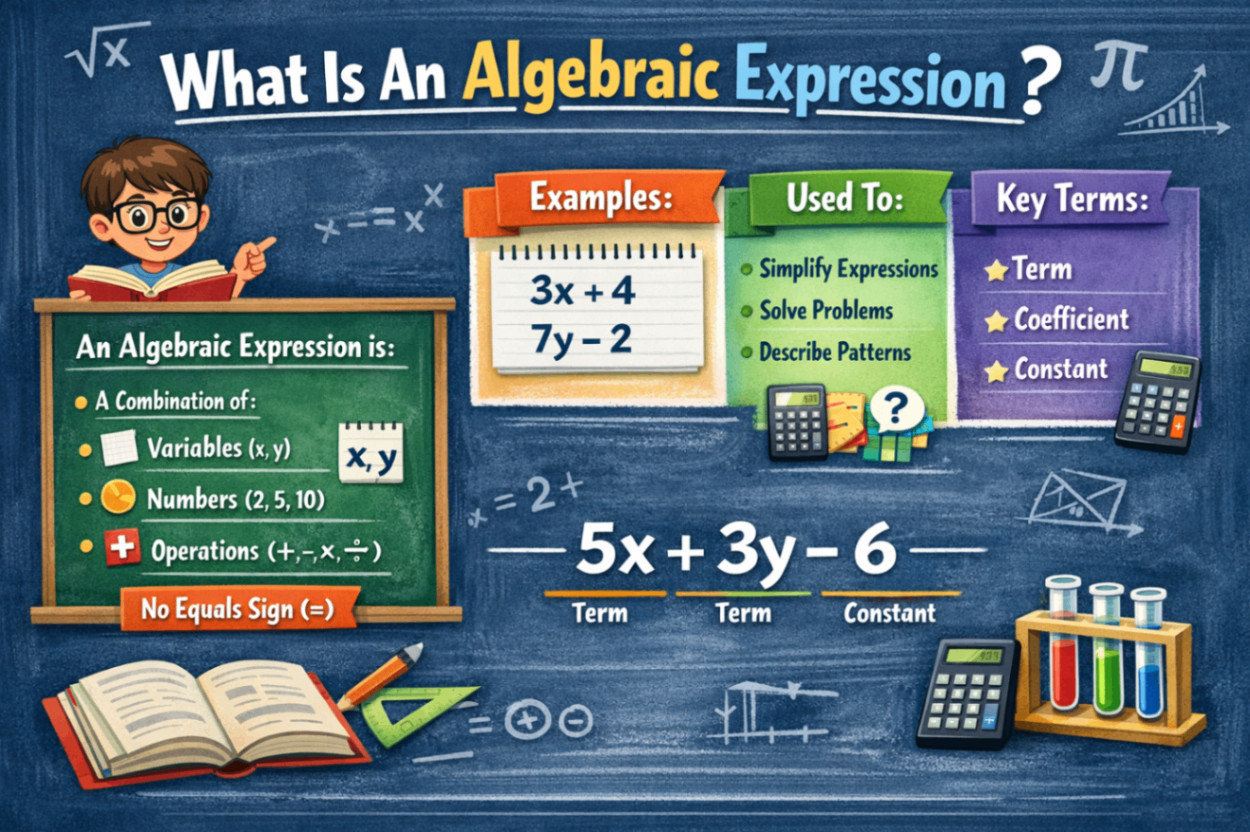
An algebraic expression is a mathematical statement that combines constants, variables, and algebraic operations such as addition, subtraction, multiplication, and division to represent relationships or quantities. More formally, what is an algebraic expression in math can be defined as an expression built up from constants, variables, and the basic algebraic operations including whole number powers and roots.
Core Components of Algebraic Expressions
Understanding the building blocks helps clarify what makes an expression algebraic. A variable is a symbol that doesn't have a fixed value and can take any value, typically represented by letters like x, y, z, a, or b. Variables enable expressions to represent general relationships rather than specific numerical calculations. For instance, in the expression 5x + 3, the letter x is a variable whose value remains unknown until specified. Constants are numbers with fixed, definite values that don't change, such as 3, -7, 15, or π. These numerical values provide concrete quantities within expressions. Coefficients are constants multiplied by variables, determining how many times the variable is counted. In the term 7x, the number 7 serves as the coefficient of x, meaning seven times whatever value x represents. Operators are mathematical symbols indicating which operations to perform—addition (+), subtraction (−), multiplication (×), and division (÷). These operations connect the various components of expressions, creating mathematical relationships. A term can be a constant, a variable, or a combination of both, with each term separated by either addition or subtraction. Understanding these fundamental components enables recognition and manipulation of algebraic expressions.
What Distinguishes Expressions from Equations
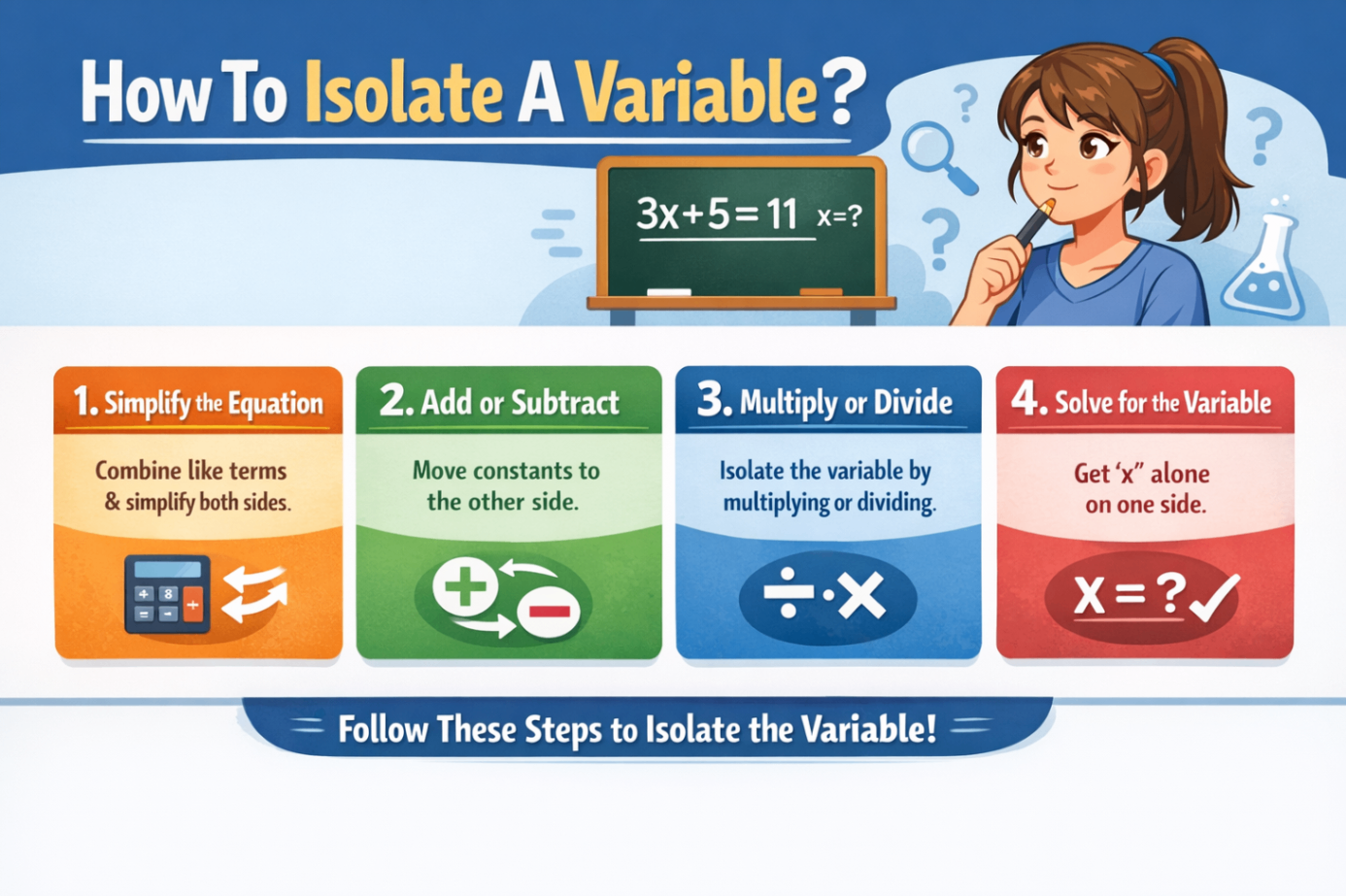
A crucial distinction exists between algebraic expressions and algebraic equations. Unlike an algebraic equation, an algebraic expression has no sides or equal to sign. Expressions represent values or relationships but don't claim these values equal anything specific. For example, 3x + 7 is an expression, while 3x + 7 = 22 is an equation asserting that the expression equals 22. This distinction matters because expressions and equations serve different purposes. Expressions describe quantities or relationships that can be simplified or evaluated, while equations state that two expressions are equal, creating problems to solve by finding values that make the equation true. Understanding how to isolate a variable becomes essential when working with equations derived from algebraic expressions.
What Is a Term in an Algebraic Expression
Terms represent the individual parts of algebraic expressions, separated by addition or subtraction operations. A term is a variable alone (or) a constant alone (or) it can be a combination of variables and constants by the operation of multiplication or division. Recognizing and classifying terms enables simplification and manipulation of expressions.
Types of Terms
Terms in algebraic expressions fall into several categories based on their composition. A constant term contains only a number without any variables, such as 5, -12, or 0.75. These terms maintain the same value regardless of what values variables take. A variable term includes at least one variable, which may stand alone (like x or y) or be combined with coefficients (like 3x or -7y). If 3xy is a term, then its factors are 3, x and y, demonstrating how terms can contain multiple components multiplied together. Terms with multiple variables like 4xy or -2abc involve products of different variables, often appearing in expressions modeling multi-dimensional relationships or situations involving several changing quantities.
Like Terms and Unlike Terms
Classifying terms as "like" or "unlike" proves essential for simplifying expressions. Like terms contain exactly the same variables raised to the same powers, differing only in their coefficients. For example, 3x and 7x are like terms because both contain the variable x to the first power. Similarly, 2x² and -5x² are like terms since both contain x squared. Unlike terms either contain different variables or the same variables raised to different powers. The terms 3x and 3y are unlike because they involve different variables, while 2x and 2x² are unlike because x appears to different powers. Only like terms can be combined through addition or subtraction when simplifying expressions, making this distinction crucial for algebraic manipulation.
Counting Terms in Expressions
After we identify the terms, we can just count them to classify expressions by the number of terms they contain. The expression 5x contains one term, making it a monomial. The expression 3x + 7 contains two terms (3x and 7), making it a binomial. The expression 2x² + 5x - 3 contains three terms, making it a trinomial. Expressions with more than three terms are generally called polynomials.
What Is an Example of an Algebraic Expression
Concrete examples help illustrate how algebraic expressions represent various situations and mathematical relationships. For example, 5x + 7 is an algebraic expression containing a variable term (5x) and a constant term (7) connected by addition.
Simple Expression Examples
Basic algebraic expressions demonstrate fundamental concepts. The expression x + 3 can be described as "3 more than x," representing a situation where you add 3 to an unknown value. The expression 2y represents "twice y" or "2 times y," showing multiplication between a coefficient and variable. The expression a - 5 means "5 less than a," demonstrating subtraction of a constant from a variable. More complex single-operation examples include 7m (7 times m), x/4 (x divided by 4), and -3p (negative 3 times p). Each expression models different relationships between constants and variables using various operations.
Multi-Term Expression Examples
Expressions combining multiple terms model more complex relationships. The expression x³ + 3x² − 2x³ + 2x − x² + 3 − x contains multiple terms of different types that can be combined and simplified. The expression 3x² + 2x + 5 includes a squared term (3x²), a linear term (2x), and a constant (5), representing a complete quadratic relationship. Business contexts provide practical examples. The expression 3c + 5d might represent buying 3 cookies at price c per cookie and 5 donuts at price d per donut, calculating the total cost. The expression 2p + 3q could represent total basketball points scored, with p representing 2-point shots and q representing 3-point shots made.
Real-World Applications
Instead of saying "The cost of 3 pens and 4 pencils", it is simple to say 3x + 4y where x and y are the costs of each pen and pencil respectively. This efficiency makes algebraic expressions invaluable for modeling real situations. If you're driving at speed v for time t, the expression vt represents distance traveled, encapsulating the fundamental relationship between speed, time, and distance. For students working through complex expression problems, tools like AI Algebra Solver can provide step-by-step guidance on simplification, evaluation, and manipulation techniques.
Types of Algebraic Expressions
Algebraic expressions are classified in multiple ways based on their structure, number of terms, and mathematical properties. Understanding these classifications helps in recognizing patterns and applying appropriate algebraic techniques.
Classification by Number of Terms
A monomial expression is having only one term, such as 5x, -3y², or 7. These single-term expressions represent the simplest form of algebraic statements. A binomial expression is having two terms, which are unlike, such as 2x + 3, 5y - 7, or x² + 4x. Binomials appear frequently in factoring and multiplication problems. A trinomial consists of three terms, such as x² + 5x + 6 or 2a - 3b + 4. Trinomials are particularly important in quadratic equations and factoring. Polynomial expressions contain multiple terms with non-negative integer exponents, such as 4x⁴ + 2x² + 5x - 3. The term "polynomial" encompasses monomials, binomials, and trinomials as special cases.
Numerical vs. Variable Expressions
Expressions can also be classified by whether they contain variables. Numeric expressions consist only of numbers and operations without any variables, such as 10 + 5 or 15 ÷ 2. While technically not algebraic since they lack variables, understanding them provides context for algebraic expressions. Variable expressions contain variables along with numbers and operations, such as 4x + y or 5ab + 33. These true algebraic expressions enable representation of general relationships and problems where some quantities remain unknown or variable.
Rational and Irrational Expressions
Rational algebraic expressions can be written as quotients of polynomials, such as (x² + 4x + 4)/(x + 2) or (3x - 5)/(2x + 1). These fractional expressions extend algebraic thinking to ratios and proportions. Irrational algebraic expressions contain roots or radicals that cannot be expressed as polynomial quotients, such as √(x + 4) or ∛(2x - 1).
Simplifying Algebraic Expressions
Simplification reduces expressions to their most compact form by combining like terms and applying algebraic properties. To simplify an algebraic expression, we just combine the like terms, making expressions easier to work with and understand.
Identifying and Combining Like Terms
The simplification process begins by identifying like terms—terms containing identical variables raised to identical powers. First, find out the terms having the same power. Then, if the terms are like terms, add them. In the expression 3x + 5x, both terms contain x to the first power, so they combine to give 8x. Consider the expression 4a + 7b - 2a + 3b. The like terms 4a and -2a combine to give 2a, while 7b and 3b combine to give 10b, producing the simplified expression 2a + 10b. This process reduces complexity while maintaining the expression's mathematical meaning.
Multi-Variable Simplification
Expressions with multiple variables require careful attention to which terms are alike. For instance, let's simplify 4x⁵ + 3x³ - 8x² + 67 - 4x² + 6x³. Same powers that are repeated are cubic and square, upon combining them together, the expression becomes 4x⁵ + (3x³ + 6x³) - (8x² + 4x²) + 67. After combining like terms, this simplifies to 4x⁵ + 9x³ - 12x² + 67. When variables have different exponents or when different variables appear, terms cannot combine. In 5x² + 3x + 2, none of the terms are alike—x² differs from x, and neither contains the constant 2. This expression is already in its simplest form since no further combination is possible.
The Order of Operations
Simplification must respect the order of operations (PEMDAS/BODMAS): Parentheses/Brackets first, then Exponents/Orders, followed by Multiplication and Division from left to right, and finally Addition and Subtraction from left to right. By adhering to this rule, one can easily solve complex equations without becoming confused. When evaluating 2(3x + 4) - 5x where x = 2, first handle parentheses: 2(3(2) + 4) = 2(6 + 4) = 2(10) = 20. Then subtract: 20 - 5(2) = 20 - 10 = 10. Following this sequence ensures accurate results.
Evaluating Algebraic Expressions
Evaluation means substituting specific values for variables and calculating the numerical result. This process transforms abstract expressions into concrete numbers relevant to particular situations.
Substitution and Calculation
To evaluate an expression, replace each variable with its given value and perform the indicated operations. If evaluating 3x + 7 when x = 4, substitute 4 for x: 3(4) + 7 = 12 + 7 = 19. The expression's value is 19 when x equals 4. For expressions with multiple variables, substitute all given values before calculating. To evaluate 2a + 3b when a = 5 and b = 2, substitute both values: 2(5) + 3(2) = 10 + 6 = 16. Careful substitution and systematic calculation prevent errors.
Expressions with Exponents
When expressions contain exponents, evaluate them according to the order of operations. To evaluate 11x² - 6 when x = 5: 11 × 5² - 6 = 11 × 25 - 6 = 275 - 6 = 269. The exponent is calculated first (5² = 25), then multiplication (11 × 25 = 275), and finally subtraction (275 - 6 = 269). Complex expressions require methodical work through each operation step. For 4x² + 3x - 7 when x = -2: First, 4(-2)² + 3(-2) - 7. Calculate the exponent: 4(4) + 3(-2) - 7. Then multiply: 16 + (-6) - 7. Finally, add and subtract: 16 - 6 - 7 = 3.
Writing Algebraic Expressions from Word Problems
Translating word problems into algebraic expressions represents a crucial skill connecting mathematics to real-world applications. This translation requires identifying unknown quantities, recognizing operations, and expressing relationships symbolically.
Common Phrases and Their Translations
Certain phrases correspond to specific operations. "More than," "increased by," "sum of," and "added to" indicate addition. "Less than," "decreased by," "difference of," and "subtracted from" indicate subtraction. "Times," "product of," and "multiplied by" indicate multiplication, while "divided by," "quotient of," and "ratio of" indicate division. "Three more than a number" translates to x + 3. "Five less than twice a number" becomes 2x - 5. "The product of four and a number, decreased by seven" translates to 4x - 7. Recognizing these patterns facilitates accurate translation.
Multi-Step Translation
Complex situations require combining multiple operations. "The cost of renting a car for d days at 50 dollars per day plus a 25 dollar fee" translates to 50d + 25. "The total cost of b books at 15 dollars each and m magazines at 5 dollars each" becomes 15b + 5m. When problems describe relationships between multiple quantities, identify each variable carefully. "Maria's age is three times Juan's age minus four years" requires defining variables (let j = Juan's age) before writing the expression (3j - 4) representing Maria's age.
Common Mistakes and How to Avoid Them
Students commonly encounter certain errors when working with algebraic expressions. Recognizing these pitfalls helps develop accurate algebraic thinking and manipulation skills.
Incorrectly Combining Unlike Terms
The most frequent error involves attempting to combine unlike terms. Students sometimes add 3x and 5y to get 8xy, but these terms cannot combine since they contain different variables. Similarly, 2x and 3x² cannot combine because the variables are raised to different powers. Only terms with identical variable parts can be added or subtracted.
Sign Errors
Mistakes with negative signs frequently occur during simplification and evaluation. When subtracting a negative term, students sometimes forget that subtracting a negative is equivalent to adding a positive: 5x - (-3x) equals 5x + 3x = 8x, not 2x. Similarly, when evaluating expressions with negative variable values, carefully apply negatives through all operations.
Order of Operations Violations
Failing to follow the correct order of operations produces incorrect results. In evaluating 3 + 2 × 4, multiplication must occur first (2 × 4 = 8) before addition (3 + 8 = 11), yielding 11, not 20. Always perform operations in the correct sequence: parentheses, exponents, multiplication and division (left to right), then addition and subtraction (left to right).
Conclusion
Understanding what is an algebraic expression provides an essential foundation for mathematical thinking across countless applications in academics and real life. The definition encompasses mathematical statements combining constants, variables, and operations—components that work together to represent relationships and solve problems efficiently. What is a term in an algebraic expression refers to individual parts separated by addition or subtraction, with terms classified as like or unlike based on their variable composition. What is an example of an algebraic expression can range from simple statements like 3x + 7 to complex polynomials like 4x⁴ + 2x² - 5x + 3, each serving specific purposes in modeling relationships. These expressions differ from equations by lacking equal signs, representing values rather than claims of equality. Mastering identification of components including variables, coefficients, constants, and operations enables simplification through combining like terms and evaluation through substitution of specific values. From calculating costs and distances to modeling growth patterns and analyzing data, algebraic expressions serve as the fundamental language through which mathematics describes the quantifiable world, making them indispensable tools for students, professionals, and anyone seeking to understand or manipulate numerical relationships systematically.
Frequently Asked Questions
What makes an expression algebraic?
An expression becomes algebraic when it combines constants (fixed numbers), variables (letters representing unknown or changing values), and algebraic operations (addition, subtraction, multiplication, division, exponents, and roots). The presence of at least one variable distinguishes algebraic expressions from purely numerical expressions. For example, 5 + 3 is a numerical expression, while 5x + 3 is algebraic because it contains the variable x. The expression must also follow mathematical operation rules, connecting its components with proper operators.
Can an algebraic expression have an equal sign?
No, algebraic expressions do not contain equal signs. Once an equal sign appears, the mathematical statement becomes an equation rather than an expression. For instance, 3x + 7 is an expression, while 3x + 7 = 22 is an equation. This distinction matters because expressions represent values that can be simplified or evaluated, whereas equations assert that two expressions are equal and typically require solving to find specific variable values that make the equality true.
What is the difference between a coefficient and a constant?
A coefficient is a constant (fixed number) that multiplies a variable, indicating how many times the variable is counted. In the term 5x, the number 5 is the coefficient of x. A constant by itself is a term without any variables—just a fixed number like 7, -3, or 0.5. In the expression 4x + 9, the number 4 is a coefficient (multiplying x), while 9 is a constant term standing alone. Both are fixed values, but coefficients are specifically attached to variables through multiplication.
How do you simplify an algebraic expression?
Simplification involves combining like terms—terms with identical variables raised to identical powers. First, identify all like terms in the expression. For example, in 3x + 5x - 2 + 7, the terms 3x and 5x are like terms, while -2 and 7 are like constant terms. Combine each group by adding or subtracting coefficients: 3x + 5x = 8x and -2 + 7 = 5, yielding the simplified expression 8x + 5. Terms with different variables or different exponents cannot be combined, so 3x² + 5x is already simplified.
Why are algebraic expressions important in real life?
Algebraic expressions enable efficient representation and solution of real-world problems involving unknown or changing quantities. They appear in financial calculations (interest formulas), distance problems (speed × time), business contexts (cost and revenue models), science applications (formulas for motion, growth, and decay), and countless other situations. Instead of calculating each specific case separately, expressions provide general formulas applicable to any values. For example, the expression 15h represents earnings for h hours of work at 15 dollars per hour, instantly calculating pay for any number of hours without repeated individual calculations.