Table of contents
- Understanding the Core Content Differences
- Is Statistics Harder Than Calculus: The Complexity Question
- Why Different Students Struggle With Each Subject
- College vs High School: How Difficulty Changes
- Which Subject Do Different Majors Require
- Career Applications: Which Subject Matters More
- Practical Considerations for Choosing Between Statistics and Calculus
- Common Misconceptions About Difficulty
- Conclusion
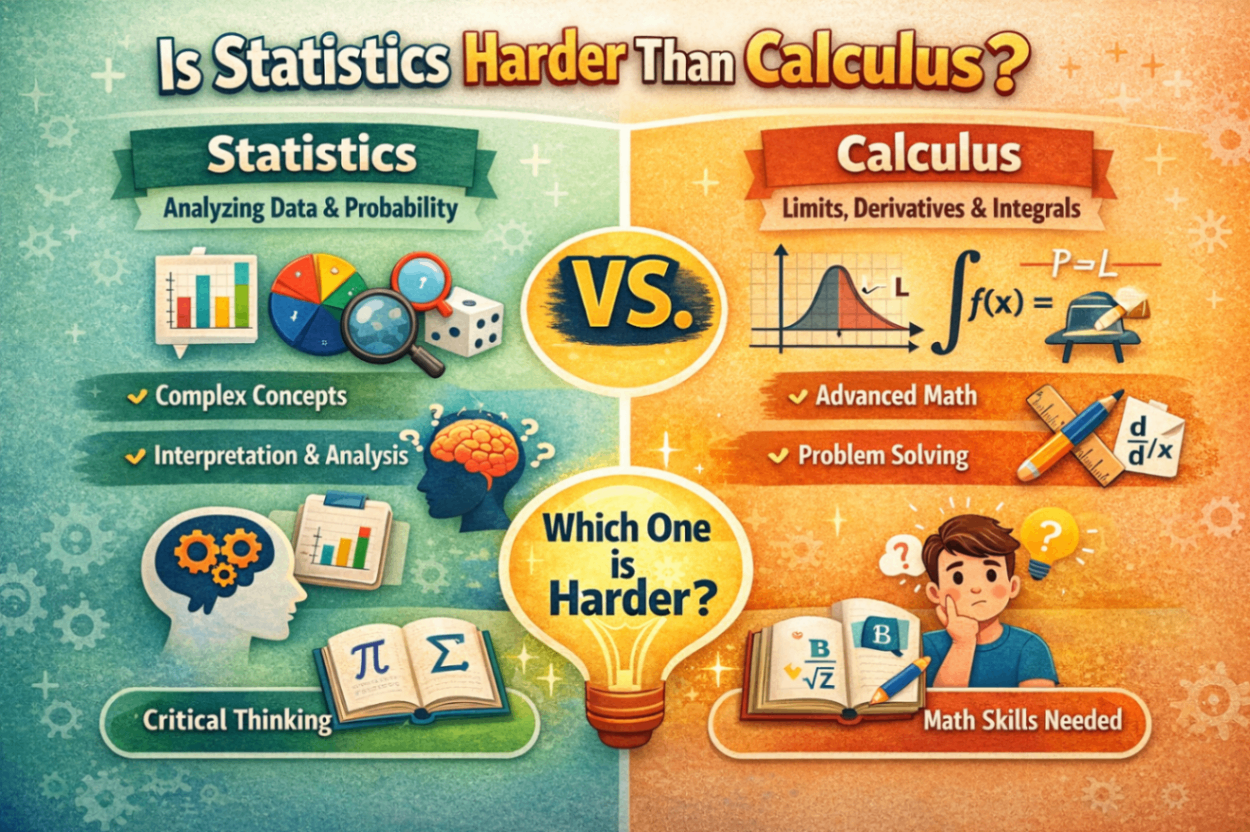
The age-old debate about whether statistics or calculus is harder continues to perplex high school and college students facing critical course selection decisions. This question carries significant weight since your choice impacts college applications, major requirements, career trajectories, and your overall academic experience. While some students find calculus' abstract concepts and complex formulas intimidating, others struggle with statistics' interpretation-heavy approach and real-world applications that demand contextual thinking beyond mechanical calculations. The truth about is statistics harder than calculus involves recognizing that difficulty is inherently subjective, depending on individual learning styles, mathematical backgrounds, career goals, and even instructor quality. Statistics demands conceptual understanding, interpretation skills, and comfort with ambiguity, while calculus requires strong algebraic foundations, abstract reasoning, and precise execution of multi-step procedures. This comprehensive guide examines both subjects' content, difficulty factors, major requirements, and practical considerations to help you make informed decisions about which course best aligns with your strengths and academic objectives.
Understanding the Core Content Differences
Before evaluating difficulty, understanding what each subject entails provides essential context for comparison. Statistics and calculus approach mathematics from fundamentally different perspectives, requiring distinct skill sets and ways of thinking.
What Is Statistics
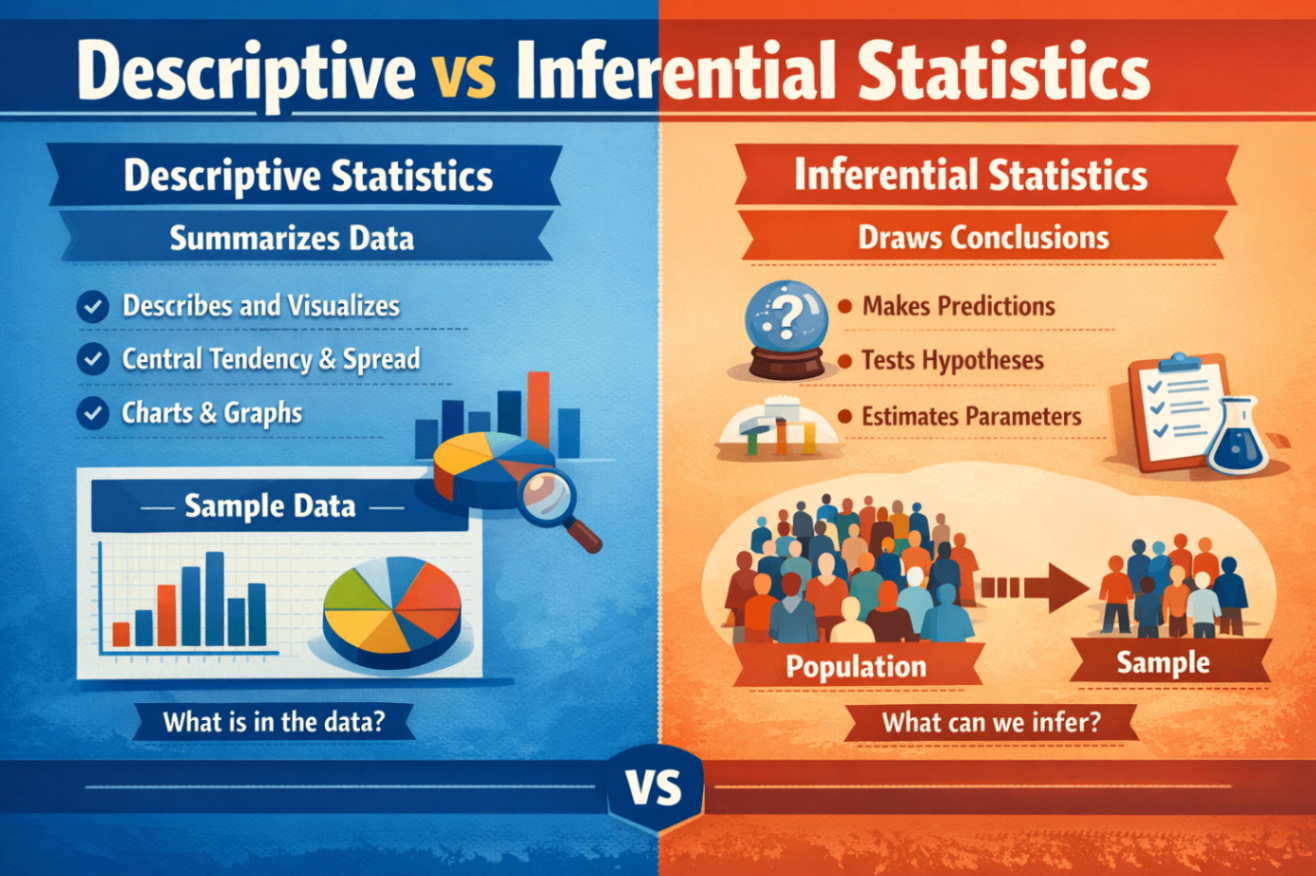
Statistics is a branch of mathematics devoted to the collection, analysis, interpretation, presentation, and organization of data. This field focuses on making sense of numerical information, identifying patterns, testing hypotheses, and drawing conclusions about populations based on sample data. Statistics has more real-life applications than calculus, appearing in everyday contexts from polling and market research to medical studies and business analytics. The discipline divides into two main branches: descriptive statistics that summarize and present data characteristics, and inferential statistics that use sample information to make predictions about larger populations. Understanding descriptive vs inferential statistics helps clarify the field's scope and different analytical approaches students encounter. Statistics courses typically cover probability theory, distributions (normal, binomial, t-distributions), hypothesis testing, confidence intervals, regression analysis, correlation, and various statistical tests (t-tests, chi-square tests, ANOVA). The subject emphasizes interpretation—understanding what statistical results mean in context rather than just calculating numbers.
What Is Calculus
Calculus is a mathematical discipline that deals with rates of change and accumulation, studying continuous change the way geometry studies shape. Developed independently by Isaac Newton and Gottfried Wilhelm von Leibniz in the 17th century, calculus provides tools for analyzing motion, growth, decay, and optimization problems across physics, engineering, and economics. The subject is divided into differential calculus (studying rates of change through derivatives) and integral calculus (studying accumulation through integrals). Standard calculus courses progress through limits, derivatives of various functions, applications of derivatives (optimization, related rates), integration techniques, and applications of integrals (area, volume, work). Calculus involves the study of rates of change and accumulation, and it relies heavily on algebra and trigonometry. Students need strong foundations in these prerequisite areas to succeed, as calculus builds directly on algebraic manipulation skills and trigonometric identities.
Key Conceptual Differences
The fundamental difference lies in approach and application. Statistics deals with real data and uncertainty, requiring students to interpret results contextually and understand what numbers mean in practical situations. Calculus deals with abstract mathematical relationships, requiring students to manipulate symbols and follow logical procedures to reach definitive answers. Many students report that statistics feels more like a reading comprehension class with math sprinkled in. Others say it's hard because the formulas aren't always enough to find the answer—you need context and interpretation. This interpretive aspect distinguishes statistics from calculus' more mechanical problem-solving approach.
Is Statistics Harder Than Calculus: The Complexity Question
Comparing overall difficulty between these subjects requires examining multiple dimensions including conceptual challenge, prerequisite requirements, and skill demands.
The Case for Statistics Being Harder
Yes, statistics tends to be harder than calculus mainly because it is vast and covers many topics built on top of calculus. Statistics itself represents a vast field, making comparison like equating all mathematics with calculus—an inherently unbalanced comparison. Statistics does tend to be harder than calculus, especially at the advanced levels. While elementary statistics courses introduce relatively straightforward concepts, advanced statistics incorporates complex probability theory, mathematical proofs, and sophisticated analytical techniques that build on calculus foundations. The breadth of statistics contributes to difficulty. Students must master probability theory, understand various distributions and their properties, learn when to apply different statistical tests, interpret complex results, recognize assumptions and limitations, and communicate findings clearly. This comprehensive knowledge base exceeds what typical calculus courses require. Additionally, statistics demands skills beyond pure mathematics. Students need critical thinking to evaluate study designs, logical reasoning to select appropriate tests, communication skills to explain results to non-technical audiences, and contextual awareness to interpret findings meaningfully. These multi-dimensional requirements challenge students differently than calculus' more focused mathematical demands.
The Case for Calculus Being Harder
Calculus is commonly considered the most difficult math subject due to its abstract nature. The subject introduces conceptually challenging ideas like limits, instantaneous rates of change, and infinite series that lack obvious real-world parallels, making intuitive understanding difficult. Calculus requires exceptionally strong prerequisite knowledge. Students weak in algebra, trigonometry, or geometry struggle significantly since calculus constantly applies these foundations. Every derivative and integral relies on algebraic manipulation, and many problems involve trigonometric functions requiring facility with identities and transformations. The cumulative nature of calculus increases difficulty—each topic builds directly on previous concepts. Students who don't fully master limits struggle with derivatives, weak derivative skills undermine integration ability, and gaps compound throughout the course. This sequential dependency means early confusion snowballs into lasting comprehension problems. Abstract reasoning requirements also challenge students. Visualizing limits as values approached but never reached, understanding derivatives as instantaneous rates of change, and conceptualizing integrals as infinite sums of infinitesimal pieces demand mental flexibility that many students find difficult.
It Depends on the Level
The difficulty comparison changes dramatically across educational levels. Entry-level or beginner statistics is much easier as compared to calculus, while advanced statistics is way more complex and difficult than calculus in general. This progression matters when comparing college courses. Elementary statistics (often called Statistics 101 or Introduction to Statistics) typically covers basic descriptive statistics, simple probability, and fundamental inferential techniques. These introductory courses are generally more accessible than Calculus I, which immediately confronts students with limits and derivatives. However, advanced statistics courses covering mathematical statistics, probability theory, multivariate analysis, or Bayesian methods become significantly more challenging than typical undergraduate calculus. These courses often require calculus as a prerequisite and build sophisticated theoretical frameworks atop that foundation.
Why Different Students Struggle With Each Subject
Individual differences in learning styles, backgrounds, and cognitive strengths explain why students experience varying difficulty with these subjects.
Who Finds Statistics Harder
Stats is harder for: Students who dislike ambiguity, interpreting graphs, or working through text-heavy problems. Students who excel at following clear procedures and applying formulas mechanically often struggle when statistics requires judgment calls about which test applies or how to interpret results. Students with weaker reading comprehension skills find statistics particularly challenging since problems often embed statistical questions in lengthy contextual descriptions requiring careful interpretation. Those uncomfortable with uncertainty also struggle since statistical conclusions always involve probability and confidence levels rather than definitive answers. Additionally, students seeking single "right" answers find statistics frustrating. Statistical analysis frequently yields results requiring nuanced interpretation, and different valid approaches might produce slightly different conclusions. This ambiguity unsettles students who prefer mathematics' traditional certainty.
Who Finds Calculus Harder
Calculus is harder for: Students who struggle with algebraic manipulation, abstract equations, or multi-step logic. Students with weak algebra foundations face constant frustration since every calculus problem requires substantial algebraic work. Those who think concretely rather than abstractly struggle with calculus' emphasis on conceptual understanding. Grasping what derivatives and integrals represent beyond mechanical procedures requires abstract thinking that doesn't come naturally to all students. Students who dislike memorizing formulas and procedures also find calculus challenging. While conceptual understanding matters, students must remember numerous derivative rules, integration techniques, and problem-solving strategies. The volume of formulas and when to apply each can overwhelm some learners. For students working through challenging problems in either subject, tools like AI Statistics Solver can provide step-by-step guidance and explanations that clarify difficult concepts.
Student Profile Examples
Consider Maria, a nursing major who's a strong reader, good with people, and not comfortable with abstract mathematics. She finds statistics easier than calculus because it connects to practical healthcare applications, involves interpreting real data, and doesn't require advanced algebraic manipulation. Contrast Derek, an engineering major who's mathematically skilled, excels at step-by-step logical procedures, and dislikes wordy, ambiguous problems. He prefers calculus and finds statistics frustratingly vague, as it requires contextual interpretation beyond just applying formulas correctly. These examples illustrate that neither subject is universally harder—difficulty depends on how each student's strengths and weaknesses align with each subject's demands.
College vs High School: How Difficulty Changes
The difficulty comparison shifts considerably between high school and college levels, creating potential misconceptions about each subject's challenge.
Is Elementary Statistics Harder Than Calculus
At the introductory level, most students find elementary statistics easier than calculus. Basic statistics courses covering descriptive statistics, simple probability, and fundamental hypothesis testing require less mathematical sophistication than calculus with its limits, derivatives, and integrals. Elementary statistics often emphasizes applying formulas and interpreting computer output rather than deriving results mathematically. Students learn when to use t-tests versus chi-square tests, how to calculate confidence intervals using given formulas, and what p-values indicate about hypotheses—practical skills accessible to students with moderate mathematical backgrounds. However, this accessibility can create false confidence. High school statistics courses, particularly AP Statistics, tend to be less rigorous than their college counterparts. Students who excel in high school statistics sometimes struggle when college courses demand deeper theoretical understanding and more sophisticated analysis.
Is College Statistics Harder Than Calculus
This kind of easy introduction to Stats in high school could be a bit misleading for students who think that their college stats course will be as much of a cakewalk as their high school stats class was. College statistics courses, particularly those required for mathematics, economics, or science majors, increase rigor substantially. College statistics courses often require calculus as a prerequisite, using derivatives and integrals to derive probability distributions and statistical formulas. These courses emphasize mathematical rigor, requiring students to understand why statistical methods work, not just how to apply them. The gap between high school and college statistics often exceeds the gap for calculus. Pre-calculus in high school resembles college Calculus I reasonably well, but high school statistics may bear little resemblance to rigorous college courses covering mathematical statistics, probability theory, or advanced inferential methods.
The Role of Course Rigor
Course difficulty varies tremendously even among classes with identical names. One university's "Introduction to Statistics" might cover basic descriptive statistics and simple tests, while another's course with the same title might require calculus and cover mathematical probability theory. Similarly, calculus course rigor varies. Some Calculus I courses emphasize applications and computational skills, while others stress theoretical understanding and rigorous proofs. Always research specific course content and prerequisites rather than assuming difficulty based solely on course titles.
Which Subject Do Different Majors Require
Major requirements significantly influence whether you should prioritize statistics or calculus, regardless of which you find easier or more interesting.
STEM Majors and Calculus
Engineering, physics, computer science, and mathematics majors almost universally require calculus—typically multiple semesters covering differential and integral calculus, multivariable calculus, and differential equations. These majors use calculus constantly in upper-division courses analyzing dynamic systems, optimizing designs, and modeling physical phenomena. For STEM students, the question isn't whether to take calculus but rather how many calculus courses to complete. While statistics also benefits STEM majors, calculus represents the foundational mathematics for technical fields involving continuous change, motion, optimization, and modeling. Chemistry and biology majors typically require at least one semester of calculus, though requirements vary by program. Life sciences increasingly emphasize statistics given its importance for research, but calculus remains necessary for physical chemistry, biophysics, and quantitative biology courses.
Business and Social Science Majors
Business, economics, psychology, sociology, political science, and other social science majors typically require statistics but not calculus. These fields emphasize data analysis, hypothesis testing, and drawing conclusions from empirical research—all statistical applications. Economics majors represent a notable exception, often requiring both calculus and statistics. Intermediate microeconomics and macroeconomics use calculus for optimization and modeling, while econometrics and empirical research require sophisticated statistics. Business analytics, data science, and quantitative finance programs increasingly require both subjects. Modern business relies heavily on data analysis (statistics) while also using optimization and forecasting models (calculus), creating demand for graduates with comprehensive quantitative skills.
Health Sciences and Education
Nursing, public health, and many allied health programs require statistics for understanding medical research, evaluating treatment effectiveness, and interpreting health data. These programs rarely require calculus since healthcare applications emphasize data analysis over continuous mathematical modeling. Education majors typically need statistics to understand educational research and assessment data. Future teachers must interpret test scores, understand measurement reliability and validity, and evaluate program effectiveness—all statistical applications that inform educational practice.
Liberal Arts and Humanities
Many liberal arts programs require either calculus or statistics for general education mathematics requirements, allowing students to choose based on interest and perceived difficulty. Students planning graduate school in quantitative social sciences should prioritize statistics, while those considering technical graduate programs might choose calculus.
Career Applications: Which Subject Matters More
Beyond college requirements, considering how each subject applies to various careers helps evaluate their long-term value regardless of difficulty.
Statistics in the Modern Workforce
Educators and employers increasingly champion advanced statistics as critical for navigating today's data-driven workforce. The explosion of data across industries makes statistical literacy increasingly valuable for virtually every profession. Business analysts, data scientists, market researchers, quality control managers, healthcare administrators, policy analysts, and countless other professionals use statistics daily. Even roles not explicitly focused on data analysis benefit from statistical thinking when interpreting reports, evaluating evidence, and making data-informed decisions. Research in any field—from medicine and psychology to education and marketing—fundamentally relies on statistics. Understanding study designs, interpreting results, and evaluating statistical significance distinguish informed professionals from those who merely consume research superficially.
Calculus in Technical Fields
Calculus remains indispensable for engineers, physicists, and applied mathematicians who model dynamic systems, optimize designs, and analyze continuous change. Electrical engineers use calculus for circuit analysis and signal processing, mechanical engineers apply it to dynamics and thermodynamics, and civil engineers employ it in structural analysis and fluid mechanics. Computer graphics, machine learning, and artificial intelligence increasingly use calculus for optimization algorithms and neural network training. Even seemingly non-mathematical CS specializations benefit from calculus when implementing algorithms or understanding computational complexity. Economics, particularly at advanced levels, uses calculus extensively for optimization problems, marginal analysis, and dynamic modeling. Financial analysts apply calculus in options pricing, risk analysis, and portfolio optimization.
Long-Term Career Outcomes
Students who take AP Calculus don't necessarily earn higher long-term salaries than those who take AP Statistics, according to research tracking Texas students into the workforce. While taking rigorous math courses improves postsecondary outcomes, students who take AP Calculus don't necessarily earn higher long-term salaries than those who take AP Statistics. This finding challenges assumptions that calculus represents superior preparation. The vast range of rigor in courses that carry the same name is a problem that plagues high school math—not just statistics or data science, suggesting course quality matters more than subject choice for long-term outcomes. Both subjects provide valuable quantitative skills transferable across careers. The key is selecting the subject aligning with your intended major and career path, then pursuing rigorous coursework that develops genuine analytical capabilities.
Practical Considerations for Choosing Between Statistics and Calculus
When deciding which course to take, several practical factors beyond pure difficulty should influence your decision.
College Admissions Perspectives
College admissions officers, especially at selective institutions, have a persistent preference for calculus as a differentiator, believing that it signals which students are ready for college-level work. This preference persists despite growing recognition of statistics' value. 92 percent of admissions officers in 2024 said that "faculty places a high priority on calculus for demonstrating a rigorous math curriculum," and about three-quarters of them ranked AP Calculus in the top four math courses. However, 95 percent of them also acknowledged that "calculus is not necessary for all students", revealing tension between tradition and practicality. For students targeting highly selective colleges, calculus often provides an admissions advantage despite statistics' practical value. Students applying to less selective schools or pursuing non-STEM majors face less pressure to take calculus specifically.
Prerequisites and Course Sequences
Calculus requires strong foundations in algebra, geometry, and typically trigonometry. Students who struggled in these prerequisite courses should carefully consider whether they're ready for calculus or would benefit from additional preparation. Statistics requires less advanced prerequisites, typically just solid algebra skills. This makes statistics accessible to students who didn't complete the traditional sequence through pre-calculus, providing an advanced mathematics option for diverse student backgrounds. Consider your future course plans. If you might pursue a technical major requiring multiple calculus courses, starting with Calculus I in high school provides a significant advantage. If your intended major requires only statistics, taking calculus might be unnecessary preparation.
Study Strategies and Resources
Success in either course requires dedicated effort and appropriate strategies. Calculus demands extensive practice with diverse problem types, strong algebra skills maintenance, and understanding when to apply different techniques. Visual learners benefit from graphing derivatives and integrals to build geometric intuition about these concepts. Statistics requires careful reading to extract questions from contextual descriptions, understanding when different statistical tests apply, and practicing result interpretation. Students should focus on understanding concepts rather than memorizing formulas, as statistics problems often require judgment beyond mechanical calculation. Both subjects benefit from collaborative learning through study groups, regular practice rather than cramming, and seeking help early when confusion arises. Many students find that teaching concepts to peers strengthens their own understanding.
Common Misconceptions About Difficulty
Several persistent misconceptions complicate comparisons between statistics and calculus difficulty.
Misconception: One Is Objectively Harder
The most common misconception is that one subject is universally harder than the other. In reality, difficulty is highly individual, depending on your learning style, mathematical background, interests, and cognitive strengths. Students who excel at abstract reasoning often find calculus manageable while struggling with statistics' ambiguity. Those comfortable with interpretation and context find statistics more natural than calculus' abstract procedures.
Misconception: High School Experience Predicts College Difficulty
Students often assume their high school statistics or calculus experience will mirror college courses. However, college courses vary tremendously in rigor, and the gap between high school and college versions differs by subject and institution. Success in AP Statistics doesn't guarantee success in rigorous college mathematical statistics, just as AP Calculus success doesn't ensure smooth sailing through multivariable calculus.
Misconception: The Easier Subject Has Less Value
Some students assume the "harder" subject must be more valuable or impressive. However, subject value depends on your goals, intended major, and career aspirations. Statistics may be easier at introductory levels but provides crucial skills for data-driven careers. Calculus may be harder but remains essential for technical fields. Choose based on requirements and applications, not perceived difficulty hierarchy.
Conclusion
The question "is statistics harder than calculus" lacks a simple universal answer since difficulty fundamentally depends on individual learning styles, mathematical backgrounds, course levels, and institutional rigor. At introductory levels, most students find basic statistics more accessible than calculus, which requires strong algebra and trigonometry foundations and introduces abstract concepts like limits and derivatives. However, advanced statistics covering probability theory and mathematical foundations often exceeds calculus in complexity. Stats is harder for students who dislike ambiguity, interpreting graphs, or working through text-heavy problems, while calculus is harder for students who struggle with algebraic manipulation, abstract equations, or multi-step logic. Beyond difficulty comparisons, practical considerations matter more—STEM majors require calculus for technical applications, while business and social science fields emphasize statistics for data analysis and research. Students who take AP Calculus don't necessarily earn higher long-term salaries than those who take AP Statistics, suggesting that mastering either subject well matters more than which you choose. Ultimately, select the subject aligning with your major requirements and career aspirations, play to your cognitive strengths, and pursue rigorous coursework that develops genuine analytical capabilities rather than focusing solely on perceived difficulty.
Frequently Asked Questions
Which is actually harder, statistics or calculus?
Statistics tends to be harder than calculus at advanced levels because it's a vast field covering many topics, some of which build on calculus foundations. However, introductory statistics is generally easier than calculus since basic stats involves straightforward descriptive measures and simple probability, while calculus immediately introduces abstract concepts like limits and derivatives requiring strong algebraic foundations. Difficulty also depends heavily on individual strengths—students who dislike ambiguity and interpretation struggle more with statistics, while those weak in algebra and abstract reasoning find calculus more challenging.
Should I take statistics or calculus if I hate math?
If you dislike math but need to fulfill requirements, consider which type of mathematical thinking you find less objectionable. Statistics may feel easier because it emphasizes interpreting meaning rather than solving complex equations, relates more directly to real-world applications, and requires less advanced algebra. However, calculus may feel more predictable if you're decent at following formulas and step-by-step procedures. Neither is easy if mathematics fundamentally doesn't align with your strengths, but statistics generally requires less prerequisite mathematical sophistication, making it more accessible for students without strong math backgrounds.
Do engineering majors need both statistics and calculus?
Most engineering programs require multiple calculus courses (typically Calculus I, II, III, and differential equations) since engineering constantly applies calculus for optimization, modeling dynamic systems, and analyzing continuous change. Engineering programs also typically require at least one statistics course for quality control, experimental design, and data analysis. However, calculus represents the primary mathematical foundation for engineering, while statistics serves as an important supplementary tool. Students pursuing engineering should prioritize developing strong calculus skills, as weak calculus foundations severely limit upper-division engineering coursework.
Will taking calculus instead of statistics hurt my college application?
For students targeting highly selective colleges, calculus often provides an admissions advantage since 92% of admissions officers report that faculty prioritizes calculus for demonstrating rigorous preparation. However, this preference doesn't mean statistics hurts your application—rather, calculus serves as a traditional signal of mathematical rigor. Students applying to less selective schools or pursuing non-STEM majors face minimal disadvantage from choosing statistics. Additionally, taking both courses eliminates this concern entirely. Ultimately, demonstrating rigorous coursework in whichever subject you choose matters more than the specific subject, though calculus does carry traditional prestige in college admissions.
Can I succeed in statistics if I struggled in algebra?
Statistics requires solid algebra skills for manipulating formulas, solving equations, and working with expressions, so students who seriously struggled with algebra will face challenges. However, statistics doesn't require the same depth of algebraic facility that calculus demands. If you can handle basic algebraic operations and feel comfortable with formulas, you can likely succeed in introductory statistics with dedicated effort. Focus on strengthening fundamental algebra skills through review, seek help early when confusion arises, and use calculators or software for computational support. Many students who found algebra challenging discover they can handle statistics better than expected because of its practical applications and emphasis on interpretation over pure calculation.