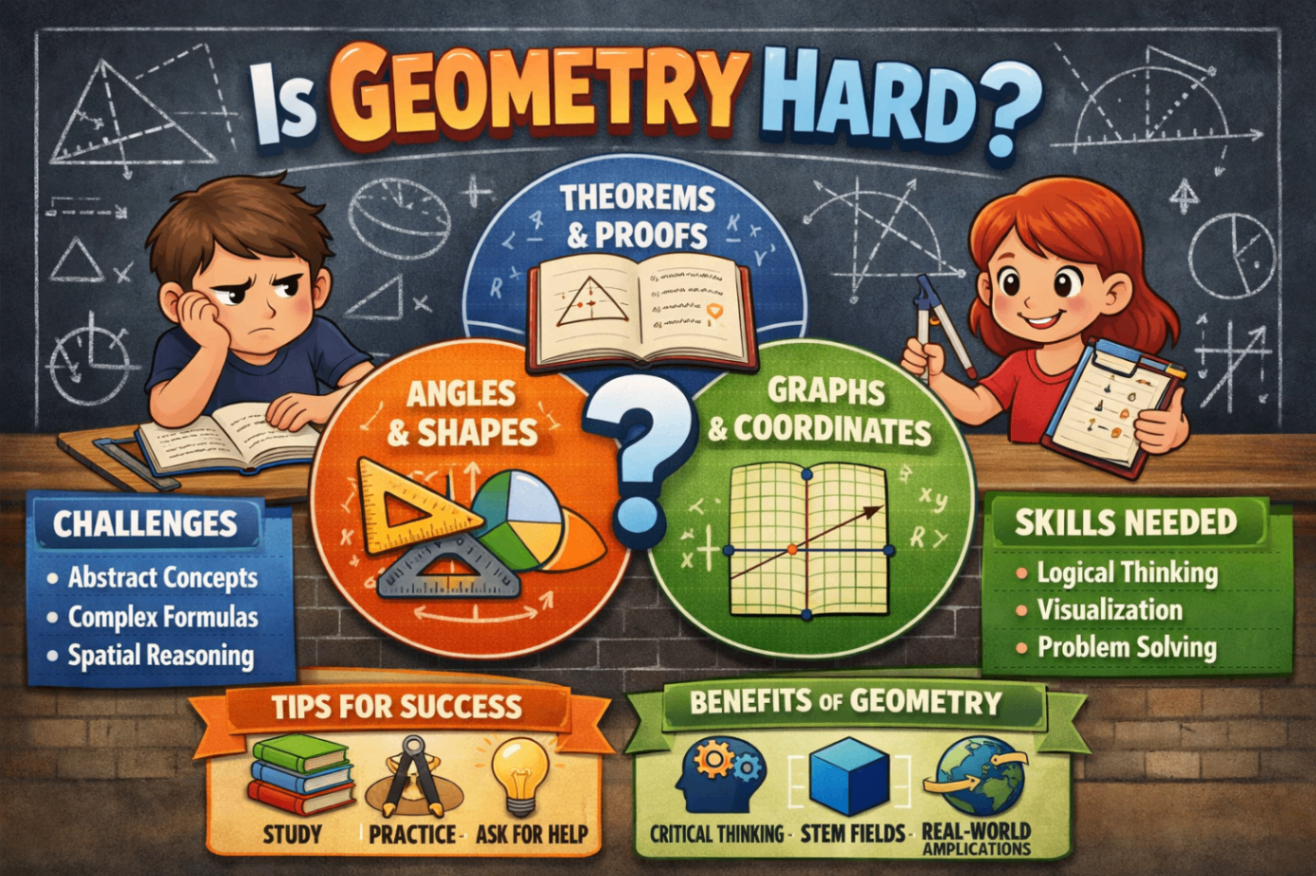
Many students asking is geometry hard find themselves surprised by how different this subject feels compared to other math courses they have taken. Geometry requires a unique combination of visual thinking, logical reasoning, and spatial awareness that can feel completely foreign to students accustomed to algebraic calculations. The transition from algebra to geometry often catches students off guard because the skills that made them successful in previous math classes do not automatically transfer. Instead of solving equations with numbers and variables, geometry asks students to work with shapes, angles, and proofs that require creative thinking and visualization. Understanding why geometry is so hard helps students prepare for its challenges and develop effective strategies to succeed. This guide explores the specific difficulties students face, compares geometry to other math subjects, and provides actionable tips to make this visual subject more manageable for learners at every level.
Why Is Geometry So Hard for Students
Geometry presents unique challenges that differ significantly from other mathematics courses students encounter.
The Shift from Numbers to Visual Thinking
Geometry demands that students think in pictures rather than focusing primarily on numerical calculations and algebraic manipulation. While algebra deals with equations and finding unknown values, geometry requires visualizing shapes, spatial relationships, and transformations in two and three dimensions. Students who excel at computational math often struggle when problems require them to picture geometric figures mentally. This fundamental shift in thinking style explains why many students find geometry surprisingly difficult.
Proof Writing Feels Like a Foreign Language
Unlike other math classes where finding the correct answer completes the problem, geometry often requires students to explain their reasoning step by step through formal proofs. Writing proofs feels more like constructing a logical argument or essay than solving a traditional math problem. Students must justify each step using theorems, postulates, and definitions they have learned throughout the course. Many students who can solve geometry problems intuitively struggle to articulate their reasoning in the structured format proofs demand.
Vocabulary Overload Creates Confusion
Geometry introduces an extensive vocabulary of specialized terms that students must memorize and understand to succeed in the course. Words like congruent, bisector, transversal, perpendicular, and corresponding appear constantly in problems and require precise understanding. Students who do not master this vocabulary find themselves unable to comprehend problem statements or apply appropriate theorems. The language barrier creates frustration because students may understand concepts intuitively but cannot decode what problems are asking.
Multiple Solution Paths Cause Uncertainty
Many geometry problems have several correct approaches to reach the solution, which can feel overwhelming for students accustomed to following single procedures. This flexibility requires creative thinking and the ability to recognize which theorems and properties apply to each unique situation. Students may freeze when facing problems because they are unsure which approach to try first. The open-ended nature of geometry problem-solving demands confidence and willingness to experiment that takes time to develop.
How Hard Is Geometry Compared to Other Math
Understanding where geometry fits among math subjects helps students set realistic expectations for the course.
Geometry Versus Algebra Requires Different Skills
Algebra focuses on manipulating equations and following systematic procedures to solve for unknown variables using established rules. Geometry shifts the focus to spatial reasoning, visualization, and logical deduction based on properties of shapes and figures. Students strong in algebraic manipulation may struggle with geometry because their procedural skills do not directly transfer to visual problems. Conversely, students who struggled with algebra sometimes find geometry easier because it plays to different cognitive strengths.
Geometry Demands More Creativity Than Calculus
While calculus involves complex calculations and abstract concepts, it follows predictable patterns and procedures once students learn the rules. Geometry requires students to approach each problem fresh and determine which combination of theorems and properties will lead to a solution. The creative element of geometry means students cannot simply memorize steps and apply them mechanically to every problem. This demand for flexible thinking makes geometry feel harder for students who prefer structured algorithmic approaches.
Visual Learners Often Excel at Geometry
Students who naturally think in pictures and images frequently find geometry more intuitive than subjects requiring purely abstract reasoning. The visual nature of geometry allows these learners to leverage their natural strengths in ways that algebra and calculus do not. Drawing diagrams, visualizing transformations, and seeing spatial relationships come naturally to visual thinkers. However, students who struggle with visualization may find geometry more challenging than subjects that rely primarily on symbolic manipulation.
Geometry Builds Foundation for Advanced Mathematics
The logical reasoning skills developed in geometry become essential for success in higher mathematics courses including trigonometry and calculus. Learning to construct proofs teaches students how to think systematically and justify their conclusions with evidence. The spatial reasoning geometry develops throughout physics, engineering, and computer science courses students may take later. Investing effort in geometry pays dividends beyond the immediate course because these skills transfer to many academic and professional fields.
Common Reasons Why Geometry Is Hard
Identifying specific obstacles helps students target their efforts and improve more efficiently in the subject.
Weak Algebra Skills Create Hidden Problems
Geometry relies heavily on algebraic concepts including solving equations, working with variables, and manipulating expressions to find unknown values. Students who did not master algebra find themselves struggling with geometry problems that require computational skills they lack. Finding angle measures, calculating side lengths, and applying formulas all require solid algebraic foundations. Recognizing algebra weaknesses and addressing them directly removes a significant barrier to geometry success.
Memorizing Without Understanding Backfires
Students who try to memorize geometry formulas and theorems without understanding why they work consistently struggle on tests and assignments. Geometry problems rarely look exactly like examples from class, so rote memorization fails when students encounter new situations. Understanding the logic behind theorems allows students to apply them correctly even in unfamiliar contexts. Building genuine understanding takes more time initially but produces much better results than surface-level memorization.
Skipping Diagrams Leads to Errors
Many students try to solve geometry problems mentally without drawing figures, which dramatically increases their error rate. Diagrams help students identify relationships, spot relevant theorems, and organize information that problems provide. Even quick sketches reveal details that remain invisible when students try to hold everything in working memory. Taking time to draw accurate diagrams feels slow but actually speeds up problem-solving and improves accuracy significantly.
Rushing Through Problems Causes Mistakes
Geometry problems require careful attention to detail because small errors in reasoning cascade into completely wrong answers. Students who rush through problems often miss crucial information, apply wrong theorems, or make computational errors along the way. The logical chain in geometry means one mistake early in a solution invalidates everything that follows. Slowing down and checking each step carefully produces much better results than racing through problems carelessly.
Strategies to Make Geometry Easier
Implementing proven techniques helps students overcome geometry challenges and build confidence in the subject.
Draw Everything You Can Visualize
Creating visual representations of geometry problems activates spatial reasoning skills and reveals relationships that remain hidden in text. Even when problems provide diagrams, redrawing them yourself helps you understand the configuration and identify relevant features. Add labels, mark equal segments, and indicate parallel lines to make all given information visible on your figure. Using a Geometry AI Solver can help you check your work and understand complex geometric relationships when you get stuck.
Master the Vocabulary First
Learning geometry terminology thoroughly removes a major obstacle that trips up many students throughout the course. Create flashcards for terms like supplementary, complementary, corresponding, alternate interior, and other vocabulary that appears repeatedly. Understanding precise definitions allows you to decode problem statements and recognize which theorems apply to each situation. Investing time in vocabulary early prevents confusion and frustration throughout the entire course.
Practice Proof Patterns Regularly
Geometry proofs follow recognizable patterns that become easier to identify and apply with consistent practice over time. Common proof types like proving triangles congruent, showing lines parallel, or demonstrating angle relationships appear repeatedly in different forms. Learning to recognize these patterns helps you approach new proofs with confidence because you understand the general structure. Regular practice builds the pattern recognition skills that make proof writing feel natural rather than overwhelming.
Connect Concepts to Real World Examples
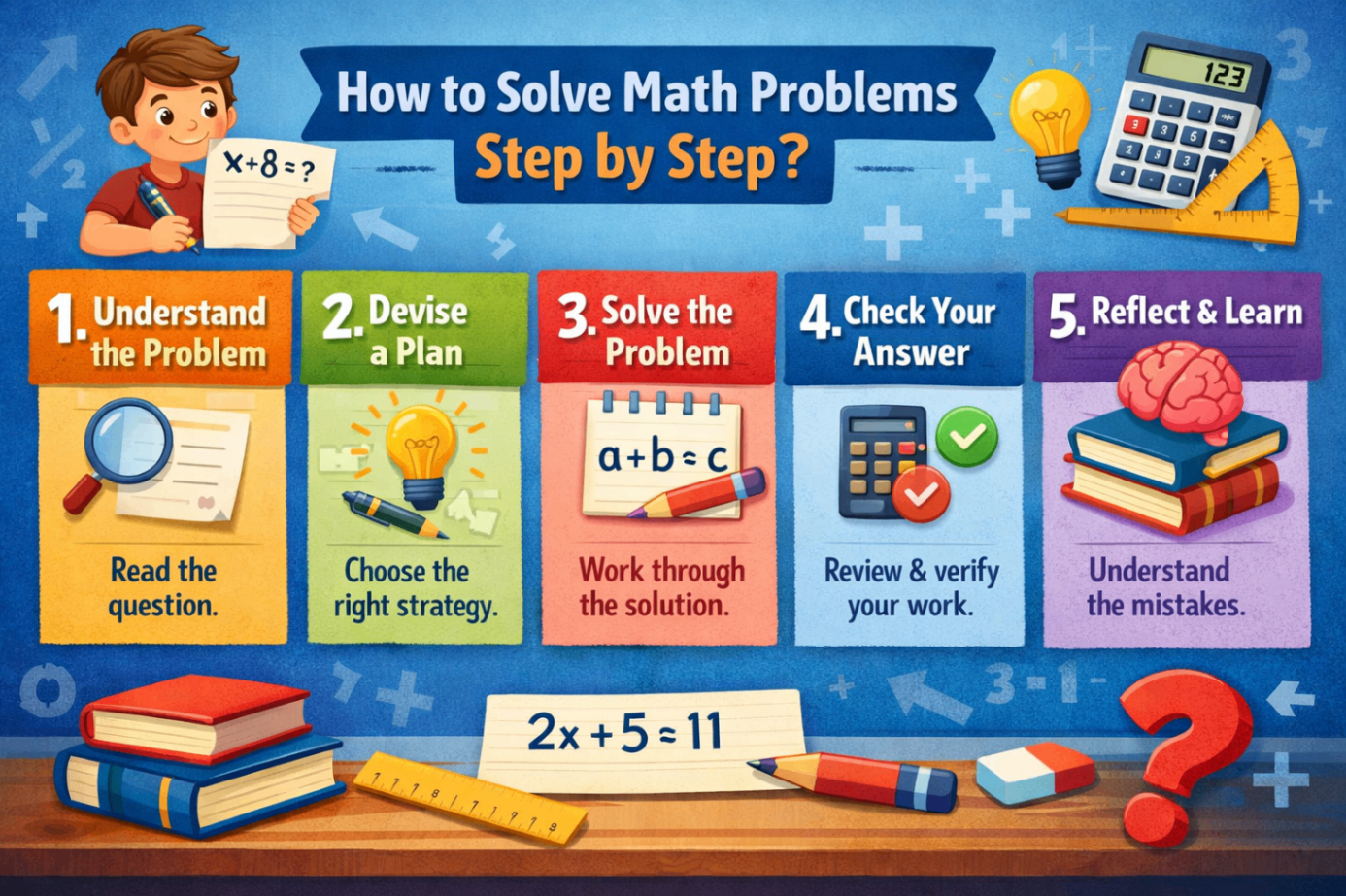
Relating geometry to physical objects and real situations makes abstract concepts more concrete and memorable for students. Architecture, construction, sports, art, and video games all rely heavily on geometric principles you can observe directly. Understanding how to solve math problems step by step becomes easier when you see how geometry applies to things you encounter daily. Making these connections transforms geometry from abstract exercises into practical tools for understanding the world.
Common Geometry Mistakes to Avoid
Recognizing frequent errors helps students develop better habits and prevent problems before they occur.
Assuming Information Not Given
Students often make assumptions about figures that problems do not actually state, leading to incorrect conclusions and wrong answers. Just because an angle looks like a right angle does not mean you can treat it as ninety degrees unless stated. Diagrams in geometry are not drawn to scale, so visual estimates of measurements are unreliable guides for solving problems. Only use information explicitly provided in the problem statement or provable from given facts using theorems.
Forgetting to State Reasons in Proofs
Every step in a geometry proof requires justification with a specific theorem, postulate, definition, or given information from the problem. Students lose points when they make correct logical leaps but fail to cite the mathematical principle that allows each step. Instructors cannot award credit for reasoning that students do not explicitly demonstrate in their written work. Practice stating reasons for every step until including justifications becomes automatic in your proof writing.
Mixing Up Similar Theorems
Geometry contains many theorems with similar names or applications that students frequently confuse when solving problems under pressure. Corresponding angles and alternate interior angles both relate to parallel lines but apply to different angle pairs. SSS, SAS, ASA, and AAS all prove triangle congruence but require different combinations of corresponding parts. Creating comparison charts that highlight differences between similar theorems helps prevent mix-ups on tests.
Neglecting to Check Answers
Students often lose easy points by failing to verify that their answers make sense in the context of geometry problems. Checking whether angle measures sum correctly, side lengths satisfy triangle inequality, and shapes have valid properties catches many errors. Substituting calculated values back into original relationships confirms your solution works mathematically. Building the habit of checking answers systematically prevents careless mistakes from costing points unnecessarily.
Tips for Success in Geometry Class
Following best practices helps students maximize their learning and performance throughout the geometry course.
Attend Every Class and Take Notes
Geometry concepts build on each other sequentially, so missing classes creates gaps that make later material increasingly difficult to understand. Taking detailed notes including diagrams, definitions, and worked examples gives you resources for studying and completing assignments. Review your notes within twenty-four hours of each class to reinforce learning while material remains fresh in memory. Consistent attendance and active note-taking establish the foundation for geometry success throughout the course.
Form Study Groups with Classmates
Explaining geometry concepts to others deepens your own understanding and reveals gaps in your knowledge you might not notice alone. Study partners can offer different perspectives on problems and help you see approaches you might not consider independently. Working through challenging problems together builds confidence and makes difficult material feel less overwhelming. Regular study sessions with classmates create accountability that keeps you on track with assignments and exam preparation.
Seek Help Early When Struggling
Students who wait until they are completely lost in geometry face much harder recovery than those who ask for help at first signs of confusion. Teachers, tutors, and online resources can clarify misconceptions quickly when problems are still small and manageable. Geometry concepts build on each other, so small confusions compound into major difficulties if left unaddressed for too long. Asking questions immediately when something does not make sense prevents minor struggles from becoming major obstacles.
Review Previous Material Regularly
Geometry tests often cover multiple chapters and require combining concepts learned at different points throughout the course. Regular review of earlier material keeps foundational concepts fresh and ready for application in new contexts. Spacing your review across multiple sessions produces better retention than cramming everything right before exams. Creating a weekly review routine that revisits key theorems and problem types builds lasting mastery of geometry content.
Conclusion
Understanding why geometry is hard helps students approach the subject with realistic expectations and effective strategies for success. The visual thinking, proof writing, and vocabulary demands that make geometry challenging also make it valuable for developing reasoning skills that transfer to many other fields. Students who struggle with geometry can improve significantly by drawing diagrams consistently, mastering vocabulary early, and practicing proof patterns regularly. Connecting geometric concepts to real-world applications makes abstract ideas more concrete and memorable while building appreciation for the subject's practical relevance. With patience, consistent practice, and willingness to seek help when needed, geometry becomes manageable for students at every level. The logical reasoning and spatial thinking skills developed through geometry study provide lasting benefits that extend far beyond the classroom into academic and professional success.
Frequently Asked Questions
Is geometry harder than algebra for most students?
Geometry and algebra require different cognitive skills, so difficulty varies by individual student strengths. Students strong in procedural thinking often find algebra easier, while visual thinkers may prefer geometry. The proof-writing component of geometry creates challenges for many students because it requires explaining reasoning rather than just finding answers. Success in geometry depends more on spatial reasoning and logical thinking than computational skills.
Why do I understand geometry concepts but fail tests?
Understanding concepts conceptually differs from applying them under test conditions with time pressure and unfamiliar problem formats. Many students comprehend ideas when explained but struggle to recognize which concepts apply to specific test problems. Insufficient practice with varied problem types and weak proof-writing skills often explain the gap between understanding and test performance. Regular practice with timed problem sets helps bridge this gap.
How can I get better at geometry proofs?
Improving at proofs requires learning common proof structures and practicing identifying which theorems apply to different geometric situations. Start by studying worked examples carefully and noting the logical flow from given information to conclusion. Practice writing proofs regularly even when not assigned, focusing on stating clear reasons for every step. Over time, patterns become recognizable and proof writing feels increasingly natural.
Is geometry important for future math courses?
Geometry provides foundational skills essential for success in trigonometry, calculus, physics, and many other STEM courses. The logical reasoning developed through proof writing transfers directly to advanced mathematics and helps students construct rigorous arguments. Spatial reasoning from geometry appears throughout engineering, architecture, computer graphics, and scientific fields. Mastering geometry creates advantages for students pursuing math-intensive academic and career paths.
What should I do if I am failing geometry?
First, identify whether your struggles stem from vocabulary gaps, algebra weaknesses, visualization difficulties, or proof-writing challenges. Seek help from your teacher, a tutor, or online resources to address specific problem areas you have identified. Commit to consistent daily practice with geometry problems and review of foundational concepts you may have missed. Most students can turn around their geometry performance with targeted effort and willingness to ask for help.