Are you feeling overwhelmed by the SAT math section? You are not alone. Thousands of students struggle with time management, tricky questions, and test anxiety every year. The good news is that with the right SAT math tips, you can significantly improve your performance and achieve your target score. Whether you are months away from test day or searching for last minute SAT tips math students swear by, this comprehensive guide will equip you with everything you need to succeed.
Understanding the Digital SAT Math Section
Before diving into specific math SAT tips, it is essential to understand the test structure. Knowing what to expect helps you prepare strategically and approach each question with confidence.
Test Format and Timing
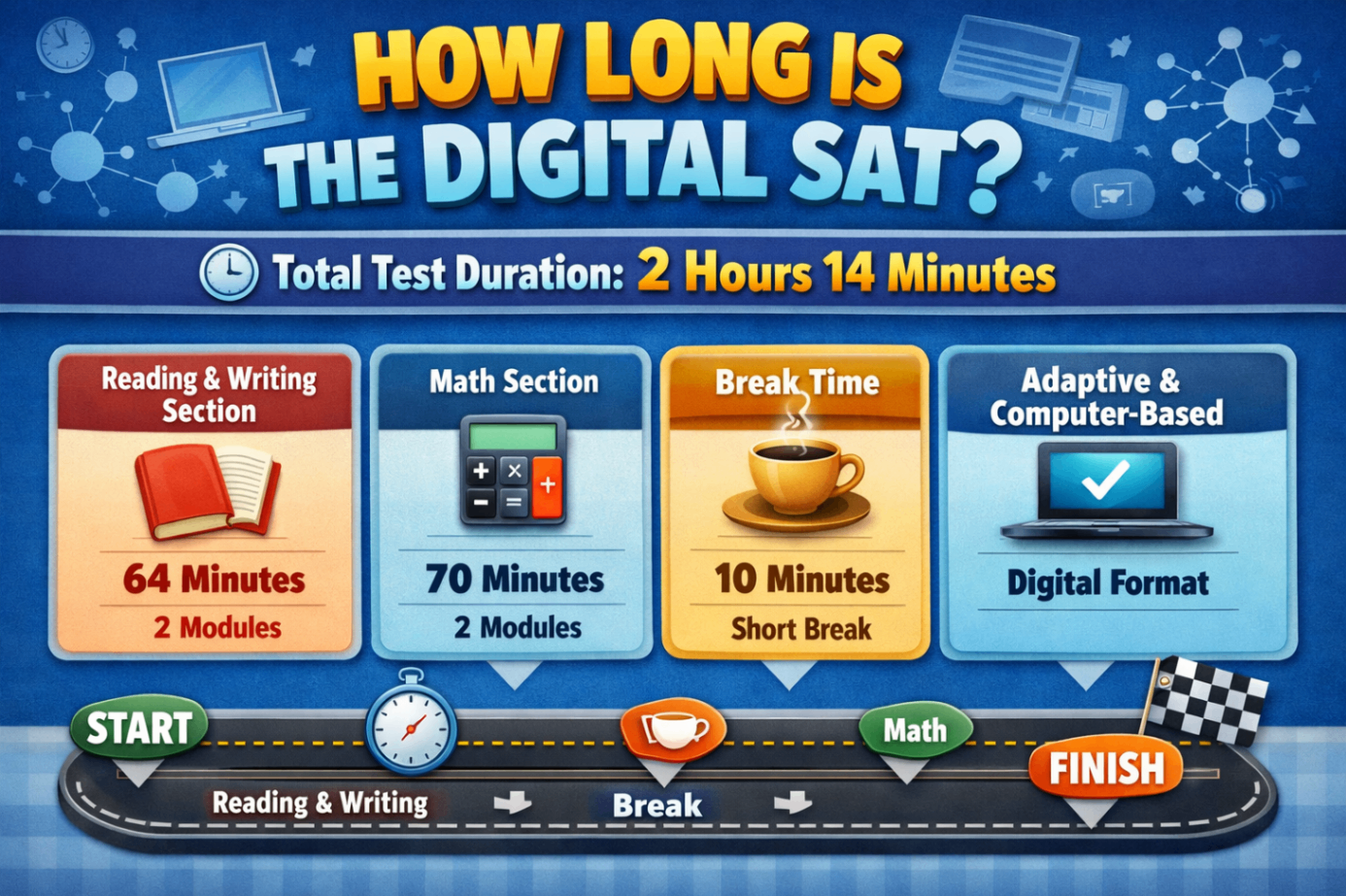
The digital SAT math section consists of two modules with 22 questions each, totaling 44 questions. You get 35 minutes per module, which translates to approximately 95 seconds per question. This is actually more time per question than the previous paper-based test offered. If you want detailed timing information, check out how long is the digital SAT for a complete breakdown.
Content Areas Covered
The section covers four main content areas: Algebra, Advanced Math, Problem Solving and Data Analysis, and Geometry and Trigonometry. Algebra and Advanced Math make up roughly 70% of questions, making them your highest priority during preparation. Problem Solving and Geometry share the remaining 30%, so allocate your study time accordingly.
Calculator Policy Changes
One significant advantage of the digital format is that calculators are now permitted throughout the entire math section. You can use the built-in Desmos graphing calculator or bring your own approved device. This eliminates the stress of the old no-calculator section and gives you powerful tools for complex calculations.
Adaptive Testing System
The digital SAT uses adaptive technology, meaning your performance on Module 1 determines the difficulty of Module 2. Performing well on the first module qualifies you for harder questions that offer higher scoring potential. This makes accuracy in the first module critically important for achieving top scores.
Essential SAT Math Tips and Tricks for Test Day
Test day success depends on applying proven strategies consistently throughout the exam. These sat tips for math will help you avoid common pitfalls and maximize your score potential.
Read Questions Carefully
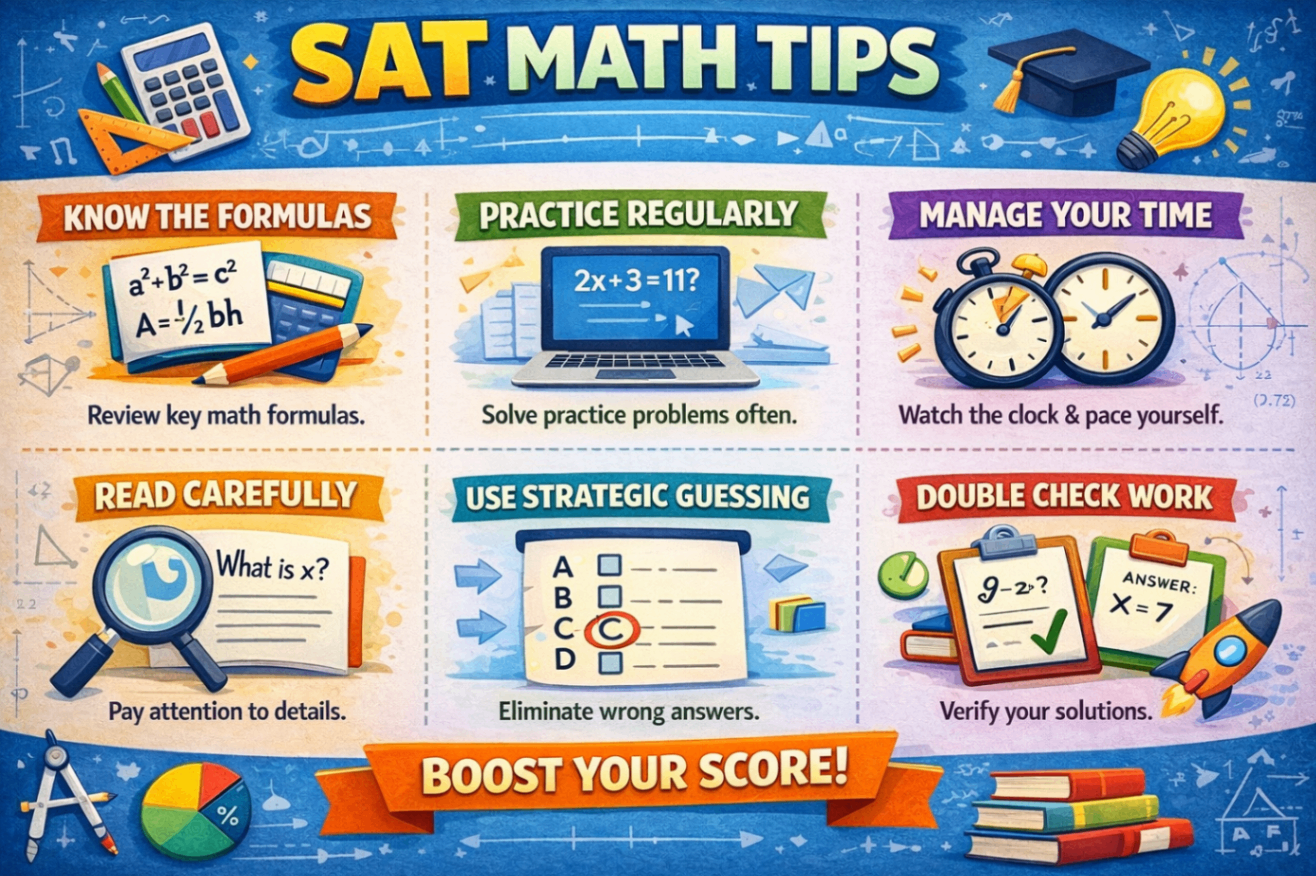
One of the most common mistakes students make is misreading what the question actually asks. The SAT frequently tests whether you can identify the correct variable or value to solve for. A question might require you to find 2x instead of x, and test makers know many students will solve for x and select that trap answer. Always write down exactly what you need to find before calculating.
Use Process of Elimination
Since every multiple-choice question has exactly one correct answer, elimination becomes a powerful tool. Before diving into complex calculations, scan the answer choices for options that are clearly too large, too small, or mathematically impossible. This approach works especially well for geometry problems where estimating angles or lengths can quickly narrow your choices.
Plug In Real Numbers
When facing abstract algebraic expressions, try substituting simple numbers for variables like 2, 3, or 10. Work through the problem with these concrete values, then check which answer choice gives you the same result. This technique is one of the sat math tips and tricks that turns confusing abstract problems into straightforward arithmetic.
Double Check Your Work
If time permits, verify your answers before moving on, especially for questions you found challenging. Plug your answer back into the original equation to confirm it works. This simple habit catches careless calculation errors and is among the most effective tips for sat math section success.
Digital SAT Math Tips and Strategies for Higher Scores
The digital format introduces new tools and features that can significantly boost your performance. Mastering these digital sat math tips and strategies gives you a competitive advantage over less prepared students.
Master the Desmos Calculator
The built-in Desmos graphing calculator is incredibly powerful when used correctly. Practice graphing equations to find intersection points, which represent solutions to systems of equations. You can also verify answers by plugging values back into original equations. However, knowing when not to use the calculator is equally important since simple arithmetic is often faster by hand.
Memorize Key Formulas
While the SAT provides a reference sheet with basic geometry formulas, you should not rely on it entirely. The provided formulas cover only circles, rectangles, triangles, and special right triangles. You need to memorize additional formulas for linear equations, quadratics, slope, and statistical concepts. Create flashcards for formulas you struggle to remember and review them daily.
Utilize the Flagging Feature
The digital format allows you to flag questions for review and return to them later. If a question has you stuck after 60 seconds, make your best guess, flag it, and move forward. This prevents you from wasting precious time on one difficult problem while easier points remain unclaimed elsewhere.
Practice in Digital Format
Get familiar with the testing interface by downloading the Bluebook app and completing practice tests digitally. Understanding how to navigate between questions, use the on-screen tools, and manage the timer prevents surprises on test day. For additional practice with challenging problems, try using Sat Solver AI to work through questions step by step.
Best Tips for SAT Math Time Management
Time pressure causes many students to rush and make avoidable mistakes during the exam. Developing a solid pacing strategy is essential for completing all questions while maintaining accuracy.
Establish a Pacing Strategy
Since questions generally progress from easier to harder within each module, spend less time on early questions to bank extra minutes for challenging ones later. Aim to complete the first ten questions in about twelve minutes, leaving more time for complex problems. Track your pace periodically to ensure you stay on schedule throughout each module.
Prioritize Easy Points First
Remember that all questions carry equal weight regardless of difficulty. Answering three easier questions correctly is worth more than spending excessive time on one hard problem. Move through questions you understand quickly and confidently, saving your mental energy for problems that genuinely require deeper analysis.
Know When to Skip
If a question has you completely stuck, do not waste valuable minutes staring at it hoping for inspiration. Make an educated guess, flag the question, and return to it only if time permits after completing the module. This ensures you attempt every question and never leave easy points on the table.
Build Testing Stamina
Practice completing full-length math sections under timed conditions to build endurance. Many students lose focus and make careless errors in the final minutes of each module. Regular timed practice helps you maintain concentration and accuracy throughout the entire 70-minute math portion of the exam.
Last Minute SAT Tips Math Students Should Remember
Even with limited preparation time remaining, you can still optimize your performance significantly. These best tips for sat math will help you make the most of your final days before the exam.
Focus on High-Frequency Topics
Review the most heavily tested concepts: linear equations, quadratic functions, and basic statistics. These topics appear frequently and offer the best return on your limited study investment. Skip obscure topics and focus on mastering the fundamentals that will definitely appear on your test.
Review Common Trap Answers
The SAT uses predictable patterns for incorrect answer choices, such as offering the value of x when the question asks for 2x. Familiarize yourself with these common traps so you recognize and avoid them. Knowing how the test tries to trick you makes you less likely to fall for misleading options.
Prepare Physically and Mentally
Prioritize rest the night before your exam since sleep deprivation impairs mathematical reasoning significantly. Eat a balanced breakfast and arrive at the testing center early to avoid unnecessary stress. A well-rested, calm mind performs dramatically better than one running on caffeine and anxiety.
Trust Your Preparation
On test day, trust the work you have put in and approach each question methodically. Second-guessing yourself leads to changed answers that are often wrong. If your first instinct was based on solid reasoning, stick with it unless you find a clear error in your work.
Conclusion
Mastering the SAT math section requires a combination of content knowledge, strategic thinking, and smart test-taking habits. By implementing these sat math tips and tricks consistently during your preparation, you will build the confidence and skills needed to achieve your target score. Remember that improvement takes practice, so apply these tips for sat math during every study session. Stay focused, trust your preparation, and approach each question methodically on test day.
Frequently Asked Questions
What is the best way to prepare for SAT math?
The most effective preparation combines content review with timed practice tests. Focus on understanding core concepts in algebra and advanced math first, as these comprise 70% of questions. Use official College Board materials through the Bluebook app for the most accurate practice experience.
How many questions are on the digital SAT math section?
The digital SAT math section contains 44 total questions divided into two modules of 22 questions each. You have 35 minutes per module, giving you approximately 95 seconds per question on average.
Can I use a calculator on the entire SAT math section?
Yes, calculators are permitted throughout the entire digital SAT math section. You can use the built-in Desmos graphing calculator provided in the testing software or bring your own College Board-approved calculator.
What topics are most important for SAT math?
Algebra and Advanced Math topics are most heavily tested, accounting for about 70% of all questions. Focus on linear equations, systems of equations, quadratic functions, and polynomial expressions. Problem Solving with Data Analysis and Geometry with Trigonometry make up the remaining 30%.
How can I improve my SAT math score quickly?
For quick improvement, focus on eliminating careless errors by always writing down what you need to find. Practice with timed sections to build pacing skills and review your mistakes thoroughly to identify patterns. Learning strategic approaches like plugging in numbers and process of elimination can boost scores rapidly.