Table of contents
- How Long Is The Digital SAT Test?
- Breaking Down The Digital SAT Duration By Section
- How Long Is Each Section Of The Digital SAT Math Portion?
- How Long Is The Digital SAT With Breaks?
- The New Digital SAT Format Advantages
- Preparing For The Digital SAT Timeline
- Accommodations and Extended Time
- Time Management Strategies for Test Day
- Conclusion
The transition to the digital SAT has brought significant changes to the test-taking experience, and one of the most notable improvements is the reduced time commitment. If you're wondering how long the digital SAT test takes, you'll be pleased to know that it's considerably shorter than its paper predecessor while maintaining the same rigorous academic standards. Understanding the exact duration of the digital SAT is crucial for proper preparation and planning your test day strategy. This comprehensive guide will walk you through every aspect of the digital SAT duration, from total test time to individual section lengths and break periods, ensuring you're fully prepared for what to expect on test day.
How Long Is The Digital SAT Test?
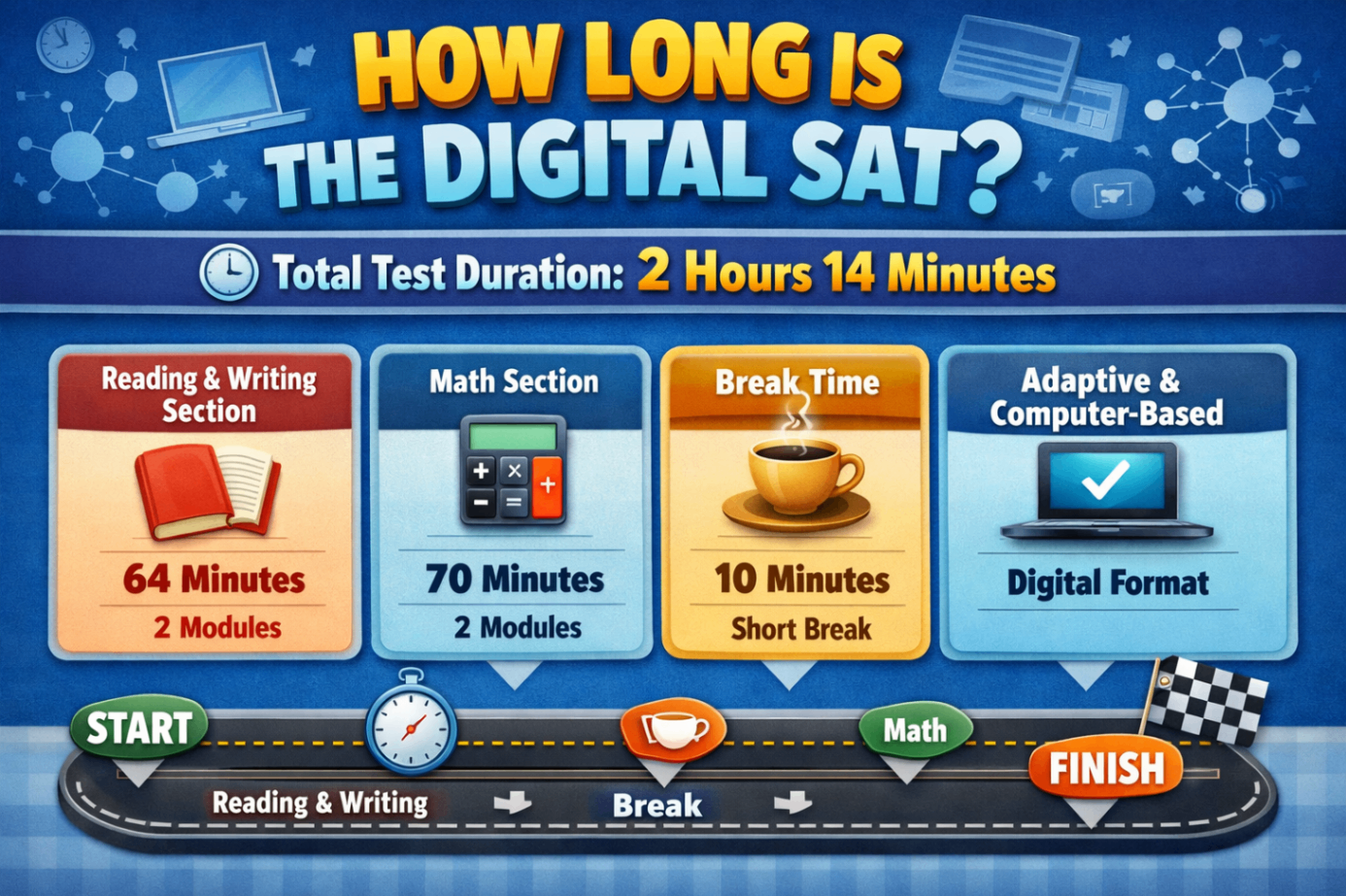
The digital SAT takes approximately 2 hours and 14 minutes of actual testing time. When you factor in the break period and check-in procedures, students should plan to be at the testing center for about 3 hours total. This represents a significant reduction from the previous paper-based SAT, which required 3 hours of testing time alone.
Total Testing Time Breakdown
The streamlined digital format has made the test more efficient without compromising the quality of assessment. This shorter duration helps reduce test fatigue and allows students to maintain better focus throughout the examination. The College Board designed this new format specifically to address student feedback about test length and mental exhaustion.
Comparison With Paper-Based SAT Duration
The paper SAT required students to sit through 3 hours of continuous testing, not including breaks and administrative time. The digital SAT duration represents a 46-minute reduction in pure testing time, making it significantly more manageable for students while still providing colleges with accurate assessment data.
Why The Digital SAT Duration Matters
Understanding how long the new digital SAT takes impacts more than just your schedule. The reduced time commitment influences your study approach, test-day energy management, and overall performance strategy. Students who know exactly what to expect can pace themselves more effectively and reduce anxiety about running out of time.
Impact on Test Day Performance
The shorter format also means you need to develop efficient problem-solving strategies that work within tighter time constraints. Every minute counts, making time management skills more critical than ever for achieving your target score. Students report feeling less mentally drained after the digital SAT compared to the paper version.
Breaking Down The Digital SAT Duration By Section
Understanding how long each section of the digital SAT takes is essential for developing an effective time management strategy. The test is divided into two main sections: Reading and Writing, and Math. Each section uses an adaptive testing model that adjusts question difficulty based on your performance.
Reading and Writing Section Timing
The Reading and Writing section of the digital SAT consists of two modules, each lasting 32 minutes. This gives you a total of 64 minutes for this section. Unlike the traditional SAT, the digital version combines reading comprehension and writing skills into a single integrated section with shorter passages and more focused questions.
Question Distribution in Reading and Writing
Each module contains 27 questions, meaning you'll have approximately 1 minute and 11 seconds per question. The adaptive nature of the test means your performance on the first module determines the difficulty level of the second module. This smart allocation ensures every student receives appropriately challenging content.
Understanding Module-Based Timing
The module structure is one of the most innovative aspects of the digital SAT. Rather than having one long continuous section, you complete two separate 32-minute modules. This break in the middle of each section provides a natural mental reset, even though you don't get a formal break between modules within the same section.
Review Time Within Modules
If you finish a module early, you can review your answers within that module, but you cannot move ahead to the next module until the time expires. This structure encourages thorough review and reduces the pressure of managing time across an entire lengthy section. Use any remaining time wisely to double-check your work.
How Long Is Each Section Of The Digital SAT Math Portion?
The Math section also features two modules, with each module lasting 35 minutes. This provides a total of 70 minutes for mathematical problem-solving. You'll encounter 22 questions per module, giving you roughly 1 minute and 35 seconds per question.
Calculator Access Throughout Math Section
The digital format allows you to use the built-in graphing calculator for the entire Math section, which can help you save time on complex calculations. Unlike the paper SAT, which had a calculator and non-calculator portion, the digital SAT provides calculator access throughout all math questions, streamlining your problem-solving approach.
Math Content and Time Allocation
The Math section covers four main content areas: Algebra, Advanced Math, Problem-Solving and Data Analysis, and Geometry and Trigonometry. Understanding how to allocate your time across these different question types is crucial for maximizing your score.
Question Complexity Variation
Some questions require multiple steps and more complex reasoning, while others can be answered quickly with the right approach. During your preparation, identify which question types take you longer and develop strategies to handle them efficiently during the actual test.
Adaptive Math Module Design
Similar to the Reading and Writing section, the Math section uses adaptive testing. Your performance on the first 35-minute module determines whether you receive an easier, medium, or harder second module. This personalized approach ensures accurate score measurement while respecting how long the SAT digital test takes.
How Long Is The Digital SAT With Breaks?
When considering how long is the digital SAT with breaks, you need to account for the 10-minute break scheduled between the Reading and Writing section and the Math section. This break is mandatory and provides students with a chance to rest, use the restroom, and have a snack.
Official Break Duration and Timing
Adding the break time to the testing time, the total examination period comes to 2 hours and 24 minutes. However, when you include pre-test procedures such as check-in, identification verification, and post-test survey questions, students should expect to spend approximately 3 hours at the testing center.
Making the Most of Your Break Time
The 10-minute break is strategically placed to give you maximum benefit. Use this time wisely to recharge both mentally and physically. Step away from your testing station, stretch your legs, have a healthy snack, and drink some water. Avoid using this time to discuss test questions with other students, as this could lead to test security violations.
Break Time Strategies for Peak Performance
Many students find that light stretching or deep breathing exercises during the break help them refocus for the Math section. Prepare your break-time routine in advance during practice tests so you develop habits that help rather than stress you. Having a plan eliminates decision fatigue during the break.
Pre-Test and Post-Test Time Considerations
Before testing begins, you'll need to complete check-in procedures that include identity verification, testing room assignment, and review of testing rules. This typically takes 30-45 minutes depending on the size of your testing center and how early you arrive. After completing the Math section, you'll answer a brief survey about your test experience and background information, usually taking 5-10 minutes.
The New Digital SAT Format Advantages
The new digital SAT brings several time-related benefits that enhance the overall testing experience. The shorter test length directly addresses one of the most common complaints about standardized testing: exhaustion and mental fatigue during extended examination periods.
Technology-Enhanced Efficiency
The digital platform eliminates time spent bubbling in answers on scantron sheets, allowing students to focus entirely on solving problems. The built-in timer for each module helps students track their pace more effectively than the traditional wall clock method. These technological improvements make the digital SAT duration feel more manageable.
Built-In Digital Tools Save Time
The digital format includes features that save time and reduce errors. The built-in answer elimination tool lets you cross out wrong answers visually, helping you narrow down choices quickly. The highlight and annotation features allow you to mark important information in passages without wasting time writing notes.
Accessible Features and Reference Materials
The digital calculator is always accessible with a single click, and the reference sheet for math formulas appears on-screen when needed. These conveniences eliminate fumbling with physical materials and help you maintain focus and momentum throughout the test.
Faster Score Delivery Benefits
Score reports are available much faster with the digital format, typically within days rather than weeks. This means you can make decisions about college applications and potential retakes more quickly. Understanding how much does it cost to take the SAT alongside the time commitment helps you make informed decisions about test registration and scheduling.
Preparing For The Digital SAT Timeline
Effective preparation requires understanding not just the total duration but how to allocate your time during each section. Practice with digital SAT prep materials using realistic timing conditions to build your pacing skills and stamina.
Building Test-Taking Stamina
Even though the digital SAT is shorter than the paper version, 2 hours and 14 minutes of focused concentration still requires mental stamina. Build this endurance gradually through your preparation by starting with individual timed sections and progressing to full-length practice tests.
Scheduling Practice at Optimal Times
Schedule your practice tests at the same time of day as your actual test to help your body and mind adjust to performing at peak levels during that timeframe. This biological conditioning can give you a competitive advantage on test day and helps you understand exactly how long the digital SAT test feels in real conditions.
Developing Section-Specific Strategies
Create a study schedule that includes regular timed practice sessions for individual sections as well as complete practice tests. This approach helps you develop an intuitive sense of pacing that will serve you well during the actual examination. For the Reading and Writing section, practice reading passages efficiently and identifying key information quickly.
Using Technology in Your Preparation
Consider using tools like the SAT AI Solver to enhance your preparation strategy and identify areas where you might need additional time management practice. Simulating full-length tests under timed conditions helps you become comfortable with the digital SAT duration and builds the mental endurance needed for test day.
Accommodations and Extended Time
Students who qualify for accommodations may receive extended time on the digital SAT. The amount of additional time varies based on individual needs and approved accommodations. Students with extended time typically receive 50% or 100% additional time per section, which significantly impacts the overall test duration.
How Extended Time Affects Test Length
With 50% extended time, the digital SAT test would take approximately 3 hours and 21 minutes of testing time, plus breaks. With 100% extended time (time and a half), the test would take approximately 4 hours and 28 minutes, plus breaks. Understanding your specific accommodation ensures you can plan appropriately for test day.
Applying for Extended Time Accommodations
If you have approved accommodations, familiarize yourself with how the extended time will be distributed across modules and plan your test day accordingly. The testing center will provide specific information about your expected time commitment during the registration process. Students should apply for accommodations well in advance of their test date.
Additional Accommodation Considerations
Students with accommodations may also receive additional breaks, alternate test formats, or other modifications that affect the total time at the testing center. Contact your testing coordinator well in advance to understand exactly how your accommodations will be implemented and what to expect on test day.
Planning Your Extended Test Day
Students with extended time should plan for a significantly longer testing center visit. Bring adequate snacks, water, and any necessary medications. Inform family members or transportation providers about your expected completion time to avoid unnecessary stress about pickup arrangements.
Time Management Strategies for Test Day
Knowing how long the SAT digital test takes is only valuable if you can manage that time effectively. Develop a personalized time management strategy based on your strengths and weaknesses to maximize your performance within the digital SAT duration.
Pacing Techniques That Work
For the Reading and Writing section with 27 questions in 32 minutes, aim to spend no more than 75 seconds per question on your first pass. Mark questions you're unsure about and return to them if time permits. For the Math section with 22 questions in 35 minutes, you have about 95 seconds per question, but some complex problems may require 2-3 minutes while simpler ones take 30 seconds.
Creating Mental Checkpoints
Use the digital timer displayed on screen to check your pace at regular intervals. Create mental checkpoints: for example, in a 32-minute Reading and Writing module, you should complete roughly 9 questions every 10 minutes to stay on track. These benchmarks help you adjust your pace before falling too far behind.
The Strategic Skip-and-Return Method
Don't let difficult questions consume disproportionate amounts of time. If a question is taking too long, make your best guess, flag it for review, and move forward. The digital platform makes it easy to mark questions and return to them later if time allows, helping you make the most of how long each section of the digital SAT provides.
Avoiding Common Timing Mistakes
This strategy ensures you at least attempt every question, maximizing your scoring potential. Remember that all questions carry equal weight, so a quick easy question is just as valuable as a time-consuming difficult one. Many students spend too much time on early questions, leaving insufficient time for later ones, while others rush through the test too quickly.
Conclusion
The digital SAT represents a more efficient and student-friendly approach to college admissions testing. With a total testing time of 2 hours and 14 minutes plus a 10-minute break, the digital SAT duration is significantly shorter than previous formats while maintaining rigorous academic standards. Understanding exactly how long the digital SAT takes, including how long each section of the digital SAT lasts, empowers you to prepare effectively and approach test day with confidence. The modular structure, built-in tools, and streamlined format all contribute to a better testing experience that reduces fatigue while still accurately measuring your college readiness. By practicing with realistic timing, developing strong pacing strategies, and understanding the full scope of the test day timeline, you'll be well-equipped to maximize your performance within the given timeframe. Remember that effective time management is a skill that improves with practice, so invest time in developing this crucial ability as part of your SAT preparation journey.
Frequently Asked Questions
How long is the SAT digital test compared to the paper SAT?
The digital SAT takes 2 hours and 14 minutes of testing time, which is approximately 46 minutes shorter than the previous paper-based SAT that required 3 hours. With breaks included, the digital version takes about 2 hours and 24 minutes compared to 3 hours and 15 minutes for the paper test. This reduction in time helps students maintain better focus and reduces test fatigue while still providing a comprehensive assessment of college readiness skills.
Can I take breaks during the digital SAT sections?
You receive one scheduled 10-minute break between the Reading and Writing section and the Math section. You cannot take unscheduled breaks during individual modules or between modules within the same section. However, once you complete a module early, you can take a brief mental pause before starting the next module within the same section, though the timer will continue running for that section.
What happens if I don't finish a section in the allotted time?
The digital SAT automatically moves you to the next module when time expires for the current module. Any unanswered questions in the incomplete module will be marked as incorrect, which is why time management and pacing practice are crucial components of digital SAT preparation. This is why developing efficient problem-solving strategies and knowing when to skip difficult questions is essential for maximizing your score.
How long should I plan to be at the testing center?
While the actual test with breaks takes approximately 2 hours and 24 minutes, you should plan to be at the testing center for at least 3 to 3.5 hours total. This accounts for check-in procedures that begin 30-45 minutes before testing starts, identity verification, reading instructions, testing time itself, and post-test survey questions. Arriving early ensures you're not rushed and can settle in calmly before the test begins.
Does the adaptive format affect how long the digital SAT takes?
No, the adaptive format does not change the overall test duration or the time allotted for each module. Each module has a fixed time limit of either 32 minutes (Reading and Writing) or 35 minutes (Math) regardless of difficulty level. The adaptability only affects which questions you see in the second module of each section based on your performance in the first module, not how much time you have to complete them. This ensures all students have equal time to demonstrate their abilities.