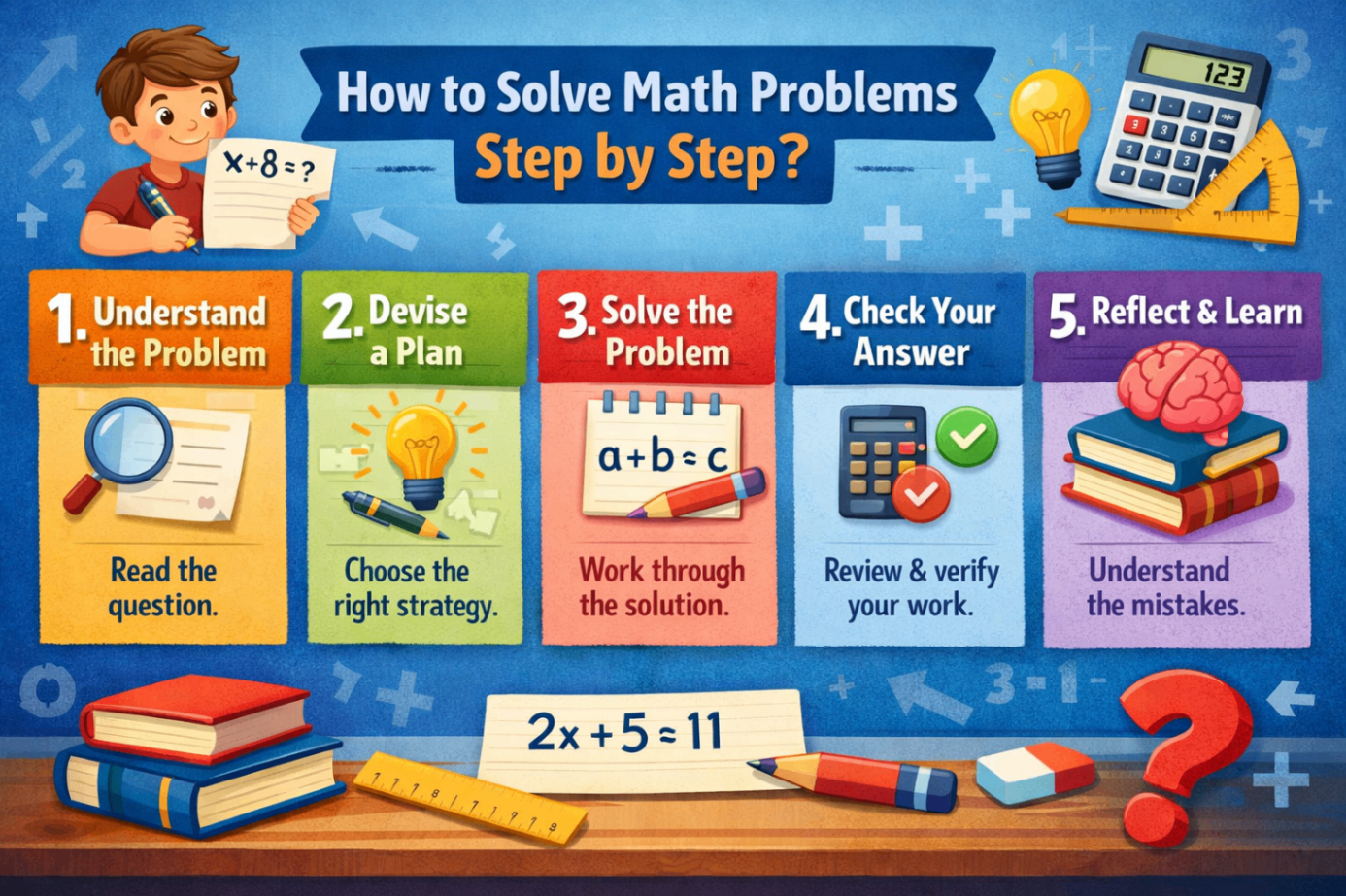
Learning how to solve math problems step by step transforms mathematics from an overwhelming subject into a manageable series of logical actions. Students who master systematic problem-solving approaches consistently outperform those who attempt to solve problems through intuition or memorization alone. The key to mathematical success lies not in natural talent but in following proven methods that break complex problems into smaller, achievable steps. Whether you struggle with basic arithmetic or advanced calculus, the same fundamental problem-solving framework applies across all areas of mathematics. This comprehensive how to solve math problems step by step guide teaches you the systematic approaches that successful math students use to tackle any problem with confidence. From understanding the question to checking your final answer, each phase of the process builds toward reliable solutions.
Understanding the Problem Before Solving
The first and most critical phase of solving any math problem involves thoroughly understanding what the problem asks you to find.
Read the Problem Completely Before Starting
Many students make the mistake of beginning calculations before fully reading and comprehending the entire problem statement. Rushing into a problem without understanding all the information leads to wasted effort solving the wrong question entirely. Read through the complete problem at least twice before picking up your pencil to begin any calculations. This initial investment of time prevents frustration and errors that come from misunderstanding what the problem requires you to determine.
Identify What the Problem Asks You to Find
Every math problem has a specific goal or unknown value that you need to determine through your calculations. Clearly identifying this target before starting keeps your work focused and prevents you from getting lost in unnecessary calculations. Write down exactly what you need to find, whether it is a number, variable, measurement, or relationship between quantities. Having a clear destination in mind helps you evaluate whether each step moves you closer to your answer.
List All Given Information Systematically
Organizing the information provided in a problem creates a foundation for your solution approach and helps you see relationships. Write down every number, measurement, condition, and constraint the problem provides in an organized format you can reference. Seeing all given information together often reveals connections and suggests which formulas or methods apply to the situation. This systematic listing prevents you from overlooking crucial details that affect your solution.
Determine What Type of Problem You Face
Recognizing the category of problem you are solving helps you select appropriate strategies and formulas for your solution. Different problem types such as algebraic equations, geometry calculations, and statistical analysis require different approaches and tools. Identifying the problem type early allows you to recall relevant formulas and methods before diving into calculations. Experience with many problem types builds pattern recognition that makes this identification faster and more accurate.
Mastering the Order of Operations
Following the correct sequence of calculations ensures you get the right answer every time you evaluate mathematical expressions.
Remember PEMDAS for Every Calculation
PEMDAS stands for Parentheses, Exponents, Multiplication, Division, Addition, and Subtraction and tells you which operations to perform first. Without following this standard order, the same expression could produce different answers depending on how you approach it. The order of operations ensures that everyone solving the same problem arrives at the same correct answer consistently. Memorizing and automatically applying PEMDAS eliminates a major source of errors in mathematical calculations.
Handle Parentheses and Grouping Symbols First
Any calculations inside parentheses, brackets, or other grouping symbols must be completed before you do anything else in the expression. When you encounter nested parentheses with groups inside other groups, work from the innermost parentheses outward systematically. Grouping symbols override the normal order of operations and force certain calculations to happen before others. Failing to handle parentheses first leads to completely wrong answers even when all your arithmetic is correct.
Work Multiplication and Division Left to Right
Multiplication and division have equal priority in the order of operations, so you perform them from left to right as they appear. A common mistake is always doing multiplication before division, but this produces incorrect answers in many situations. Whichever operation appears first as you read from left to right gets done first regardless of whether it multiplies or divides. Using a Step by Step Math Solver can help you verify you are applying the order of operations correctly.
Complete Addition and Subtraction Last
Addition and subtraction share the lowest priority and get performed after all parentheses, exponents, multiplication, and division are complete. Like multiplication and division, these operations are equal priority and get done left to right in the order they appear. Students sometimes forget that subtraction is really adding a negative number, which helps clarify tricky situations with multiple operations. Following this final step correctly produces your answer after all higher-priority operations are finished.
How to Solve Math Word Problems Step by Step
Word problems require translating English sentences into mathematical equations before you can solve them numerically.
Translate Words into Mathematical Symbols
Word problems use specific phrases that correspond to mathematical operations you need to recognize and convert accurately. Words like sum, total, and combined typically indicate addition, while difference and less than suggest subtraction operations. Phrases containing per, each, and every usually signal division or rates that require careful setup in equations. Building a mental dictionary of these translations speeds up your ability to convert word problems into solvable mathematical expressions.
Define Variables for Unknown Quantities
When a word problem involves unknown values, assign clear variable names that help you remember what each letter represents. Choose variable names that make sense, such as using d for distance or t for time, rather than arbitrary letters. Write down what each variable represents so you can interpret your final answer correctly in the context of the problem. Clear variable definitions prevent confusion when equations become complex and involve multiple unknowns to solve.
Set Up Equations from Problem Relationships
The relationships described in word problems become equations when you translate them using your variables and mathematical operations. Look for phrases that indicate equality such as is, equals, results in, and gives to know where to place your equals sign. Setting up the correct equation is often the hardest part of word problems, and checking your equation against the problem ensures accuracy. Practice with many word problems builds skill at recognizing patterns and setting up equations quickly and correctly.
Check Your Answer Against the Original Problem
After solving your equation, verify that your numerical answer makes sense in the context of the original word problem. Substitute your answer back into the problem statement to confirm it satisfies all the conditions and relationships described. Consider whether your answer is reasonable given the real-world situation the problem describes. An answer that is negative when it should be positive or impossibly large signals an error somewhere in your solution process.
Strategies for Different Math Problem Types
Different categories of math problems benefit from specific approaches tailored to their unique characteristics.
Solving Algebraic Equations Systematically
Algebraic equations require isolating the variable on one side through inverse operations applied equally to both sides. Start by simplifying each side of the equation separately using the order of operations before attempting to isolate variables. Apply inverse operations in reverse order of operations, undoing addition and subtraction before multiplication and division. Keep your work organized by writing each step on a new line so you can trace any errors back to their source.
Approaching Geometry Problems Visually
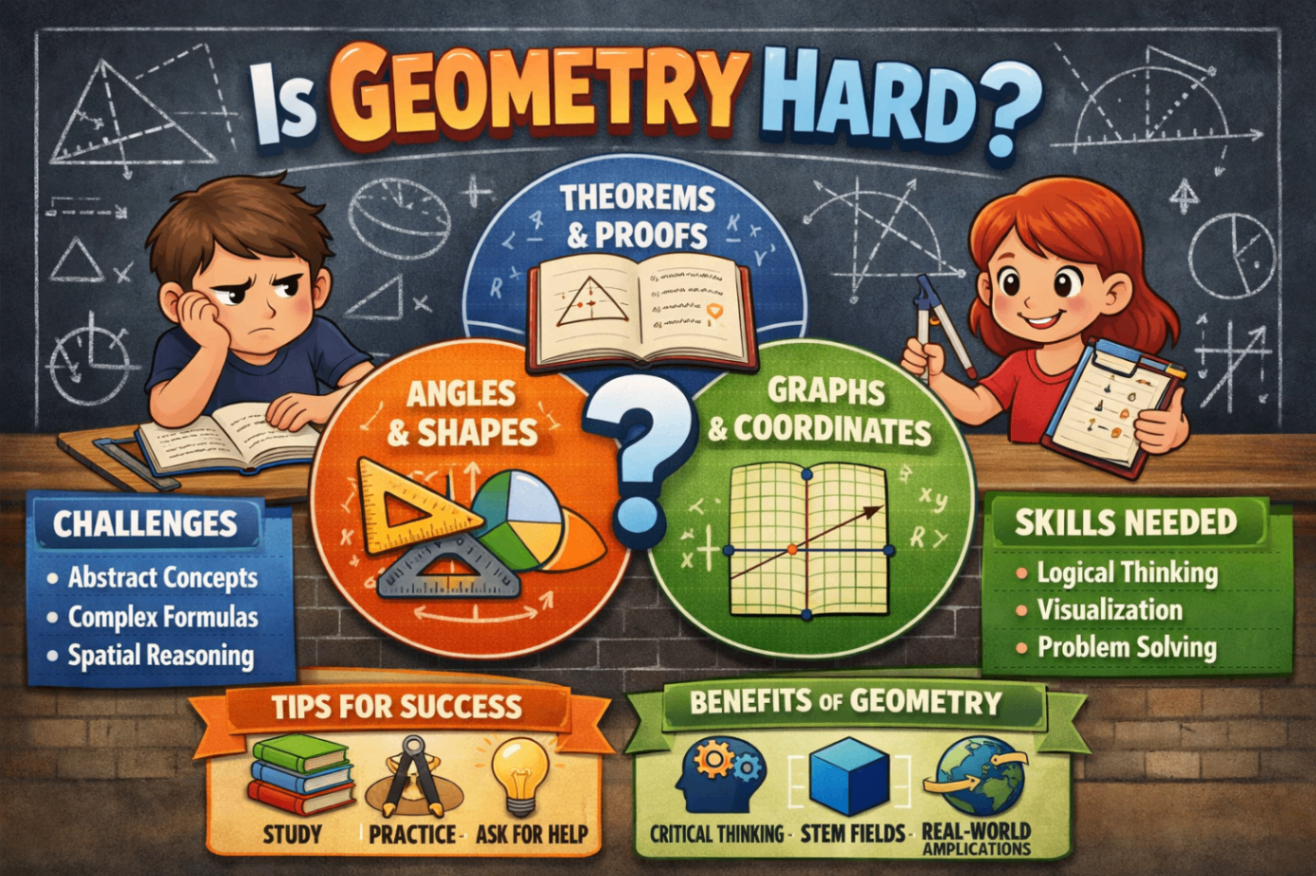
Geometry problems benefit enormously from drawing diagrams that show all the information and relationships in visual form. Label your diagrams with all given measurements, angles, and any variables representing unknown values you need to find. Understanding whether a problem involves is geometry hard concepts like congruence, similarity, or the Pythagorean theorem guides your approach. Visual representation helps you identify which formulas and theorems apply to each specific geometric situation.
Breaking Down Multi-Step Problems
Complex problems with multiple steps require planning your approach before diving into calculations that might lead nowhere. Identify intermediate values you need to calculate before you can determine the final answer the problem requests. Work through each step carefully, checking your intermediate results for reasonableness before proceeding to subsequent calculations. Breaking large problems into smaller pieces makes difficult mathematics manageable and reduces errors from trying to do too much at once.
Handling Fraction and Decimal Operations
Fractions and decimals follow the same order of operations but require additional care with their specific computational rules. When adding or subtracting fractions, find common denominators before combining numerators together over the shared denominator. Converting between fractions and decimals strategically can simplify certain problems while making others more difficult to complete. Practice with both representations builds flexibility and helps you choose the easier form for each specific problem.
Common Math Problem Solving Mistakes to Avoid
Recognizing frequent errors helps you develop habits that prevent these mistakes from appearing in your own work.
Skipping Steps to Save Time
Students often try to do multiple operations mentally to save time, but this approach leads to more errors than it prevents. Writing out each step creates a record you can check and helps you maintain focus on the current calculation without distraction. The few seconds saved by skipping steps costs much more time when you must hunt for errors in work you cannot trace. Developing the discipline to show all work pays dividends in accuracy and makes finding mistakes much easier.
Forgetting to Distribute Negative Signs
One of the most common algebraic errors involves failing to distribute negative signs correctly when removing parentheses from expressions. When a negative sign precedes parentheses, every term inside must change sign when you remove the grouping symbols. Writing out the distribution step explicitly rather than doing it mentally prevents this frequent source of wrong answers. Check your work specifically for sign errors whenever you remove parentheses that follow subtraction or negative coefficients.
Misapplying Formulas Without Understanding
Memorizing formulas without understanding when and how they apply leads to using wrong formulas or applying correct formulas incorrectly. Take time to understand what each formula calculates and what conditions must be true for the formula to apply properly. Knowing why a formula works helps you remember it better and recognize situations where it provides the solution you need. Understanding formulas deeply prevents the frustrating experience of knowing many formulas but not knowing which one solves your current problem.
Neglecting to Check Answers for Reasonableness
Finishing a problem without evaluating whether your answer makes sense misses an opportunity to catch errors before they cost points. Consider whether your answer has appropriate magnitude, correct units, and sensible sign for the situation the problem describes. Substitute your answer back into the original equation or problem to verify it satisfies all stated conditions completely. Building the habit of checking answers catches many mistakes that careful work alone might not prevent.
Tools and Techniques for Better Problem Solving
Supplementing your skills with effective tools and methods accelerates improvement and builds confidence in mathematics.
Use Scratch Paper Effectively
Organize your scratch work so calculations are neat, labeled, and easy to follow when you need to review your solution process. Draw diagrams, write out intermediate calculations, and keep track of what each number represents as you work through problems. Well-organized scratch work makes checking your solution and finding errors much faster and more reliable. Treat scratch paper as part of your solution rather than a place for random scribbling you will discard.
Create Reference Sheets for Formulas
Compile frequently used formulas, definitions, and problem-solving procedures into reference sheets you can study and consult while practicing. Organizing formulas by topic helps you see connections between related concepts and find relevant formulas quickly when needed. Review your reference sheets regularly to move information from external references into your memory for tests and timed assignments. Update your sheets as you learn new formulas and develop a better understanding of when each one applies.
Practice with Varied Problem Types
Exposure to many different problem types builds the pattern recognition that makes identifying solution strategies faster and more accurate. Seek out practice problems that challenge you rather than only doing problems you already know how to solve comfortably. Working through problems you initially find difficult builds problem-solving skills that easier problems do not develop as effectively. Regular practice with variety prepares you for the unexpected problems that appear on tests and in real applications.
Learn from Mistakes Systematically
When you get problems wrong, analyze your errors carefully to understand exactly what went wrong and why the mistake happened. Categorize your mistakes to identify patterns that reveal which concepts or procedures need more attention and practice. Reworking missed problems correctly after understanding your error reinforces proper techniques and prevents repeating the same mistakes. Treating mistakes as learning opportunities rather than failures accelerates your improvement in mathematics significantly.
Conclusion
Learning how to solve math problems step by step provides a framework that applies to every mathematical challenge you will encounter throughout your education and career. The systematic approach of understanding the problem, following correct operation order, and checking your work consistently produces accurate results. Word problems become manageable when you develop skill at translating English into mathematical equations and defining variables clearly. Different problem types benefit from specific strategies, but the fundamental step-by-step approach remains constant across all areas of mathematics. Avoiding common mistakes like skipping steps, mishandling negative signs, and forgetting to check answers prevents frustration and improves your accuracy significantly. With consistent practice using the methods in this guide, you can build confidence and competence in solving any math problem you encounter.
Frequently Asked Questions
What is the first step in solving any math problem?
The first step is always reading and understanding the problem completely before attempting any calculations. Identify what the problem asks you to find, list all given information, and determine what type of problem you face. This foundation prevents wasted effort solving the wrong question and helps you select appropriate strategies. Taking time to understand the problem thoroughly actually saves time overall by preventing errors and restarts.
How do I know which operation to do first in complex expressions?
Follow PEMDAS order: Parentheses first, then Exponents, then Multiplication and Division left to right, finally Addition and Subtraction left to right. Remember that multiplication and division have equal priority and get done left to right as they appear. The same applies to addition and subtraction at the end of your calculations. Applying this order consistently ensures you get the correct answer every time.
Why do I keep getting word problems wrong even when I understand the math?
Word problem errors usually come from translation mistakes where English phrases get converted incorrectly into mathematical operations. Practice recognizing key words like sum, difference, product, and quotient that indicate specific operations. Make sure you define variables clearly and set up equations that accurately represent all the relationships described. Checking your final answer against the original problem context catches translation errors before they become wrong answers.
How can I check if my math answer is correct?
Substitute your answer back into the original equation or problem to verify it satisfies all conditions and produces true statements. Evaluate whether your answer makes sense in context by considering magnitude, units, and whether positive or negative makes sense. Work the problem a second time using a different method if possible to confirm you get the same result. Estimation before solving helps you know approximately what answer to expect so unreasonable results stand out immediately.
What should I do when I get stuck on a math problem?
First, reread the problem to make sure you understand what it asks and have not missed any given information. Try drawing a diagram, restating the problem in your own words, or working backward from what you need to find. Look for similar problems you have solved before and consider whether those same strategies might apply here. Taking a short break and returning with fresh eyes often reveals approaches you missed when feeling frustrated.