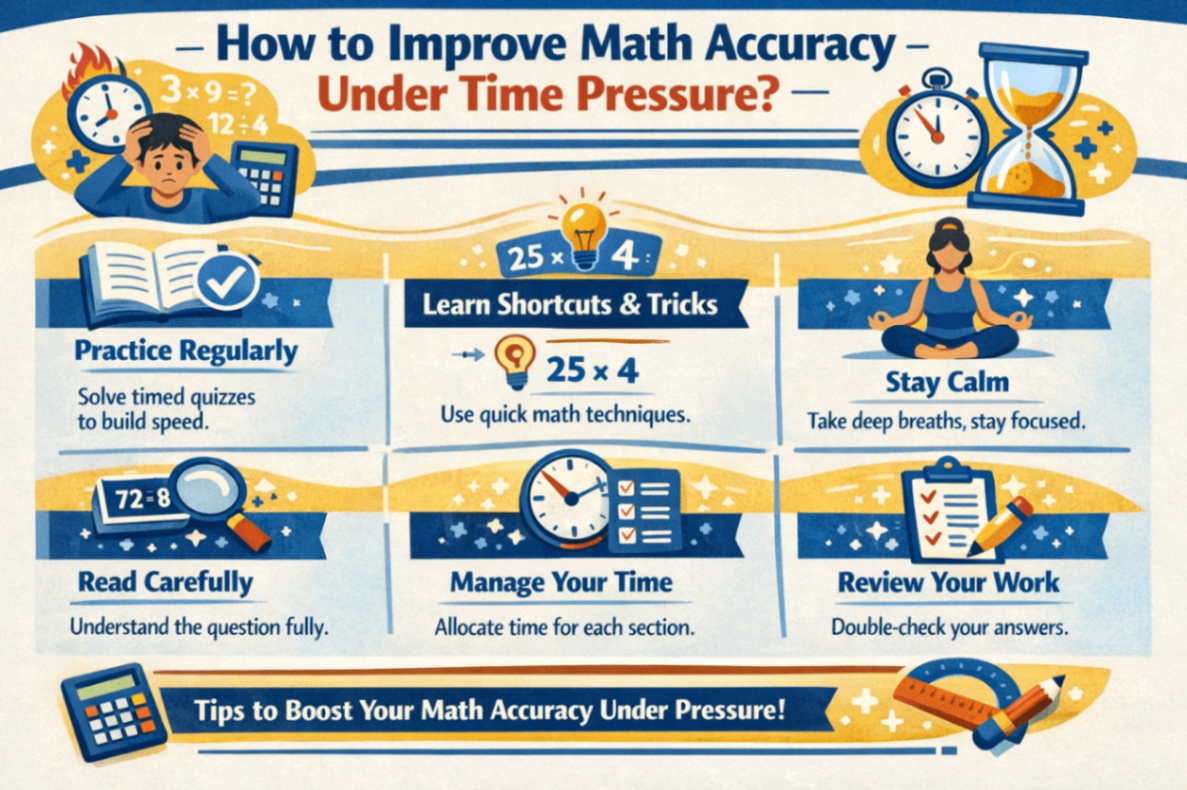
Students often understand math concepts well but lose points to careless errors when working under time constraints during exams. Learning how to improve math accuracy under time pressure requires developing specific skills that prevent mistakes without sacrificing speed. The challenge is that rushing leads to errors while being too careful means running out of time. Research shows that accuracy errors are predictable and preventable when students adopt the right strategies and mindset. This guide presents practical techniques to help you minimize mistakes and perform at your best when every minute counts.
Understand Why Accuracy Suffers Under Pressure
Before implementing solutions, it helps to understand the specific factors that cause errors during timed tests. Recognizing these patterns allows you to address them directly.
Recognize Common Error Categories
Most math errors fall into predictable categories you can learn to anticipate and check for specifically. Calculation mistakes include sign errors, arithmetic slips like adding instead of multiplying, and decimal misplacements. Procedural errors involve skipping steps, applying wrong formulas, or forgetting to complete multi-part solutions. Comprehension errors happen when you misread what the question asks or miss important conditions. Identifying which error types affect you most helps you develop targeted checking strategies.
Understand How Time Pressure Affects Thinking
Time pressure triggers stress responses that impair mathematical thinking and working memory. Under pressure, you may rush through reading questions, skip verification steps, and make hasty decisions. Anxiety narrows your attention, causing you to miss details you would normally catch when relaxed. Understanding these effects helps you recognize when pressure is affecting your performance and take steps to counteract it.
Identify Your Personal Error Patterns
Each student has characteristic mistakes that appear repeatedly across tests and assignments. Keeping track of your specific errors reveals patterns you can target with focused attention during exams. Some students consistently drop negative signs, others frequently answer the wrong part of multi-step questions, and others make arithmetic mistakes with specific operations. Reviewing returned work to classify your errors creates a personalized checklist for future tests.
Distinguish Speed Problems from Accuracy Problems
Poor test performance can result from either speed issues or accuracy issues, and each requires different solutions. If you frequently run out of time, you need strategies to work faster without increasing errors. If you finish early but make many mistakes, you need better checking habits rather than more speed. Some students have both problems in different question types or test sections. Diagnosing which problem affects you guides your improvement efforts toward the right strategies.
Develop Effective Reading and Setup Habits
Many errors originate in how you read and set up problems rather than in calculations themselves. Careful front-end work prevents errors that checking might not catch.
Read Questions Completely Before Solving
Resist the urge to start solving as soon as you recognize a familiar problem type, since rushing through prompts causes you to miss crucial details. Read every word of the question, including parts that seem standard, because teachers often include subtle changes. For lengthy word problems, read once for overall understanding, then again to extract specific information. Complete reading prevents solving correctly but answering the wrong question.
Annotate and Highlight Key Information
Actively marking important elements while reading keeps you focused and creates reference points for checking your answer later. Circle or underline what the question actually asks you to find, since this is frequently where errors occur. Mark given values, constraints, and conditions that affect how you approach the solution. Visual markers guide your attention throughout the problem-solving process.
Break Complex Problems into Manageable Parts
Multi-step problems become error-prone when you try to hold everything in your head while working through calculations. Write out the separate steps or parts explicitly before starting any calculations. For word problems, identify what intermediate values you need before reaching the final answer. This breakdown creates a roadmap that prevents you from losing track in complex solutions.
Verify Your Understanding Before Calculating
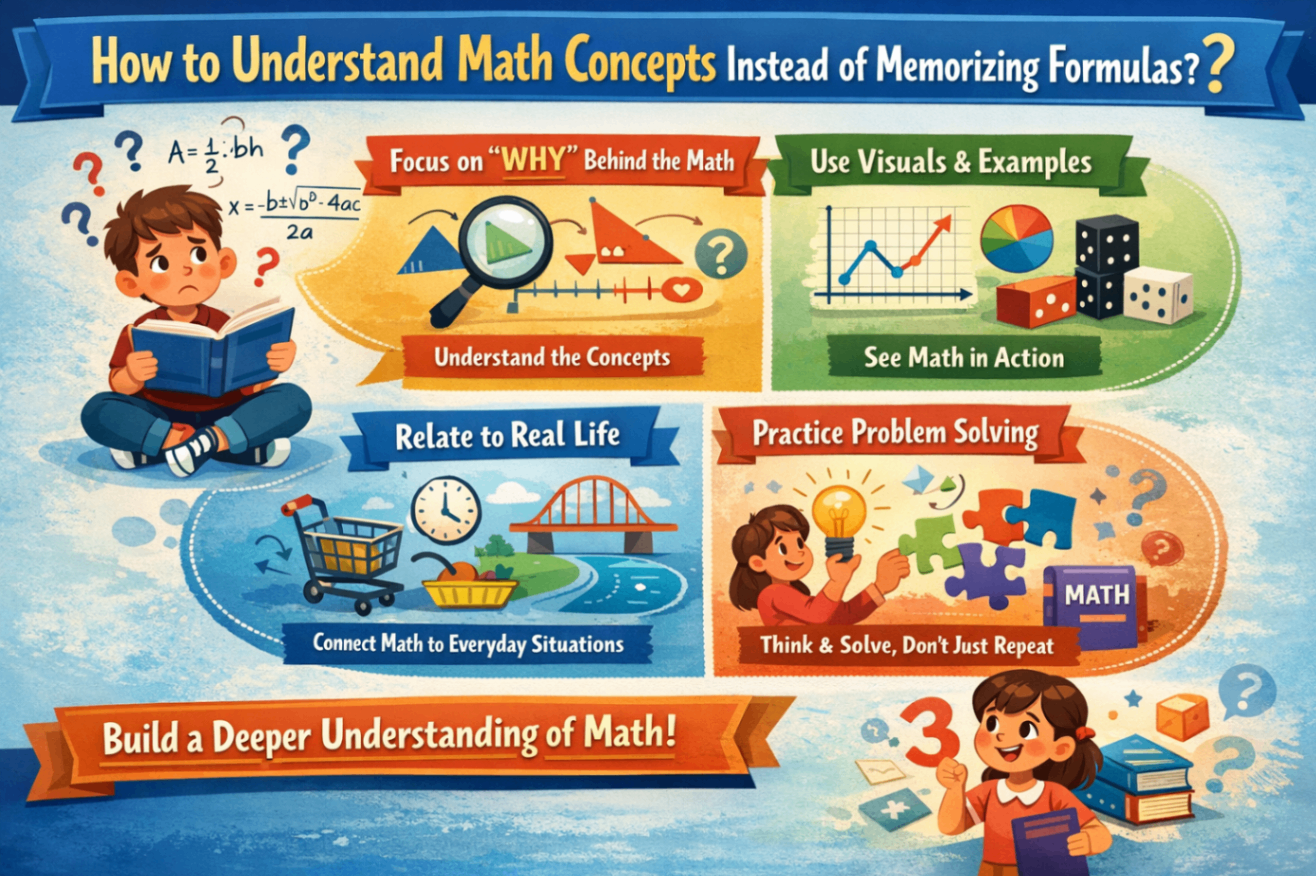
Before diving into calculations, confirm that you understand what the problem requires and have a valid approach planned. For problems where underlying concepts matter, ensure you grasp How to Understand Math Concepts Instead of Memorizing Formulas so your approach is sound from the start. Taking a moment to plan reduces wasted effort from pursuing wrong solution paths.
Build Speed Without Sacrificing Accuracy
Working faster does not have to mean making more mistakes if you develop efficiency through the right kinds of practice. Strategic speed improvement maintains accuracy while reducing time per problem.
Master Foundational Facts and Operations
Instant recall of basic math facts frees mental resources for higher-level thinking and reduces calculation errors. Know multiplication tables, common fraction-decimal conversions, and basic algebraic manipulations so thoroughly that they require no conscious thought. When foundational operations are automatic, you can focus attention on the harder parts of problems where errors are more likely. This foundation of fluency is essential for both speed and accuracy under pressure.
Learn and Practice Mental Math Shortcuts
Efficient mental calculation techniques reduce both time spent and opportunities for transcription errors. Learn shortcuts for common operations like multiplying by eleven, squaring numbers ending in five, or checking divisibility. Practice estimation skills that let you verify whether answers are reasonable without full recalculation. These techniques become automatic with practice and significantly speed up routine calculations. An AI Math Solver can help you learn and verify these shortcuts as you develop your mental math toolkit.
Develop Efficient Written Work Habits
How you organize your written work affects both speed and your ability to catch errors during checking. Write legibly enough that you can read your own work quickly, since messy writing causes transcription errors. Organize calculations vertically with aligned equals signs so the logical flow is clear. Use consistent notation and abbreviations that you can interpret quickly when reviewing.
Practice Under Realistic Time Conditions
Regular practice with time pressure builds the skills and comfort needed to perform accurately when it matters. Simulate actual test conditions with appropriate time limits rather than practicing only in relaxed settings. Timed practice reveals which problem types slow you down and where errors emerge under pressure. Start with generous time limits and gradually reduce them as your skills improve.
Implement Strategic Checking Routines
Checking your work is essential but must be done efficiently to fit within time constraints. Strategic verification catches errors without wasting precious minutes.
Check as You Go Rather Than Only at the End
Catching errors immediately after making them is more efficient than trying to find them later. After each major calculation step, quickly verify the result makes sense before proceeding. This ongoing verification prevents small errors from propagating through entire solutions. If you only check at the end, you may not have time to find and fix all mistakes.
Use Different Methods for Verification
Checking by repeating the same calculation often misses errors because you make the same mistake twice. Instead, verify answers using alternative approaches when possible, such as substituting answers back into original equations. Use estimation to confirm that numerical answers are approximately correct in magnitude. Check that units work out correctly, as unit errors often signal calculation problems.
Prioritize Checking High-Value Questions
When time is limited, focus your checking efforts where they have the greatest impact on your score. Verify answers to questions worth more points before checking lower-value items. Also prioritize checking questions where you felt uncertain during solving over those you found straightforward. Questions involving many calculation steps deserve more checking attention than simple ones. Strategic prioritization maximizes the error-catching value of your limited checking time.
Create a Personal Error Checklist
Based on your identified error patterns, develop a brief mental checklist specific to your common mistakes. Before moving to the next problem, quickly run through your checklist of typical errors for that problem type. This targeted checking is faster and more effective than general reviewing because it focuses on your actual vulnerabilities. Update your checklist as you identify new error patterns.
Manage Time and Pressure Effectively
How you approach the test as a whole and manage your mental state significantly affects accuracy throughout. Strategic test-taking and pressure management support sustained accuracy.
Allocate Time Strategically Across the Test
Before starting, survey the entire test and create a rough time budget for each section or question type. Knowing how much time you have per question prevents both rushing and dwelling too long on any problem. If a question takes longer than budgeted, mark it and move on rather than sacrificing time for other questions. Time awareness prevents the panic that causes accuracy to collapse.
Start with Confidence-Building Questions
Beginning with questions you can solve quickly and accurately builds confidence and ensures you capture those points. Early success calms anxiety and creates positive momentum for tackling harder problems. This approach also guarantees that easy points are not lost to time running out. Strategic sequencing improves both your score and your mental state.
Stay Calm Through Breathing and Focus
Physical relaxation techniques help maintain the mental clarity needed for accurate math work under pressure. If you feel anxiety rising, take a few slow, deep breaths to activate your body's calming response. Refocus on the current problem rather than worrying about time or other questions. Calm focus is essential for the careful attention that accuracy requires.
Maintain Physical Readiness
Your physical state directly affects mental performance, so prepare your body as well as your mind for test day. Get adequate sleep the night before rather than cramming, since tired brains make more errors. Eat appropriately before the test to maintain blood sugar and mental energy. Physical readiness supports the sustained concentration that accurate math work demands.
Conclusion
Learning how to improve math accuracy under time pressure combines understanding your error patterns with developing specific prevention and checking strategies. The techniques in this guide address errors at every stage from reading questions through final verification. Building speed through fluency and shortcuts allows time for careful work without sacrificing completion. Managing pressure and time strategically ensures you can apply these accuracy techniques consistently throughout the test. Start implementing these strategies in your practice sessions, and you will see improvement in both your accuracy and your confidence during math exams.
Frequently Asked Questions
How can I stop making careless mistakes even when I know the material?
Careless mistakes typically follow patterns you can learn to anticipate and check for specifically. Track your errors across multiple tests to identify your personal vulnerability areas, then create a targeted checklist for those mistake types. Build checking into your solving process rather than only reviewing at the end. Understanding the material is necessary but not sufficient without deliberate attention to accuracy.
Should I work faster or check more carefully to improve my test scores?
The answer depends on whether you currently lose more points to incomplete tests or to errors on completed questions. Analyze recent tests to determine which problem affects you more, then focus your improvement efforts accordingly. Most students benefit from developing both faster solving skills and more efficient checking routines. The goal is working at a pace that allows completion with time for verification.
How do I decide when to move on from a difficult question?
Set a time budget before starting and monitor roughly where you are relative to that budget as you work. If a question exceeds its allocated time significantly and you are not close to a solution, mark it and move on. Spending excessive time on one question sacrifices points from questions you could definitely answer correctly. Return to skipped questions after completing others if time remains.
What should I do if I start feeling anxious during a test?
Pause briefly and take several slow, deep breaths to activate your body's relaxation response. Remind yourself that some anxiety is normal and that you have prepared for this test. Refocus your attention on the current problem rather than thinking about time or overall performance. If anxiety persists, move to an easier question to rebuild confidence.
How much time should I leave for checking my work?
Reserve roughly ten to fifteen percent of total test time for final review, though this varies by test length and your error rate. However, checking as you solve each problem is more effective than relying solely on end review. Use reserved time to recheck high-value questions and questions where you felt uncertain. Prioritize strategically rather than trying to recheck everything equally.