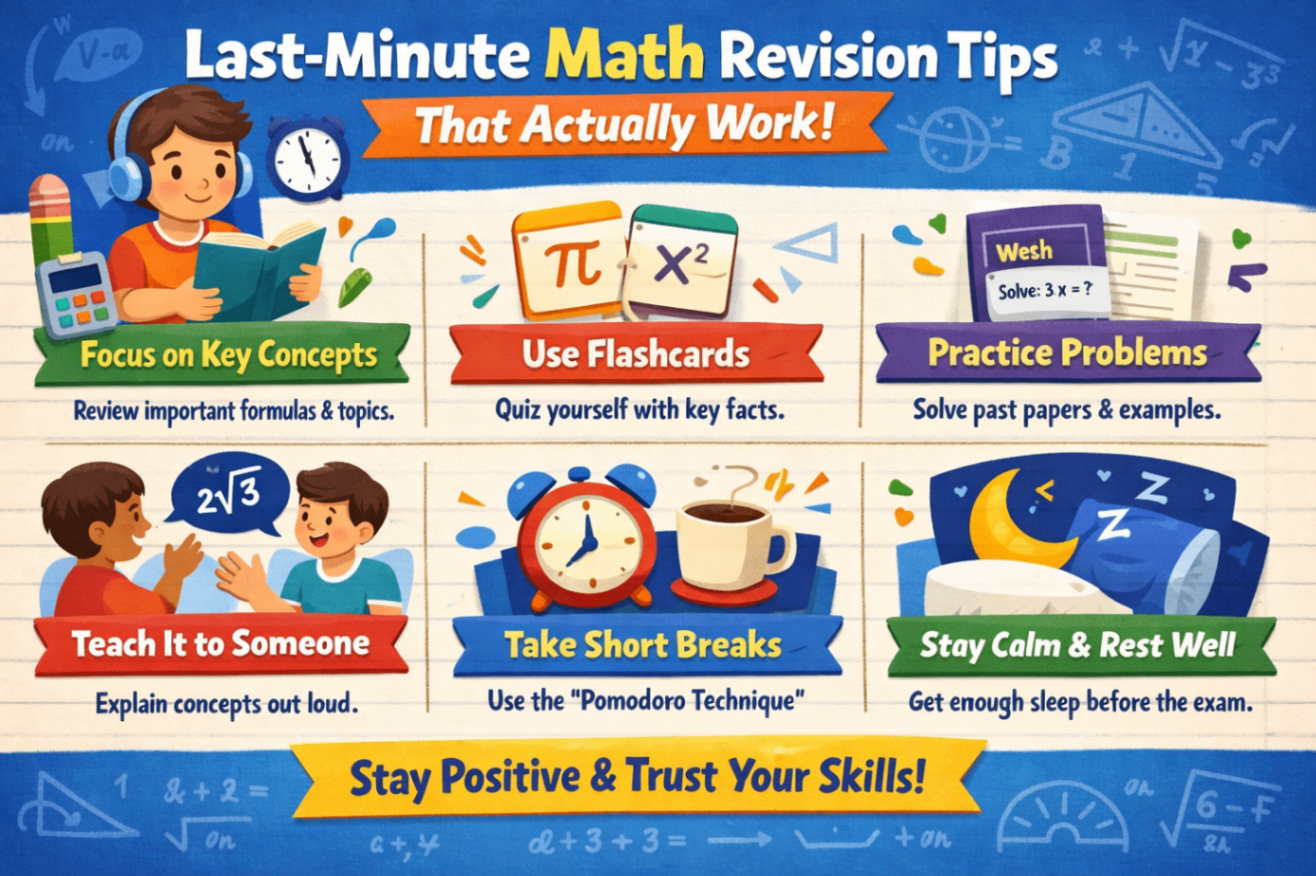
Finding yourself with limited time before a math exam can feel overwhelming, but strategic last-minute revision can still make a significant difference in your performance. Unlike subjects that rely primarily on memorization, math requires understanding concepts and applying problem-solving techniques, which means your approach to cramming must be intentional and focused. Research shows that students who use strategic study methods during last-minute preparation outperform those who simply reread notes. The key lies in prioritizing high-impact topics, using active recall techniques, and practicing problems similar to what you will face on the exam. This guide provides last-minute math revision tips that actually work, helping you maximize whatever time remains before your test.
Prioritize High-Impact Topics Strategically
When time is limited, trying to review everything guarantees you master nothing. Strategic prioritization ensures your study time delivers maximum results by focusing on topics most likely to appear and where you can realistically improve.
Identify Frequently Tested Concepts
Review your previous tests, quizzes, and homework to identify patterns in what your teacher emphasizes. Topics that appeared multiple times are highly likely to show up again. Pay attention to concepts your teacher spent multiple class periods explaining, signaling their importance on the test.
Focus on Your Weak Areas with Quick Wins
Target topics where you struggle but can realistically improve with focused practice. Avoid spending hours on material you already know well or concepts too difficult for meaningful progress. The sweet spot lies in areas where brief review can genuinely strengthen your performance.
Use Weighted Topic Analysis
If your teacher provided point values or section weights, use this to guide prioritization. Spending thirty minutes on a five-point topic makes less sense than dedicating time to a twenty-point section. Calculate the return on your study time investment and allocate hours accordingly.
Skip Brand New Material
Resist learning entirely new concepts you never studied during the course. Last-minute cramming works best for reinforcing existing knowledge, not acquiring new understanding. Attempting unfamiliar material creates confusion while taking time from topics you can improve.
Create a Focused Formula Reference Sheet
A well-organized formula sheet serves as both a study tool during revision and a mental framework you can visualize during the exam. Creating this reference actively engages your memory while providing a consolidated resource for quick review.
Compile Essential Formulas Only
Gather formulas you need to memorize, focusing on those you consistently forget or confuse. Writing formulas by hand improves retention through physical engagement. Include only formulas that frequently appear on exams and cannot be quickly derived from other knowledge.
Organize by Topic and Application
Structure your formula sheet logically, grouping related formulas and noting when each applies. Keep trigonometry formulas in one section with notes about which problem types require each. This organization mirrors how you will retrieve information during the exam.
Add Memory Triggers and Examples
Beside each formula, include an example or memory trigger helping you remember when to apply it. Mnemonics like PEMDAS or SOH-CAH-TOA endure because they work. Creating your own memory devices makes formulas stick better than simply reading them repeatedly.
Practice Active Recall with Your Sheet
After creating your formula sheet, set it aside and recreate it from memory. This active recall is far more effective than passive rereading. Formulas you cannot remember without looking indicate where you need additional focused practice.
Practice Problems Intensively
Math improves through doing, not watching or reading. Your last-minute revision must include substantial time actually solving problems to build the procedural fluency you need during the exam.
Work Through Past Exam Questions
Previous tests and practice exams provide the best indication of what you will face. These questions reflect your teacher's priorities and problem formats. Rework problems you previously answered incorrectly, ensuring you understand both the correct approach and where your original thinking went wrong.
Time Yourself Realistically
Practice under timed conditions mirroring your actual exam to build speed. Calculate time per mark, then discipline yourself to move on when that time expires. Discovering where you consistently run slow during practice allows you to adjust your exam strategy.
Show All Your Work Every Time
Even during practice, write every step as if a marker will review your work. This builds habits of organized presentation that earn partial credit when final answers are incorrect. Written work lets you trace logic to find errors.
Get Instant Feedback with Technology
When stuck on practice problems, an AI Math Solver can provide step-by-step solutions showing where your approach went wrong. This immediate feedback prevents reinforcing incorrect methods and saves valuable time. Use these tools to understand solutions, not to avoid thinking through problems yourself.
Use Active Recall Techniques
Passive rereading creates an illusion of familiarity that does not translate into exam performance. Active recall, where you test yourself by retrieving information from memory, builds the neural pathways that make information accessible when needed.
Create Flashcards for Key Concepts
Make flashcards with problems or prompts on one side and solutions on the other. The act of creating cards reinforces learning, and testing yourself builds retrieval strength. Digital flashcard apps allow quick creation and spaced repetition, but physical cards work just as well if you prefer them.
Explain Concepts Out Loud
Teaching material to someone else, even an imaginary student, forces you to organize your understanding and identify gaps. When you cannot explain a concept clearly in your own words, you have identified exactly what needs more study. This technique works even better with a study partner who asks questions.
Quiz Yourself Before Checking Notes
Before reviewing your notes on any topic, attempt to recall everything you know about it first. Write down formulas, problem-solving steps, and key concepts from memory, then check your notes to fill gaps. This retrieval practice is far more effective for retention than simply reading through material.
Use the Cover and Recall Method
When reviewing worked examples in your textbook or notes, cover the solution and attempt to solve the problem yourself first. Only uncover the solution after making a genuine attempt or getting stuck. This prevents the common trap of reading solutions and thinking you understand when you cannot reproduce the work independently.
Implement Strategic Exam Day Techniques
Your performance depends not only on what you know but on how effectively you apply that knowledge under exam conditions. Planning your approach maximizes the points you earn from your preparation.
Budget Your Time Mathematically
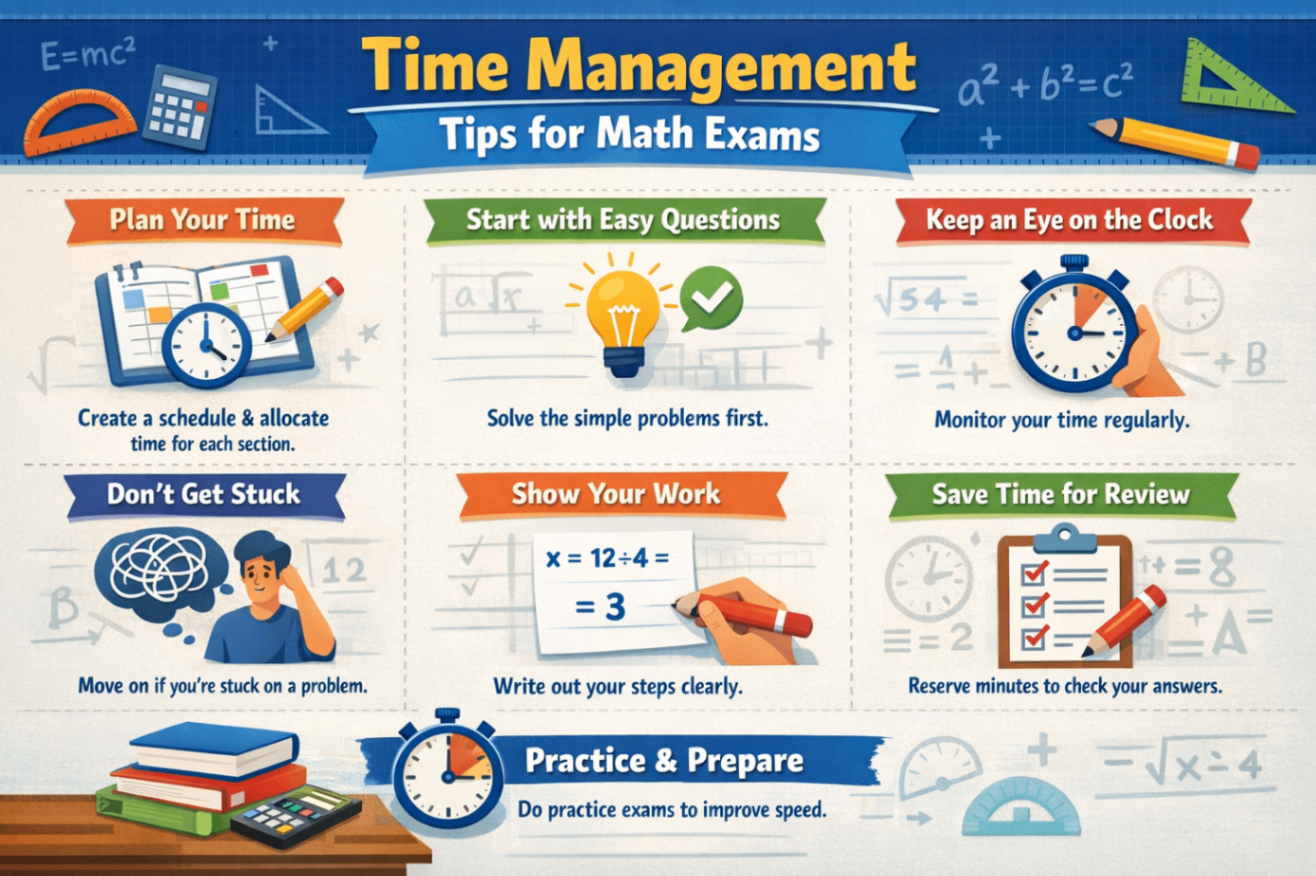
Before starting, calculate exactly how long you can spend per mark. If your exam has one hundred marks and one hundred minutes, you have one minute per mark. Spending six minutes chasing two additional marks costs you four marks elsewhere. Write your time budget at the top of your paper and stick to it.
Preview Difficult Questions During Reading Time
Use any reading time to identify the hardest, most valuable questions rather than starting from question one. Your concentration diminishes as the exam progresses, so mentally strategizing difficult questions early gives you a head start. Even if you cannot solve them during reading time, familiarity reduces cognitive load later.
Conceptualize Before Computing
Take a moment to identify your strategy before diving into calculations. Recognizing that a problem requires the quadratic formula before starting prevents wasted time going down wrong paths. Writing a brief note about your approach helps you stay on track if you get lost in complex working.
Draw Diagrams Whenever Possible
Visual representations put all relevant information on the page rather than requiring you to hold it in working memory. Diagrams help you see relationships between variables and often reveal the path to a solution that words and numbers alone obscure. Even when not required, a quick sketch can unlock seemingly impossible problems.
Take Care of Your Brain and Body
Your cognitive performance depends heavily on physical factors that many students neglect during intense revision. Taking care of yourself is not a luxury but a necessary component of effective preparation.
Protect Your Sleep Non-Negotiably
Your brain consolidates learning during sleep, transferring information from short-term to long-term memory. Pulling an all-nighter impairs recall and reduces problem-solving ability. Six to eight hours of sleep serves your exam performance far better than those same hours spent cramming with an exhausted brain.
Take Strategic Breaks During Revision
Short breaks every twenty-five to fifty minutes of focused study prevent burnout and allow your brain to process what you have learned. Get up, move around, drink water, and briefly disengage from studying before returning with refreshed focus. These pauses are essential components of effective learning, not wasted time. Fuel Your Brain Properly Stay hydrated throughout revision and eat nutritious meals providing steady energy rather than sugar crashes. Nuts, fruits, and protein support sustained cognitive function better than caffeine and candy. On exam day, eat a light meal beforehand to avoid both hunger distraction and post-meal sluggishness.
Manage Anxiety Constructively
Some nervousness before an exam is normal and can enhance performance, but excessive anxiety impairs thinking. Practice deep breathing, remind yourself of your preparation, and maintain perspective. Understanding how to learn math effectively over time reduces the need for last-minute cramming and builds lasting confidence.
Conclusion
Last-minute math revision tips that actually work share common principles: strategic prioritization, active engagement with material, and taking care of the brain that must perform on exam day. While cramming is never ideal, these approaches can genuinely improve your performance when time is short. Focus on high-impact topics, practice problems actively rather than passively reviewing notes, and protect your sleep. Students who perform best under time pressure study smart, not just hard. By prioritizing strategically, using active recall, and approaching the exam with a clear plan, you maximize results from whatever preparation time you have. These techniques serve you not only for tomorrow's test but as foundational skills for future math challenges.
Frequently Asked Questions
How many hours before an exam should I stop studying?
Stop intensive studying at least two to three hours before bedtime to allow your brain to consolidate learning during sleep. Cramming until you collapse reduces sleep quality and impairs next-day recall. On exam morning, a brief review of your formula sheet is fine, but avoid learning new material that could create confusion right before you need to perform.
Should I focus on my strongest or weakest topics when time is limited?
Focus on topics where you are moderately weak but can realistically improve with focused practice. Avoid spending hours on material you already know well or concepts so challenging that meaningful progress is impossible. The goal is maximizing points gained, which often means targeting the middle ground between your strongest and weakest areas.
Is it better to review notes or practice problems with limited time?
Practice problems are significantly more effective than reviewing notes for math exam preparation. Math is a skill developed through doing, and passive rereading creates false confidence. Dedicate the majority of your limited time to actively solving problems, using notes only as references when genuinely stuck.
How can I memorize formulas quickly before an exam?
Write formulas by hand multiple times, create mnemonics, and test yourself through active recall rather than just reading them. Make a formula sheet, set it aside, and try to recreate it from memory to identify gaps. Associate each formula with a specific problem type to build contextual connections that aid retrieval.
What should I do if I feel overwhelmed the night before my math exam?
Step back, take deep breaths, and remind yourself that some preparation is better than none. Prioritize ruthlessly by identifying three to five high-value topics and focusing only on those. Get adequate sleep even if it means studying less, as a well-rested brain significantly outperforms an exhausted one regardless of hours spent cramming.