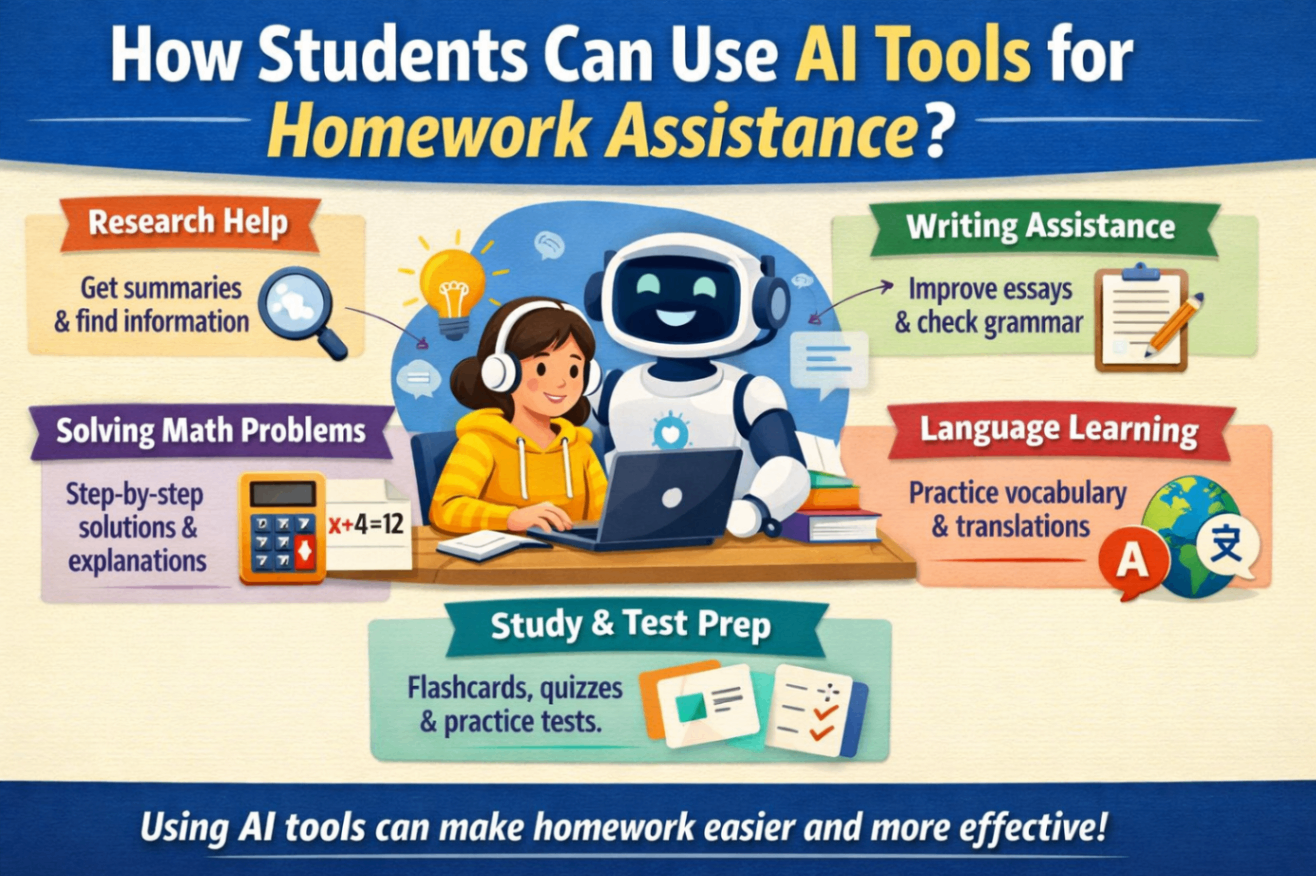
Artificial intelligence has transformed how students approach learning, offering unprecedented access to instant explanations, personalized guidance, and round-the-clock academic support. Understanding how students can use AI tools for homework assistance effectively has become essential knowledge as research shows that 69% of high school students now use AI tools like ChatGPT for schoolwork. This shift represents a fundamental change in educational support resources. The key to success lies in using AI as a learning partner rather than a shortcut that bypasses genuine understanding. When used responsibly, AI tools can help students grasp difficult concepts, receive immediate feedback, and develop stronger study habits. This guide explores practical strategies for leveraging AI assistance across different subjects while maintaining academic integrity and building the skills that matter most for your future.
Understanding AI Homework Tools
Before diving into specific applications, understanding what AI homework tools offer and how they work helps you use them more effectively. These tools have evolved rapidly and now provide sophisticated support across virtually every academic subject.
What AI Homework Helpers Actually Do
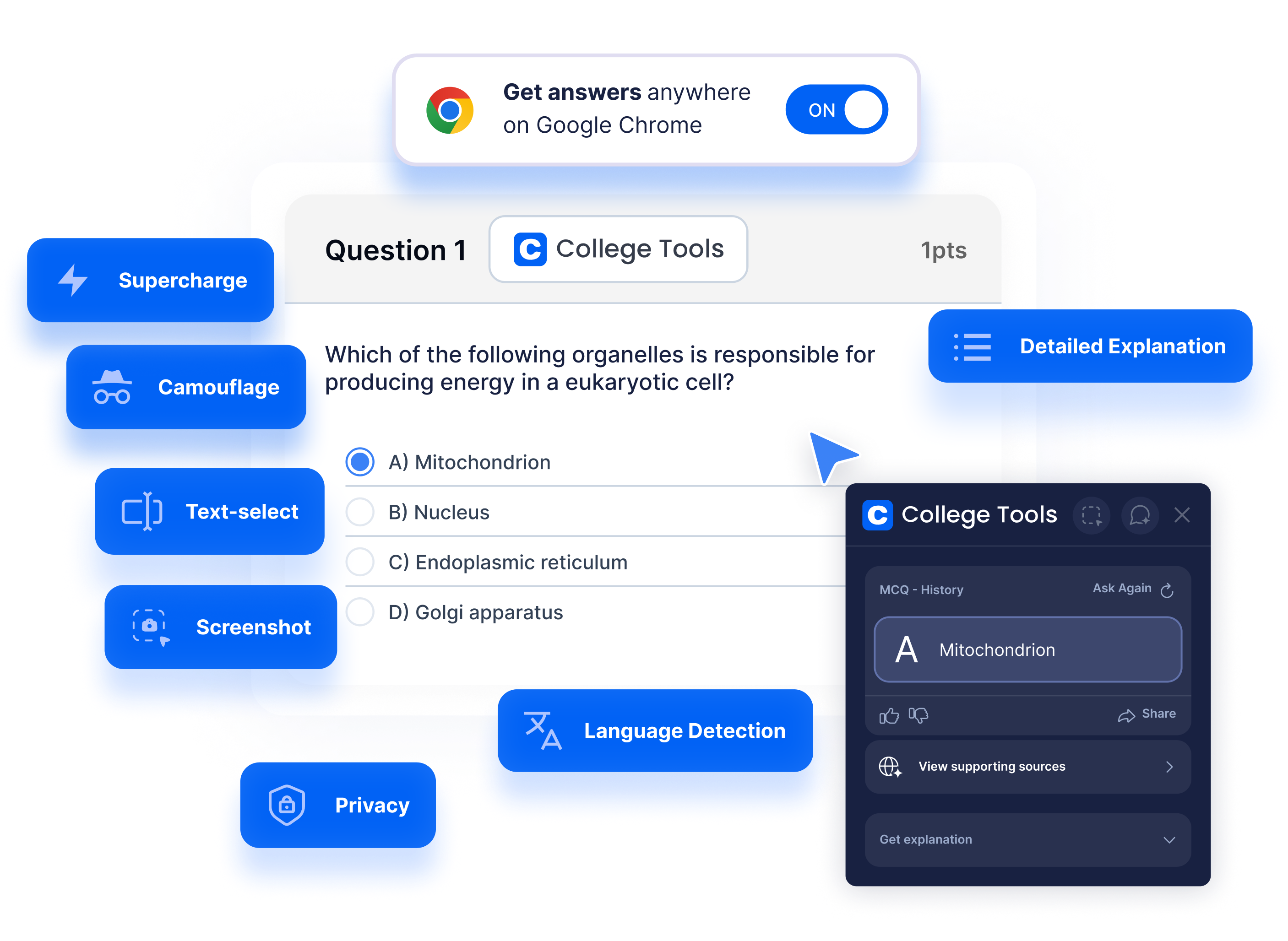
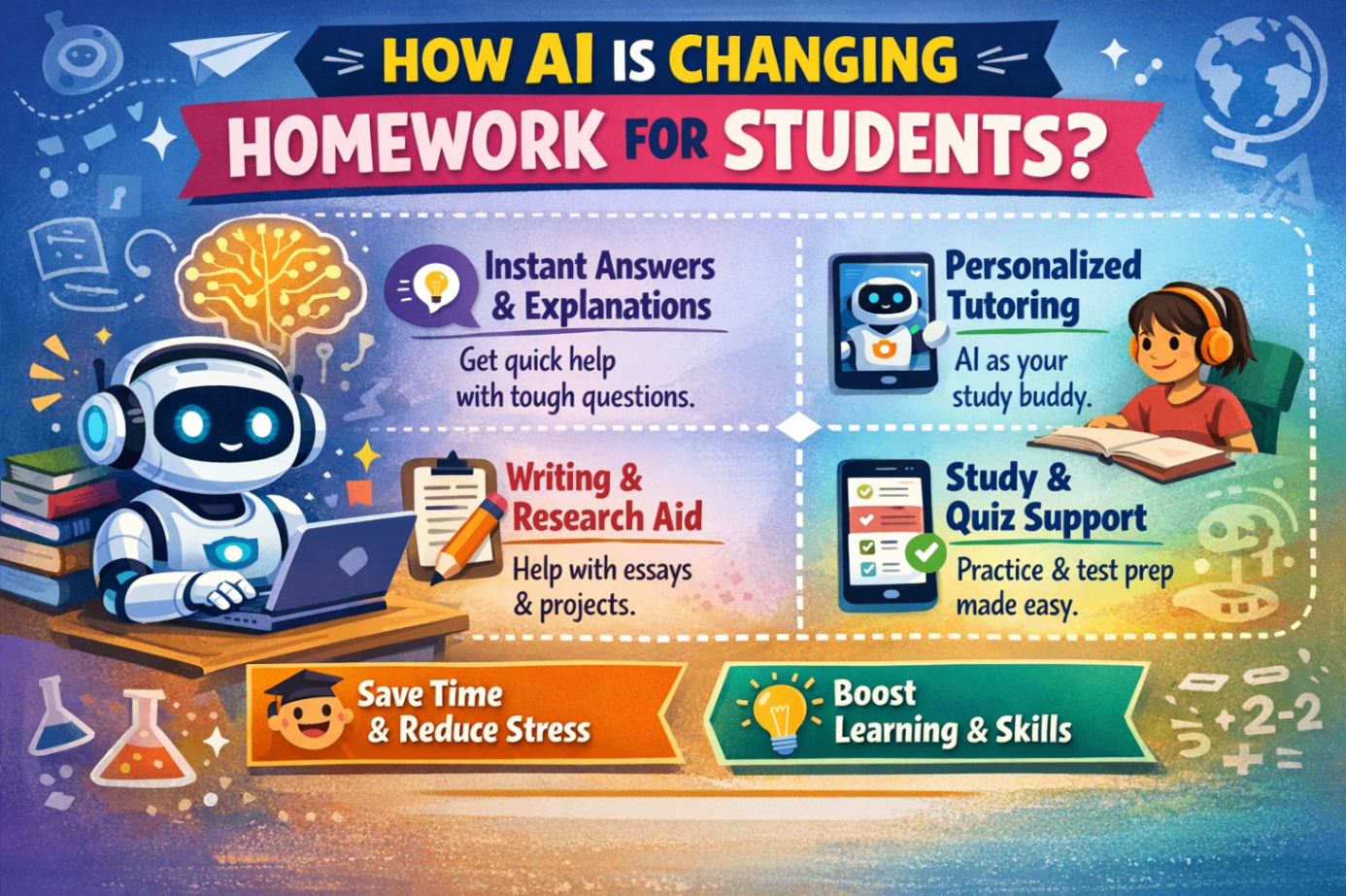
AI homework tools analyze your questions and generate responses using advanced language models trained on vast amounts of educational content. They can solve math problems step-by-step, explain complex scientific concepts, help brainstorm writing ideas, and even generate practice questions. An AI Homework Helper functions like having a patient tutor available whenever you need support with challenging material.
Types of AI Tools Available
Different AI tools specialize in different functions, from general-purpose assistants like ChatGPT and Claude to subject-specific tools like Photomath for mathematics. Some tools offer photo-based problem recognition, allowing you to snap pictures of handwritten problems for instant analysis. Others focus specifically on writing assistance, grammar checking, or generating study materials like flashcards and summaries.
How AI Differs From Traditional Resources
Unlike textbooks or static websites, AI tools provide interactive, personalized responses tailored to your specific questions and learning needs. You can ask follow-up questions, request alternative explanations, and adjust the complexity level until understanding clicks. This dynamic interaction mimics the experience of working with a tutor who adapts to your individual learning style.
Recognizing AI Limitations
AI tools sometimes generate incorrect information confidently, a phenomenon called hallucination that requires your critical evaluation. These tools work best for lower-level cognitive tasks like remembering facts and applying procedures but struggle with higher-order thinking like analysis and evaluation. Understanding these limitations helps you use AI appropriately and verify important information.
Using AI for Math and Science Homework
Mathematics and science subjects often benefit most from AI assistance due to the step-by-step nature of problem-solving in these fields. AI tools can break down complex problems into manageable steps while explaining the reasoning behind each one.
Getting Step-by-Step Solutions
When stuck on a math problem, ask AI to explain the solution process rather than just providing the final answer. Request that each step include the mathematical principle being applied so you understand why certain operations happen. This approach transforms AI from an answer machine into a teaching tool that builds genuine mathematical understanding.
Understanding Scientific Concepts
AI excels at explaining scientific concepts in multiple ways until one explanation resonates with your learning style. If the first explanation does not click, ask for analogies, real-world examples, or simplified versions. You can also request diagram descriptions or ask AI to connect new concepts to topics you already understand well.
Generating Practice Problems
Rather than simply completing assigned problems, use AI to generate additional practice targeting your specific weak areas. Request problems similar to ones you found challenging, then work through them independently before checking your approach. This targeted practice builds skill more efficiently than generic problem sets covering material you already understand.
Checking Your Work
Use AI to verify your solutions and identify where your reasoning went wrong when answers do not match. Ask AI to evaluate your problem-solving approach rather than just confirm whether your answer is correct. This feedback loop helps identify and correct misconceptions before they become ingrained habits.
Leveraging AI for Writing Assignments
Writing assignments benefit from AI assistance throughout the entire process, from brainstorming and outlining to revision and editing. The key is using AI to enhance your own thinking rather than replacing your voice and ideas.
Brainstorming and Idea Generation
When facing a blank page, ask AI to help generate topic ideas, thesis possibilities, or arguments you might explore. Use these suggestions as starting points for your own thinking rather than final products to adopt wholesale. The best approach treats AI brainstorming as a thinking partner that helps unlock your own creativity.
Organizing and Outlining
AI can help structure your ideas into logical outlines that improve the flow and coherence of your writing. Share your thesis and main points, then ask AI to suggest an organizational structure or identify gaps in your argument. This scaffolding support helps you produce better-organized writing while the ideas remain your own.
Getting Feedback on Drafts
Submit rough drafts to AI for feedback on grammar, clarity, structure, and argumentation before seeking teacher input. AI can identify weak transitions, unclear sentences, and unsupported claims that you can then revise yourself. This intermediate feedback step helps you submit stronger work and develops your self-editing skills.
Improving Vocabulary and Style
AI tools can suggest more precise vocabulary, varied sentence structures, and stronger word choices without changing your fundamental ideas. Ask AI to identify repetitive words or phrases and suggest alternatives that maintain your voice. Following Digital Homework Tips for Online Learning Success helps you integrate these tools into effective study routines.
AI for Research and Study Support
Beyond helping with specific assignments, AI tools support the broader learning process through research assistance, study material generation, and knowledge organization.
Summarizing Complex Materials
AI can condense lengthy textbook chapters, articles, or lecture notes into focused summaries highlighting key concepts and relationships. These summaries help you review material efficiently and identify areas requiring deeper study. However, always read original sources for important assignments rather than relying solely on AI summaries.
Creating Custom Study Materials
Generate flashcards, practice quizzes, and study guides tailored to your specific course content and upcoming exams. AI can create questions at varying difficulty levels and even explain why certain answers are correct. This personalized study material targets your actual learning needs rather than generic review content.
Explaining Unfamiliar Terms
When encountering unfamiliar vocabulary or concepts in your reading, ask AI for quick explanations without losing momentum. You can request definitions at different complexity levels depending on how deep an understanding you need. This instant clarification keeps you moving through material rather than getting stuck on terminology.
Connecting Ideas Across Subjects
AI can help you see connections between concepts from different courses or relate new material to things you already know. This cross-subject integration deepens understanding and improves retention by creating multiple mental pathways to the same information. Ask AI to explain how current topics connect to previous learning.
Responsible AI Use and Academic Integrity
Using AI responsibly requires understanding the difference between legitimate learning support and academic dishonesty. Most schools are still developing policies around AI use, making it important to maintain ethical standards.
Understanding What Constitutes Cheating
Having AI complete assignments you submit as your own work typically violates academic integrity policies at most schools. However, using AI to understand concepts, check your work, or generate practice problems generally falls within acceptable use. When uncertain about specific situations, ask your teacher directly about their expectations for AI use.
Being Transparent About AI Assistance
Many educators appreciate when students explain how AI helped them understand concepts rather than hiding its use entirely. Consider documenting your learning process, including what you understood before and after AI assistance. Being able to explain concepts in your own words demonstrates genuine learning regardless of how you achieved that understanding.
Verifying AI-Generated Information
Always cross-check important facts from AI against reliable sources like textbooks, academic websites, or your teacher. AI tools can present incorrect information confidently, making verification essential before relying on AI outputs for assignments. Developing this critical evaluation skill protects you from submitting inaccurate work.
Maintaining Your Own Voice
Even when AI assists with writing, the final product should reflect your thinking, analysis, and unique perspective. Use AI suggestions as starting points that you modify and develop rather than accepting them unchanged. Your assignments should showcase your critical thinking abilities, not demonstrate skill at prompting AI tools.
Conclusion
How students can use AI tools for homework assistance depends entirely on approaching these powerful resources with the right mindset and strategies. When used responsibly, AI can help you understand complex topics, receive immediate feedback, generate personalized practice, and develop stronger learning habits. The students who thrive will embrace AI as a learning partner while maintaining genuine engagement with challenging material. Remember that the goal of homework is building knowledge and skills that serve you beyond any single assignment. AI should amplify your learning rather than replace it, helping you get unstuck faster and understand concepts more deeply. By combining these powerful tools with ethical use and critical thinking, you position yourself for success in education and in a future where AI literacy matters more than ever.
Frequently Asked Questions
Is using AI for homework considered cheating?
Using AI for homework exists on a spectrum from helpful learning tool to academic dishonesty depending on how you use it. Getting explanations, checking your work, or generating practice problems is generally acceptable and beneficial for learning. However, having AI complete assignments you submit as entirely your own work typically violates academic integrity policies. When uncertain about specific situations, asking your teacher directly about their expectations is always the safest approach.
What are the best AI tools for homework help?
Several AI tools serve different homework needs effectively, including ChatGPT and Claude for general assistance, Photomath for mathematics, and Grammarly for writing support. The best choice depends on your specific subject and learning needs, with many students finding success using multiple tools together. Look for tools that explain reasoning step-by-step rather than simply providing answers to maximize learning benefit.
How can I make sure I actually learn when using AI?
Focus on understanding processes rather than just obtaining answers by asking AI to explain why steps are necessary, not just what they are. Work through problems independently first, then use AI to check your approach and identify where your reasoning went wrong. After receiving AI explanations, test your understanding by solving similar problems without assistance to confirm genuine learning occurred.
Will teachers know if I used AI for my homework?
Teachers are becoming increasingly skilled at recognizing AI-generated content through both experience and detection tools designed for this purpose. More importantly, assignments where you relied too heavily on AI often reveal themselves through inconsistencies with your demonstrated classroom abilities. Transparency about appropriate AI use is generally better than attempting to hide assistance that falls within acceptable boundaries.
How much AI help is too much for homework?
The goal is balance where AI supports learning without doing the work entirely, which means you should still struggle productively with challenging material. If you cannot explain your work in your own words or solve similar problems independently, you likely relied too heavily on AI assistance. Use AI to get unstuck and understand concepts, but ensure the final work reflects your genuine understanding and effort.