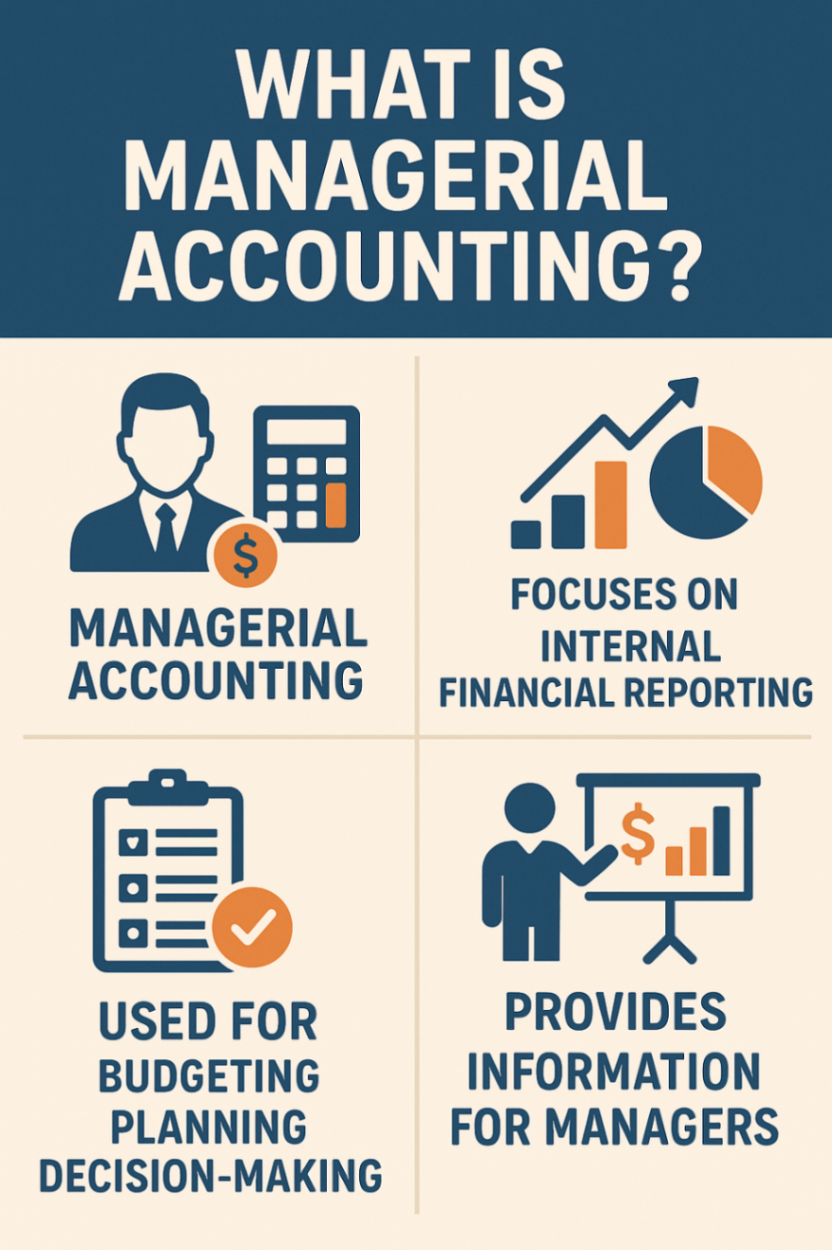
Managerial accounting serves as the backbone of internal business decision-making, providing critical financial insights that drive strategic planning and operational efficiency. Unlike financial accounting, which focuses on external reporting, managerial accounting definition centers on internal processes that help managers make informed choices about resource allocation, budgeting, and performance evaluation. Understanding the purposes of management accounting is essential for anyone looking to grasp how businesses operate behind the scenes. This specialized branch of accounting transforms raw financial data into actionable intelligence that shapes everything from daily operations to long-term strategic initiatives.
Understanding the Managerial Accounting Definition
Managerial accounting, also known as management accounting, is the practice of analyzing and interpreting financial information to support internal business operations. This discipline involves collecting, processing, and communicating financial data that managers use to plan, control, and evaluate business activities. The primary distinction between managerial and financial accounting lies in their audience and purpose. While financial accounting produces standardized reports for external stakeholders like investors and regulators, managerial accounting creates customized reports tailored to specific management needs. These internal reports don't follow strict regulatory guidelines, allowing flexibility in format and content to serve decision-makers effectively. Managerial accountants work closely with department heads and executives to provide real-time financial insights. They analyze costs, forecast future trends, and identify opportunities for improvement. This collaborative approach ensures that financial data directly supports operational goals and strategic objectives.
Why is Managerial Accounting Important for Business Success
The importance of management accounting cannot be overstated in today's competitive business environment. Organizations rely on accurate internal financial information to maintain profitability, optimize resources, and adapt to changing market conditions. One key reason why is managerial accounting important is its role in cost control. By tracking expenses across different departments and projects, managers can identify inefficiencies and implement cost-saving measures. This granular level of analysis helps businesses maintain healthy profit margins even during economic uncertainty. Managerial accounting also facilitates better planning and forecasting. Through budgeting processes and variance analysis, companies can set realistic goals and monitor progress toward achieving them. When actual results deviate from projections, managers receive timely alerts that enable corrective action before small issues escalate into major problems. Performance measurement represents another critical aspect of management accounting's importance. By establishing key performance indicators and benchmarks, organizations can evaluate how well different units are performing. This data-driven approach to assessment removes subjectivity from performance reviews and creates accountability throughout the organization.
Key Managerial Accounting Functions That Drive Results
The functions of management accounting encompass a wide range of activities designed to support managerial decision-making. Each function contributes uniquely to organizational effectiveness and operational excellence.
Cost Accounting and Analysis
Cost accounting forms the foundation of managerial accounting functions. This process involves tracking, recording, and analyzing all costs associated with producing goods or services. Managers use cost data to set prices, determine product profitability, and make decisions about product lines. Understanding fixed versus variable costs helps businesses predict how changes in production volume will affect overall profitability.
Budgeting and Forecasting
Creating comprehensive budgets represents one of the most visible management accounting functions. Budgets serve as financial roadmaps that guide spending decisions and resource allocation throughout the fiscal year. Forecasting extends this concept by projecting future financial performance based on historical trends, market conditions, and strategic initiatives. Together, these tools help organizations prepare for various scenarios and allocate resources efficiently.
Performance Analysis and Reporting
Regular performance reporting keeps stakeholders informed about operational results. Managerial accountants prepare detailed reports that compare actual performance against budgets and benchmarks. These reports highlight areas of concern and success, enabling managers to celebrate achievements and address shortfalls. The reporting function also includes creating dashboards and visualizations that make complex financial data accessible to non-financial managers.
Strategic Planning Support
Modern managerial accounting extends beyond traditional bookkeeping to support strategic decision-making. Accountants participate in planning sessions, providing financial perspectives on proposed initiatives. They conduct feasibility studies, calculate return on investment for capital projects, and assess the financial implications of strategic alternatives. This forward-looking function ensures that strategy aligns with financial reality.
Core Objectives of Management Accounting
The objectives of management accounting revolve around providing information that enhances organizational performance. These objectives guide the development of accounting systems and processes that deliver maximum value to decision-makers. Planning represents a primary objective, as management accounting provides the financial foundation for setting goals and developing action plans. Through detailed analysis of past performance and current trends, accountants help managers establish realistic targets and identify resources needed to achieve them. Controlling costs and operations stands as another essential objective. Management accounting creates systems that monitor spending, track efficiency, and flag deviations from expected performance. This control function prevents waste and ensures that operations proceed according to plan. Decision support constitutes perhaps the most critical objective of management accounting. Whether managers are evaluating new product launches, considering expansion opportunities, or deciding between suppliers, they need reliable financial analysis. Management accountants provide the quantitative foundation that complements qualitative factors in decision-making processes. Motivating employees through performance measurement also ranks among key objectives. When paired with appropriate compensation systems, management accounting metrics can drive desired behaviors and align individual efforts with organizational goals.
How Management Accounting Integrates With Other Business Functions
Management accounting doesn't operate in isolation but rather integrates deeply with other business functions. This integration enhances the value that accounting information provides across the organization. In operations management, managerial accounting helps optimize production processes by analyzing efficiency metrics and identifying bottlenecks. Production managers rely on cost data to make decisions about batch sizes, equipment purchases, and process improvements. Just as understanding what is equity in accounting helps clarify ownership structure, grasping operational costs clarifies production economics. Marketing departments utilize management accounting insights to evaluate campaign effectiveness and customer profitability. By analyzing the costs and revenues associated with different customer segments, marketers can focus resources on the most profitable opportunities. Pricing decisions also depend heavily on cost information provided by managerial accountants. Human resources benefits from management accounting through workforce planning and compensation analysis. Understanding labor costs and productivity metrics helps HR professionals make informed decisions about staffing levels, training investments, and incentive programs. For students and professionals seeking to deepen their understanding of accounting principles, tools like the Accounting AI Solver can provide valuable assistance with complex calculations and concept clarification.
Conclusion
Managerial accounting serves as an indispensable tool for modern business management, transforming financial data into strategic insights that drive organizational success. From cost analysis and budgeting to performance measurement and strategic planning, the functions of management accounting touch every aspect of business operations. The importance of management accounting continues to grow as businesses face increasingly complex challenges and competitive pressures. By understanding these principles and objectives, managers can leverage financial information to make better decisions, improve efficiency, and achieve sustainable growth.
Frequently Asked Questions
What is the primary difference between managerial and financial accounting?
The primary difference lies in their audience and purpose. Financial accounting produces standardized reports for external stakeholders like investors and regulators, following strict guidelines such as GAAP. Managerial accounting creates customized internal reports for managers to support decision-making, with flexibility in format and no regulatory requirements to follow.
What are the main functions of management accounting in a business?
The main functions include cost accounting and analysis, budgeting and forecasting, performance analysis and reporting, and strategic planning support. These functions help managers control costs, plan for the future, measure performance against goals, and make informed strategic decisions about resource allocation and business direction.
Why is managerial accounting important for small businesses?
Managerial accounting is crucial for small businesses because it provides insights into profitability, helps control costs, and supports better decision-making with limited resources. Small businesses can use management accounting to identify which products or services are most profitable, optimize pricing strategies, and plan for growth while maintaining financial stability.
How does managerial accounting support strategic decision-making?
Management accounting supports strategic decisions by providing financial analysis for various alternatives, conducting feasibility studies, calculating return on investment for proposed projects, and forecasting the financial impact of different strategies. This quantitative information helps executives evaluate options objectively and choose paths that align with organizational goals and financial capabilities.
What skills are required to work in managerial accounting?
Managerial accountants need strong analytical skills to interpret financial data, proficiency in accounting software and spreadsheet applications, understanding of business operations beyond just accounting, communication skills to present findings to non-financial managers, and strategic thinking ability to connect financial information with business decisions. Knowledge of statistical analysis and forecasting techniques is also valuable.