Table of contents
- Understanding Why Your Current Approach Isn't Working
- How to Get Better Grades in High School: Building Strong Foundations
- How to Get Better Grades in Middle School: Developing Essential Skills
- How to Get Better Grades in College: Mastering Advanced Strategies
- How to Get Better Grades in Math: Conquering Numbers and Formulas
- How to Get Better Grades in Science: Mastering Scientific Thinking
- How to Get Better Grades in English: Excelling in Reading and Writing
- Essential Study Techniques That Work Across All Subjects
- Time Management: The Secret to Consistent Academic Success
- Building Productive Relationships With Teachers and Instructors
- The Power of Organization in Academic Achievement
- Maintaining Physical and Mental Wellness for Academic Success
- Developing a Growth Mindset for Continuous Improvement
- Conclusion
Academic success doesn't happen by accident. Whether you're wondering how to get better grades in middle school or searching for strategies to excel in college, the principles remain consistent: smart study habits, effective time management, and consistent effort applied strategically. This comprehensive guide provides actionable techniques that work across all grade levels and subjects, helping you transform your academic performance. Many students spend hours studying without seeing meaningful improvement in their grades. The problem isn't effort—it's approach. Students who consistently earn high marks understand that success comes from working smarter, not just harder. By implementing the research-backed strategies outlined in this guide, you'll maximize your learning efficiency while minimizing wasted time and frustration.
Understanding Why Your Current Approach Isn't Working
Before exploring solutions, it's essential to diagnose why traditional study methods often fall short. Most students equate studying with passive activities like rereading textbooks or reviewing notes without active engagement. This creates familiarity with material rather than true mastery, explaining why you might feel prepared but perform poorly on tests. Another common obstacle involves poor time management. Procrastination leads to last-minute cramming sessions that produce stress without promoting genuine learning or retention. Even students who start early sometimes waste time on low-impact activities that don't translate into better test performance. Lack of organization also undermines academic success. When you can't find assignments, miss deadlines, or forget about upcoming tests, even your best efforts won't produce the grades you deserve. Disorganization creates unnecessary stress and prevents you from demonstrating your true capabilities. Understanding these common pitfalls helps you avoid them. The strategies that follow address these fundamental issues, providing concrete alternatives that actually work.
How to Get Better Grades in High School: Building Strong Foundations
High school represents a critical transition period where academic expectations increase significantly. Learning how to get better grades in high school sets you up for college success and opens doors to scholarships and opportunities.
Attend Classes Consistently and Come Prepared
Start by treating every class with respect, even subjects you find boring or challenging. Your GPA reflects performance across all courses, not just your favorites. Attend every class, arrive on time, and come prepared with completed homework and necessary materials. Regular attendance and preparation demonstrate commitment while ensuring you don't miss crucial information.
Master Strategic Note-Taking Techniques
Take strategic notes rather than attempting to transcribe everything verbatim. Focus on capturing key concepts, examples that clarify difficult ideas, and information your teacher emphasizes through repetition or explicit statements about importance. Effective note-taking represents a universal characteristic of straight-A students, yet many students never learn this essential skill.
Review Notes Within 24 Hours
Review your notes within 24 hours of taking them. This brief review session—just 10-15 minutes per class—dramatically improves retention by reinforcing information while it's still fresh. During review, reorganize confusing sections, fill in gaps, and highlight key concepts you'll need for tests.
Participate Actively in Class
Participate actively in class discussions and activities. Formulating and expressing your thoughts forces deeper cognitive processing than passive listening. When you contribute to discussions, you create additional memory pathways that support retention. Don't worry about sounding perfect—thoughtful participation matters more than flawless answers.
How to Get Better Grades in Middle School: Developing Essential Skills
Middle school introduces increased academic rigor while students navigate social and developmental changes. Learning how to get better grades in middle school involves developing foundational skills that serve you throughout your educational journey.
Create Organizational Systems That Work
Organization becomes crucial in middle school as you juggle multiple teachers, subjects, and expectations. Use a planner or digital calendar to track assignments, test dates, and project deadlines. Maintaining organized systems for tracking homework and tests helps prevent last-minute rushing. Color-code your materials by subject—different folders, notebooks, and supplies for each class—making it easy to grab what you need.
Establish Consistent Homework Routines
Establish a consistent homework routine. Designate specific times and places for completing assignments, transforming homework from a sporadic activity into a predictable habit. This consistency reduces resistance and procrastination since your brain anticipates the work session.
Ask Questions Without Hesitation
Don't hesitate to ask questions when confused. Middle school teachers expect questions as students encounter increasingly complex material. Asking questions benefits not only you but classmates who share your confusion. Approach teachers during class, after school, or via email with specific questions rather than vague requests for help.
Start Long-Term Projects Early
Start projects and long-term assignments immediately rather than waiting until the deadline approaches. Break large tasks into smaller, manageable steps with self-imposed deadlines for each stage. This approach prevents overwhelming last-minute panic while producing higher-quality work.
How to Get Better Grades in College: Mastering Advanced Strategies
College academics demand greater independence, deeper thinking, and more sophisticated study approaches. Understanding how to get better grades in college requires adapting high school strategies while developing new skills for this challenging environment.
Attend Lectures and Engage From Day One
Attend every lecture and actively engage with material from the beginning of the semester. Success in college stems from effective time management, active participation, engagement with professors, and solid study habits. College professors rarely remind you about assignments or upcoming exams—you must track deadlines independently.
Read Strategically for Maximum Efficiency
Read strategically rather than attempting to absorb every word of dense textbooks. Preview chapters by scanning headings, introductions, and summaries before deep reading. This creates a mental framework that helps you identify and focus on essential information. After reading, summarize key points without looking at the text to test your understanding.
Leverage Professor Office Hours
Utilize professor office hours strategically. Come prepared with specific questions about concepts you find confusing or assignments you're working on. This demonstrates initiative while providing personalized instruction that clarifies difficult material. Building relationships with professors also creates networking opportunities and potential recommendation sources.
Form Productive Study Groups
Form or join study groups with committed classmates. Collaborative learning exposes you to different perspectives and approaches while providing accountability. However, ensure group sessions remain focused on academic work rather than social conversation. Set clear agendas and time limits to maximize productivity.
How to Get Better Grades in Math: Conquering Numbers and Formulas
Mathematics frustrates many students, but understanding how to get better grades in math transforms this challenging subject into a conquerable obstacle. Math requires different strategies than memorization-heavy subjects.
Practice Consistently, Not Just Before Tests
Practice consistently rather than cramming before tests. Mathematical proficiency develops through regular engagement, not last-minute study sessions. Work through problems daily, even when no assignment is due. This continuous practice builds fluency and confidence with mathematical processes.
Focus on Understanding Concepts
Focus on understanding concepts rather than memorizing procedures. When you understand why mathematical processes work, you can apply them flexibly to various problems. If you find yourself memorizing steps without understanding the underlying logic, stop and seek clarification before proceeding.
Work Through Examples Step-by-Step
Work through example problems step-by-step, writing out each stage of your reasoning. This practice helps you internalize problem-solving processes and makes identifying errors easier. Don't just copy solutions—close examples and attempt to recreate processes independently to ensure genuine understanding.
Address Knowledge Gaps Immediately
Address knowledge gaps immediately since mathematics builds cumulatively. If you struggle with current material, the issue likely traces back to incomplete mastery of prerequisite concepts. Identify and remediate these foundational gaps rather than hoping they won't matter. Tools like Homework AI can provide step-by-step explanations that clarify confusing concepts.
How to Get Better Grades in Science: Mastering Scientific Thinking
Science courses combine conceptual understanding with factual knowledge and practical application. Learning how to get better grades in science requires balancing these elements effectively.
Understand Fundamental Principles First
Start by understanding fundamental principles that govern specific phenomena. Memorizing facts without understanding underlying concepts produces shallow knowledge that crumbles under exam pressure. When you grasp core principles, you can derive specific facts and apply knowledge to novel situations.
Connect Abstract Concepts to Real Examples
Connect abstract concepts to concrete examples and real-world applications. When you understand how principles manifest in observable phenomena, concepts become more memorable and meaningful. Draw diagrams, create flowcharts, and develop analogies that make abstract ideas tangible.
Engage Fully With Laboratory Work
Engage fully with laboratory work and demonstrations. These hands-on experiences provide invaluable learning opportunities beyond lectures and textbooks. Understand not just what happens but why it happens. These experiences create memorable associations that strengthen retention of related concepts.
Master Scientific Terminology
For courses with extensive terminology, create flashcards that test you bidirectionally—term to definition and definition to term. Review these regularly using spaced repetition principles, focusing extra attention on terms you find challenging. Scientific vocabulary opens doors to understanding complex concepts described using those terms.
How to Get Better Grades in English: Excelling in Reading and Writing
English and language arts courses require different skills than STEM subjects, but systematic approaches still produce better results. Understanding how to get better grades in English involves developing critical reading, analytical thinking, and effective writing skills.
Read Actively With Annotation
Read assigned texts actively rather than passively scanning words. Annotate as you read—highlight key passages, write marginal notes summarizing paragraphs, and pose questions about confusing sections. These annotations transform passive reading into engaged analysis while creating excellent review materials.
Analyze Literary Techniques
Analyze literary devices and techniques rather than just summarizing plots. Teachers assign literature to develop analytical skills, not test plot memorization. Identify how authors use symbolism, metaphor, characterization, and structure to convey meaning. Practice explaining how specific techniques contribute to overall themes or messages.
Start Writing Assignments Early
Start writing assignments early to allow time for multiple drafts. First drafts rarely represent your best work—plan time for revision where you refine arguments, improve clarity, and polish language. Read your work aloud to catch awkward phrasing and grammatical errors that your eyes might skip when reading silently.
Expand Your Vocabulary Intentionally
Develop your vocabulary intentionally by noting unfamiliar words during reading and looking up their meanings. Understanding sophisticated vocabulary improves both reading comprehension and writing quality. Use new words in your own writing to internalize their meanings and appropriate contexts.
Essential Study Techniques That Work Across All Subjects
Certain study strategies prove effective regardless of subject matter. These universal techniques form the foundation of academic success for students wondering how to get better grades in school.
Practice Active Recall
Practice active recall by testing yourself rather than simply reviewing material. Close your notes and attempt to write down everything you remember about a topic. This retrieval practice strengthens memory pathways more effectively than passive review. When you struggle to recall information, you've identified areas needing additional study.
Implement Spaced Repetition
Implement spaced repetition by reviewing material at increasing intervals over time. Review new information within 24 hours, then again after three days, one week, two weeks, and one month. This approach exploits how your brain naturally consolidates memories, producing stronger long-term retention than cramming.
Use the Feynman Technique
Use the Feynman Technique to ensure deep understanding. Explain concepts in simple language as if teaching someone with no background knowledge. If you struggle to explain something simply, you've identified gaps in your understanding requiring further study. This technique reveals the difference between surface familiarity and genuine mastery.
Create Practice Tests
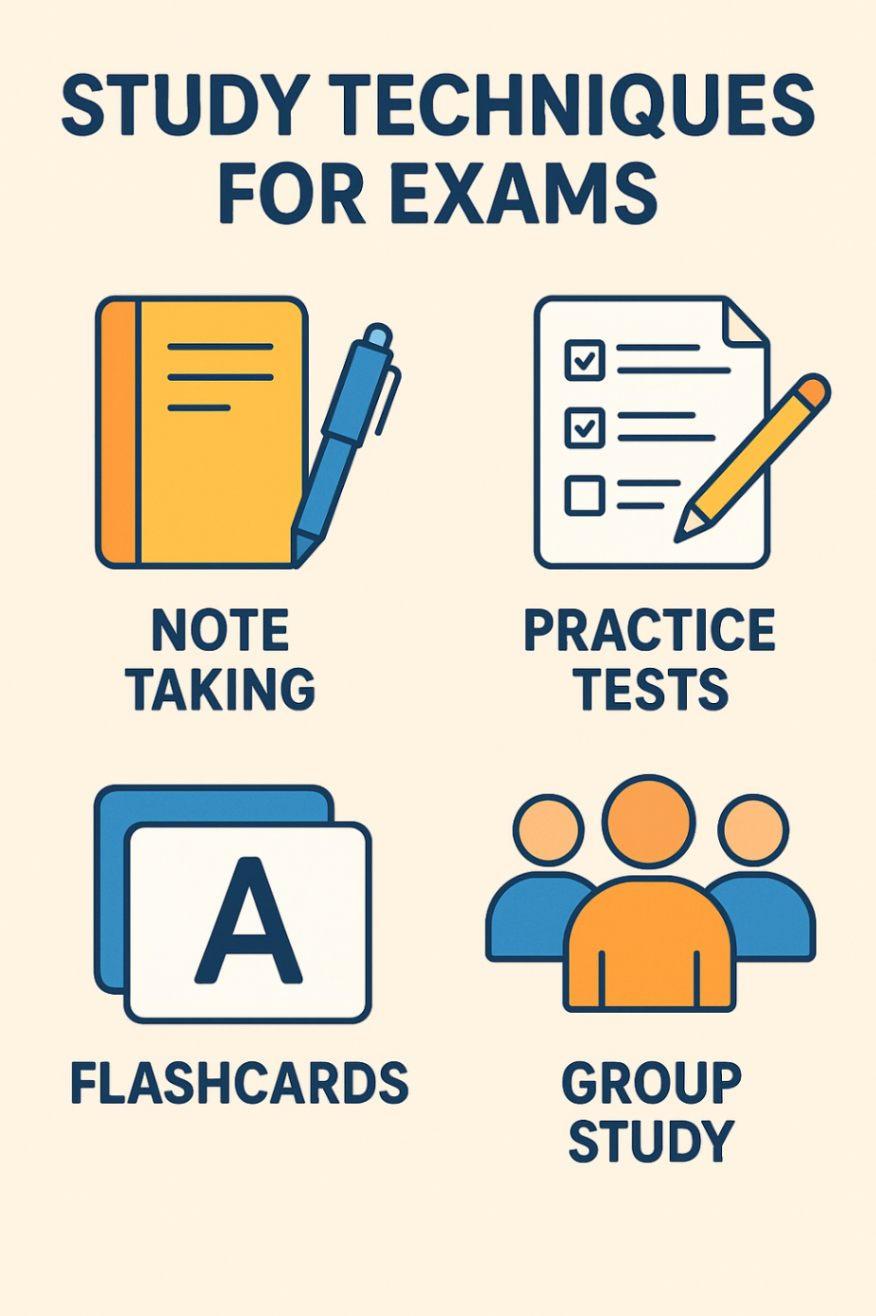
Create practice tests and work through them under timed conditions. This approach prepares you for actual test conditions while revealing areas needing additional attention. Analyze your performance to identify patterns in mistakes—do you lose points from careless errors, conceptual gaps, or time management issues? For comprehensive preparation strategies, explore proven study techniques for exams that complement these grade improvement methods.
Time Management: The Secret to Consistent Academic Success
Effective time management separates students who consistently earn high grades from those who struggle despite intelligence and effort. Mastering these skills is essential for anyone learning how to get better grades in school.
Create Weekly Study Schedules
Creating study schedules helps manage time and prevents cramming by breaking learning into small, manageable chunks. Each Sunday, review the coming week's commitments and allocate specific time blocks for coursework, studying, and assignments. This planning identifies your highest priorities and ensures adequate time for challenging subjects.
Apply the Pomodoro Technique
Use the Pomodoro Technique to maintain focus during study sessions. Work for 25 minutes with complete concentration, then take a 5-minute break. This rhythm maintains high performance while preventing mental fatigue from marathon sessions. During each interval, eliminate all distractions—silence your phone, close unnecessary browser tabs, and commit fully to the task.
Prioritize High-Impact Activities
Prioritize ruthlessly by focusing energy on high-impact activities. Not all assignments carry equal weight, and not all study activities produce equal results. Tackle the most important or difficult tasks when your energy and focus are highest, leaving routine work for low-energy periods.
Break Large Projects Into Milestones
Break large projects into smaller milestones with self-imposed deadlines for each stage. Starting early and setting checkpoints prevents procrastination while producing higher-quality final products. This approach also reduces overwhelming feelings that trigger procrastination.
Building Productive Relationships With Teachers and Instructors
Your instructors represent invaluable resources in your quest for better grades, yet many students underutilize this support. Building positive relationships with teachers enhances your academic experience while demonstrating professional behaviors valued in all settings.
Seek Help Proactively
Don't wait until after failing a test to seek help—approach teachers proactively when you first encounter confusion. Early intervention allows you to address problems before they compound, often preventing poor test performance entirely. Teachers appreciate students who take initiative in their learning.
Prepare Specific Questions
Prepare specific questions when seeking help rather than vague requests like "I don't understand anything." Review material independently first, identify exactly where your understanding breaks down, and formulate concrete questions. This preparation shows respect for teachers' time while enabling more productive conversations.
Participate Thoughtfully in Class
Participate appropriately in class to demonstrate engagement. You don't need to dominate discussions, but regular contributions show investment in learning. Even incorrect answers represent learning opportunities that may help you understand material better. Teachers value thoughtful participation over perfect answers.
Request Feedback on Graded Work
Request feedback on graded work to understand how to improve. Many students simply check grades without analyzing what led to point deductions. Reviewing assessments with teachers helps you understand expectations and identify patterns in mistakes, leading to improved future performance.
The Power of Organization in Academic Achievement
Organization might seem mundane, but it profoundly impacts academic performance. Cultivating organizational habits helps you succeed not just in your current studies but provides benefits that extend into college and beyond.
Maintain Separate Materials for Each Subject
Maintain separate materials for each subject—dedicated notebooks, folders, and supplies clearly labeled and organized. This system prevents the common problem of frantically searching for materials when you need them. Color-coding by subject provides visual cues that make organization more intuitive.
Keep a Master Calendar
Keep a master calendar or planner tracking all assignments, tests, projects, and commitments across all courses. Review this overview regularly to anticipate busy periods and plan accordingly. Digital calendars work well for some students, while others prefer physical planners—choose whichever system you'll actually use consistently.
Organize Your Notes Effectively
Mark the beginning of each new unit or chapter clearly in your notes. This organization makes reviewing for cumulative exams much easier since you can quickly locate specific content. Include dates so you can track the pacing of course material.
Create Designated Study Spaces
Create designated study spaces at home with all necessary materials organized and accessible. Searching for textbooks, notes, or supplies interrupts workflow and wastes time. A few minutes of preparation prevents numerous small disruptions that collectively destroy productivity.
Maintaining Physical and Mental Wellness for Academic Success
Academic performance doesn't exist in isolation from physical and mental health. Students who sacrifice wellness for extra study time often see diminishing returns as their overall performance suffers.
Prioritize Sleep Above All Else
Establish regular sleep schedules with 8 hours nightly, as sleep is crucial for studying, learning, and achieving good grades. Sleep deprivation impairs memory consolidation, cognitive function, and emotional regulation. All-night study sessions are counterproductive—you'll retain less and perform worse than if you'd slept adequately.
Exercise Regularly for Better Focus
Regular exercise boosts concentration and alertness while reducing stress. Even 20-30 minutes of moderate activity daily improves brain function by increasing blood flow and promoting neuroplasticity. Schedule exercise as non-negotiable maintenance, not optional activity to skip when busy.
Maintain Proper Nutrition
Eat regular, nutritious meals that support stable energy and concentration. Avoid excessive caffeine, which can disrupt sleep patterns and increase anxiety. Stay hydrated throughout the day—even mild dehydration impairs focus and memory.
Practice Stress Management
Practice stress-management techniques like deep breathing, meditation, or journaling. Academic pressure naturally creates stress, but chronic stress impairs performance and damages health. Developing healthy coping mechanisms helps you navigate challenges without becoming overwhelmed.
Developing a Growth Mindset for Continuous Improvement
Your beliefs about learning and ability profoundly influence academic outcomes. Students with growth mindsets—who believe skills develop through effort—consistently outperform those with fixed mindsets who view ability as unchangeable.
View Challenges as Growth Opportunities
View challenges as opportunities to develop skills rather than evidence of limitations. When you struggle with material, that difficulty indicates you're learning and growing, not that you lack ability. This perspective transforms frustration into motivation and persistence.
Learn From Mistakes
Treat mistakes as valuable feedback rather than failures. Every error reveals gaps in understanding or application, giving you specific areas to improve. Rather than letting poor grades discourage you, view them as chances to learn and improve.
Celebrate Effort and Progress
Celebrate effort and progress rather than only final outcomes. Recognize when you've worked hard, implemented effective strategies, or persisted through difficulties. This acknowledgment builds intrinsic motivation that sustains you through inevitable challenges.
Seek Help When Needed
Seek help when needed rather than viewing it as weakness. Everyone struggles sometimes, and successful students recognize when they need support. Tutoring, study groups, teacher office hours, and academic resources exist to help you succeed—using them demonstrates wisdom, not inadequacy.
Conclusion
Learning how to get better grades requires commitment to implementing effective strategies consistently over time. Whether you're navigating middle school, mastering high school academics, excelling in college, or conquering challenging subjects like math, science, or English, the fundamental principles remain constant: active learning, effective time management, consistent effort, and strategic approaches tailored to your needs. Start by implementing one or two techniques from this guide, building them into sustainable habits before gradually adding more strategies. Remember that improvement takes time, setbacks provide learning opportunities, and persistence combined with smart strategies produces results. With patience and dedication to these proven approaches, you can achieve the academic performance you desire while developing skills that benefit you far beyond the classroom.
Frequently Asked Questions
How long does it take to see grade improvements after implementing new strategies?
Most students notice improvements within 3-4 weeks of consistently applying effective study techniques and organizational habits. Initial changes might be subtle—better understanding during class, improved quiz performance, or reduced study time for equivalent comprehension. Significant grade increases typically appear on the next major exam or grading period after you've maintained new habits consistently.
Can I improve my grades in just one subject without affecting others?
Yes, you can focus improvement efforts on specific subjects by allocating more time and applying targeted strategies to challenging areas while maintaining your current approach in subjects where you're performing well. However, many universal strategies like better time management and active learning techniques naturally benefit all subjects when implemented, often producing broader improvements than initially intended.
What should I do if I'm currently failing a class?
Act immediately rather than hoping the situation improves spontaneously. Meet with your teacher to discuss your standing and develop a concrete improvement plan. Identify specific knowledge gaps by reviewing past assessments and assignments. Consider tutoring for particularly challenging subjects. Focus remaining coursework on demonstrating mastery, complete all assignments on time, and communicate proactively if circumstances beyond academics affect your performance.
How can I balance getting better grades with extracurricular activities and social life?
Effective time management makes balancing multiple commitments possible. Prioritize ruthlessly by focusing on highest-impact activities in all areas. Use efficient study techniques that produce better results in less time. Schedule specific blocks for academics, activities, and social time, treating each commitment seriously. The discipline learned through balancing multiple priorities often improves focus during available study time, sometimes leading to better results despite appearing to have less time.
Is it possible to get better grades in subjects I find boring or difficult?
Absolutely. While genuine interest helps, systematic strategies work even for subjects you dislike. Connect material to your interests or future goals when possible, making content personally relevant. Break studying into smaller sessions to maintain focus despite lack of enthusiasm. Use varied learning methods to add engagement—videos, discussions, practical applications. Reward yourself after completing work in difficult subjects. Remember that not all learning is immediately enjoyable, but effort invested now often proves valuable later.