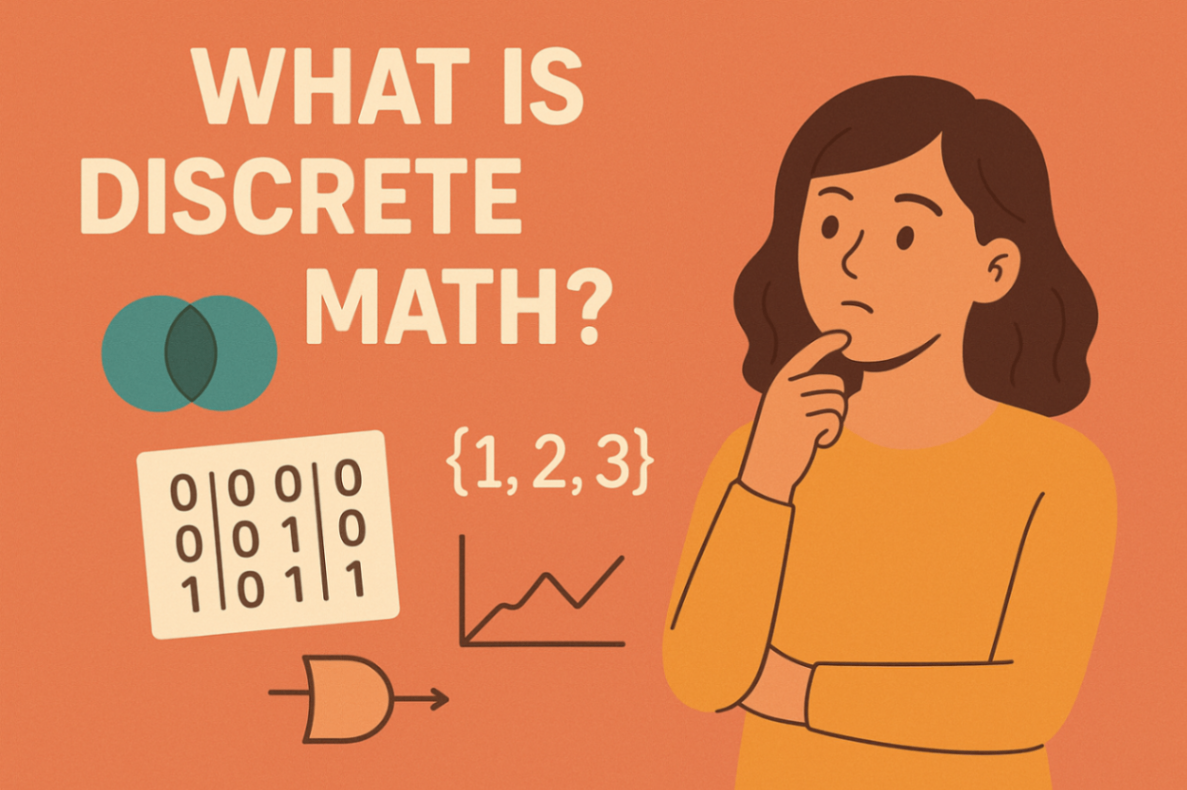
If you've ever wondered what is discrete math and why it matters in today's digital world, you're not alone. Discrete mathematics is a fascinating branch of mathematics that deals with distinct, separate values rather than continuous ranges. Unlike calculus or algebra where you work with smooth curves and infinite decimals, discrete math focuses on countable, individual elements that form the backbone of computer science, cryptography, and data analysis.
What Is Discrete Math and How Is It Different?
Discrete mathematics is the study of mathematical structures that are fundamentally countable and distinct. To understand what discrete math truly means, think about the difference between counting people in a room versus measuring the temperature. You can have 5 or 6 people, but never 5.73 people—these are discrete values. Temperature, on the other hand, can be any value on a continuous scale. When examining what is discrete math in practice, consider how it differs from continuous mathematics. In a typical algebra class, you might work with intervals like [0, ∞) representing all real numbers from zero to infinity. Between any two numbers in this set, there are infinitely many more numbers. Discrete math, however, deals with sets like {0, 1, 2, 3, 4}, where each element is separate and distinct. This fundamental distinction makes discrete mathematics especially valuable for computer programming, where everything ultimately reduces to binary digits—discrete 0s and 1s.
Core Topics in Discrete Mathematics
Understanding what discrete math encompasses requires exploring its main components. This field includes several interconnected topics that form a comprehensive framework for solving real-world problems.
Combinatorics: The Art of Counting
Combinatorics explores the theory of how things combine and, more specifically, how to count different arrangements and selections. This includes permutations, combinations, and the pigeonhole principle. For instance, if you're planning seating arrangements for 10 guests at a dinner party, combinatorics helps you calculate how many different arrangements are possible.
Graph Theory and Networks
Graph theory studies connections between objects, represented as vertices (points) and edges (lines connecting them). This topic has practical applications in social networks, transportation systems, and computer networks. A classic discrete math problem asks: can five towns each build roads to every other town without any roads crossing? This is a fundamental question in graph theory.
Logic and Proofs
Symbolic logic forms the foundation of mathematical reasoning and computer programming. Understanding logical statements, truth tables, and proof techniques is essential for both theoretical mathematics and practical software development. Logic helps establish whether statements are true or false using rigorous mathematical methods.
Sequences and Number Theory
Discrete math examines sequences of numbers that follow specific patterns. For example, if contestants in a competition eat 1, 3, 5, 7 hot dogs respectively (each eating two more than the previous person), you can use discrete mathematics to determine how many hot dogs the 26th contestant would eat. Number theory, which studies properties of integers, is another crucial component that connects to cryptography and computer security.
Real-World Applications of Discrete Math
Now that we've explored what discrete math is conceptually, let's examine where you encounter it in everyday life. The applications are more widespread than you might imagine. Computer scientists use discrete mathematics constantly. Algorithms that power your favorite apps, database structures, and encryption methods all rely on discrete math principles. When you're working with what are terms in math, understanding discrete structures becomes particularly important for computational thinking. In network design, whether designing the internet's architecture or planning delivery routes, graph theory provides essential tools. Social media platforms use discrete math to suggest friends, detect communities, and optimize content delivery. Cryptography and cybersecurity depend heavily on number theory and combinatorics. Every time you make a secure online transaction, discrete mathematics protects your information through complex encryption algorithms.
Why Study Discrete Mathematics?
Understanding what discrete math offers goes beyond academic curiosity. This field develops critical problem-solving skills and logical thinking abilities that transfer to numerous careers. For students pursuing computer science, discrete mathematics is often a required course because it provides the theoretical foundation for programming and algorithm design. Even if you're not becoming a mathematician, the analytical skills you develop prove invaluable in data analysis, business intelligence, and strategic planning. The rise of artificial intelligence and machine learning has made discrete math more relevant than ever. These technologies rely on graph algorithms, optimization techniques, and logical reasoning—all core components of discrete mathematics. If you're looking for additional support with discrete math concepts and problem-solving, tools like [Discrete Math AI] (https://www.mindko.com/free-solver/discrete-math) can help you master challenging topics and verify your solutions.
Getting Started with Discrete Math
Beginning your journey into discrete mathematics doesn't have to be overwhelming. Start by familiarizing yourself with basic counting principles and work your way up to more complex topics like proofs and graph algorithms. Practice with real problems that have practical applications. Instead of abstract exercises, think about questions like: "How many different passwords can I create with specific requirements?" or "What's the most efficient way to visit multiple locations?" These scenarios make discrete math concepts tangible and memorable. Many students find discrete mathematics more intuitive than calculus because the concepts often relate to everyday counting and logical reasoning. The distinct, separate nature of the elements makes visualization easier compared to abstract continuous functions.
Conclusion
Discrete mathematics is a dynamic and practical field that bridges pure mathematics and real-world applications. From computer algorithms to network optimization, understanding what discrete math encompasses opens doors to careers in technology, data science, and beyond. By focusing on countable, distinct structures rather than continuous values, discrete math provides the tools needed to solve modern computational challenges. Whether you're a student beginning your mathematical journey or a professional seeking to enhance your analytical skills, discrete mathematics offers valuable insights and practical problem-solving techniques that remain relevant in our increasingly digital world.
Frequently Asked Questions
1. What is discrete math used for in computer science?
Discrete math is essential in computer science for algorithm design, data structures, cryptography, database theory, and programming logic. It provides the mathematical foundation for understanding how computers process information and solve problems efficiently.
2. Is discrete math harder than calculus?
This depends on individual strengths, but many students find discrete math more intuitive because it deals with concrete, countable objects rather than abstract continuous functions. Discrete math emphasizes logical reasoning and proof techniques rather than computational procedures.
3. What jobs require knowledge of discrete mathematics?
Software engineers, data scientists, cybersecurity specialists, network architects, algorithm designers, and artificial intelligence researchers all use discrete math regularly. It's also valuable for roles in operations research, game design, and quantitative analysis.
4. Can I learn discrete math without advanced math background?
Yes! Discrete math is often more accessible than calculus because it doesn't require extensive background in continuous mathematics. Basic algebra and logical thinking skills are typically sufficient to begin studying discrete mathematics.
5. What's the difference between discrete and continuous mathematics?
Discrete mathematics deals with separate, countable values (like integers), while continuous mathematics works with values that can vary smoothly (like real numbers on a number line). Discrete math focuses on distinct elements, whereas continuous math examines uninterrupted ranges and smooth changes.