Word problems are infamous for being the most feared section of any mathematics course. The moment a word problem is presented with a list of names and numbers and vague references to trains and apples, the fear and tension grip the student. However, the reality is that word problems are no more complicated than other mathematical equations. What is needed is the most efficient way to solve word problems without getting confused.
Why Word Problems Feel So Overwhelming
Most students are not having problems with the math; they are having problems with the words. To solve word problems, students must perform two different tasks at the same time: read and think about math. To perform both tasks at the same time is the problem. Students freeze before they even begin to pick up the pencil. Some reasons for getting word problems wrong: Students are not aware which operation is needed (add, subtract, multiply, or divide). Students are distracted by numbers that are not relevant to the problem. Students do not understand what the problem is asking. Students are rushing through the problem without taking time to read the problem. Students do not have a strategy to fall back on. The good news is that all these challenges can be overcome with the right system. A systematic approach helps word problems become enjoyable and fun.
The Fastest Step-by-Step Method to Solve Word Problems
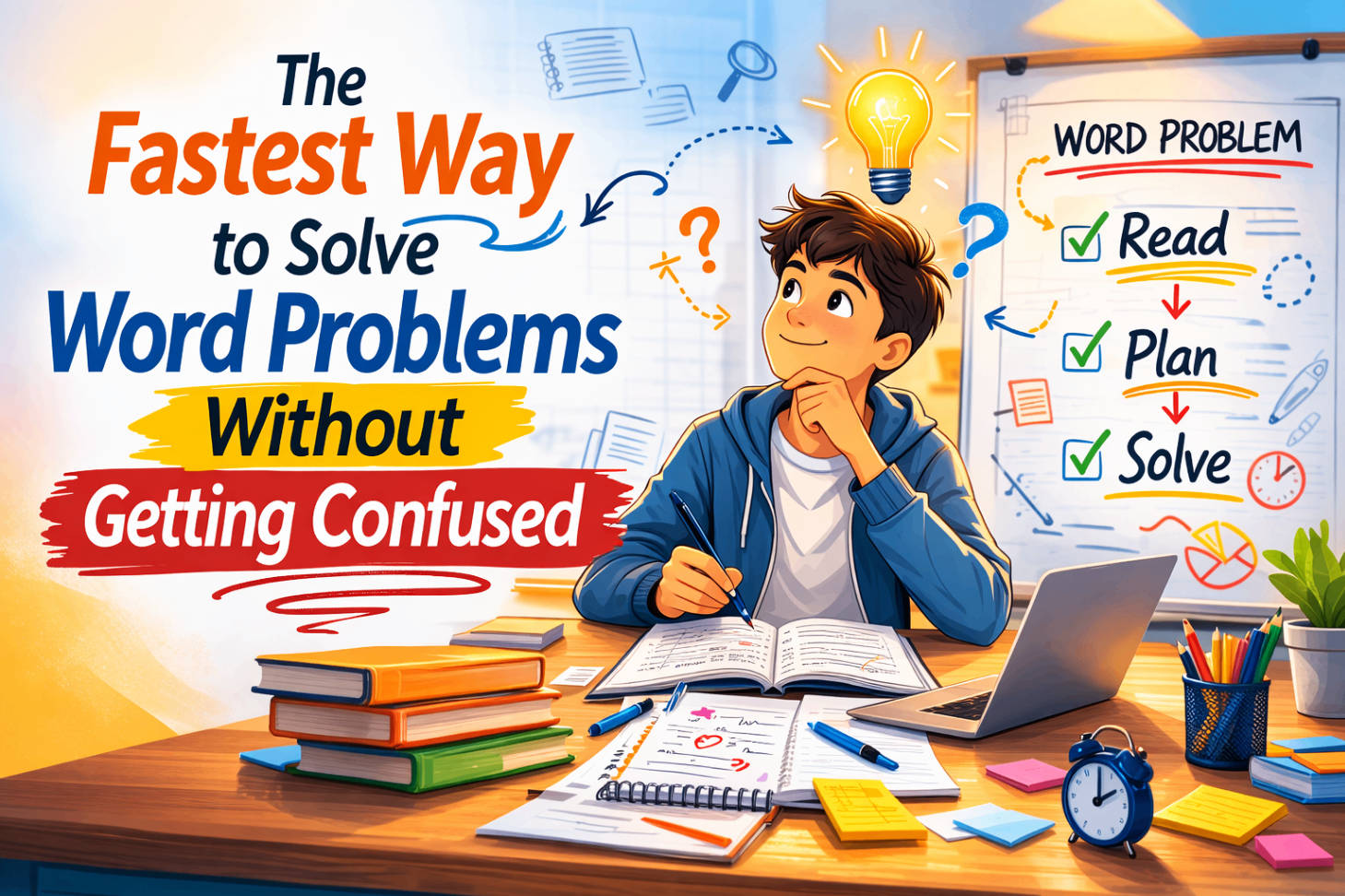
The key to answering word problems quickly and accurately is having a solid process that is followed every time. Here is one that works for all grade levels and subject areas:
1. Read the Problem Twice Before Doing Anything
Before you do anything else, including picking up a pencil, it is essential to read the word problem from start to end, and then read it again. The first reading will give you a general idea of what is going on in the problem. The second reading will allow you to narrow it down and understand exactly what is being asked. Many students tend to dive into calculations right away after reading it once and end up calculating the wrong thing entirely. The more you understand it at the beginning, the faster you will get to the end.
2. Identify and Highlight the Key Information
After you understand the word problem, it is essential to go back and highlight the key pieces of information given in the problem. Key words such as total, remaining, combined, difference, each, and per are usually great indicators of which math operation is required to solve the word problem. It is essential to develop this habit of marking these words every time before you put pencil to paper and start writing equations.
3. Filter Out the Irrelevant Details
Most word problems have extra details meant to throw you off track. Not all the details in the word problem are necessary to solve it. What this means is that you should look at the word problem and ask yourself if there is any detail which can help you solve it. If it does not help, you should cross it out. This will make it much simpler to do the math.
4. Translate the Words into a Math Equation
This is where word problems are translated into math. After filtering out the details which are not necessary, you should now look at the word problem and translate it into a math equation. For example, "Maya had 24 stickers and gave 9 to her friend — how many does she have left?" is translated into 24 - 9 = ? This is where word problems are made easy because you are only dealing with numbers.
5.Solve and Verify Your Answer
You need to solve the equation, and then go back and re-read the original question. Does your answer really answer the question? Does it make sense in the real world? If someone ends up with a negative number of apples or goes faster than a jet, then something has gone terribly wrong. A quick re-read at the end will catch errors that rushing will always miss.
Common Mistakes That Keep Students Stuck on Word Problems
Despite having a solid approach in place, students often fall into the same patterns of error. Recognizing these patterns can help you avoid making them in the first place.
Skipping the Second Read
It is not often that reading the word problem once is sufficient. Often, the key question is hidden at the end of the problem. Skipping the second read is another mistake that students often make.
Ignoring Units of Measurement
The unit of measurement of the answer is often crucial. For example, if it is in meters, minutes, dollars, or kilograms, it is essential to include it with the answer and see if it makes sense in relation to the question.
Relying Too Heavily on Trigger Words
While "more" and "total" can be helpful in determining what operation is needed in a word problem, it is not always the case. For example, "There are 7 more adults than children" may not necessarily mean addition.
Not Drawing a Visual
Drawing a diagram or picture is often helpful in making sense of the question. Sometimes it is difficult to see the relationship between two or more numbers in the question itself.
How AI Tools Can Help You Solve Word Problems Without Confusion
This is because modern learning aids have made it easier than ever to get instant and step-by-step help when you are stuck. For example, if you are working through a difficult word problem and your approach is not working out, an AI Answer Generator Free can walk you through the solution clearly and logically. Rather than simply giving you an answer, quality AI tools break down each step with reasoning, helping you understand the method rather than just memorize a result. For students who need deeper support beyond a quick solution, it also pays to build the skill of requesting detailed breakdowns. Learning How to Get Detailed Explanations for Tough Questions is a habit that improves performance across every subject, not just math.
Conclusion
Word problems are no longer intimidating challenges once you know you have a system to back you up. When you read word problems, identify the essential data, filter out unnecessary data, write a clean equation, and double-check your answer, you will realize that you have found a secret to solving word problems in record time without getting confused – every single time.
Frequently Asked Questions
1.What is the fastest way to solve word problems?
The quickest way to solve word problems is to read the problem twice, underlining important numbers and keywords, eliminating unnecessary information, and translating it into an accurate math equation to solve and check against the question before finalizing your solution.
2.Why do students get confused by word problems?
Word problems confuse students because it is a mixture of understanding what is going on and math problems. It is very easy to get confused on what is going on or what is needed to solve it without a proper strategy.
3.How do I know which math operation to use in a word problem?
To do this, we can look for keyword signals within the word problem. For example, we can look for words such as "total," "combined," "remaining," "difference," "each," and "per," which can give us hints about which math operation is being used. However, we should also try to understand the logic of the word problem.
4.Can AI tools genuinely help with solving word problems?
Yes, they can. For example, an AI tool can help students understand word problems step by step and can explain to them the logic behind each calculation. The tool can be very helpful to students who are stuck and do not understand the word problem.
5.How can I help my child practice solving word problems at home?
To help your child practice solving word problems, you can begin with basic and common situations such as shopping, cooking, sports, or traveling. You can ask your child to use the step-by-step method of solving the problem, such as reading twice, highlighting, crossing out, writing an equation, and checking the answer.