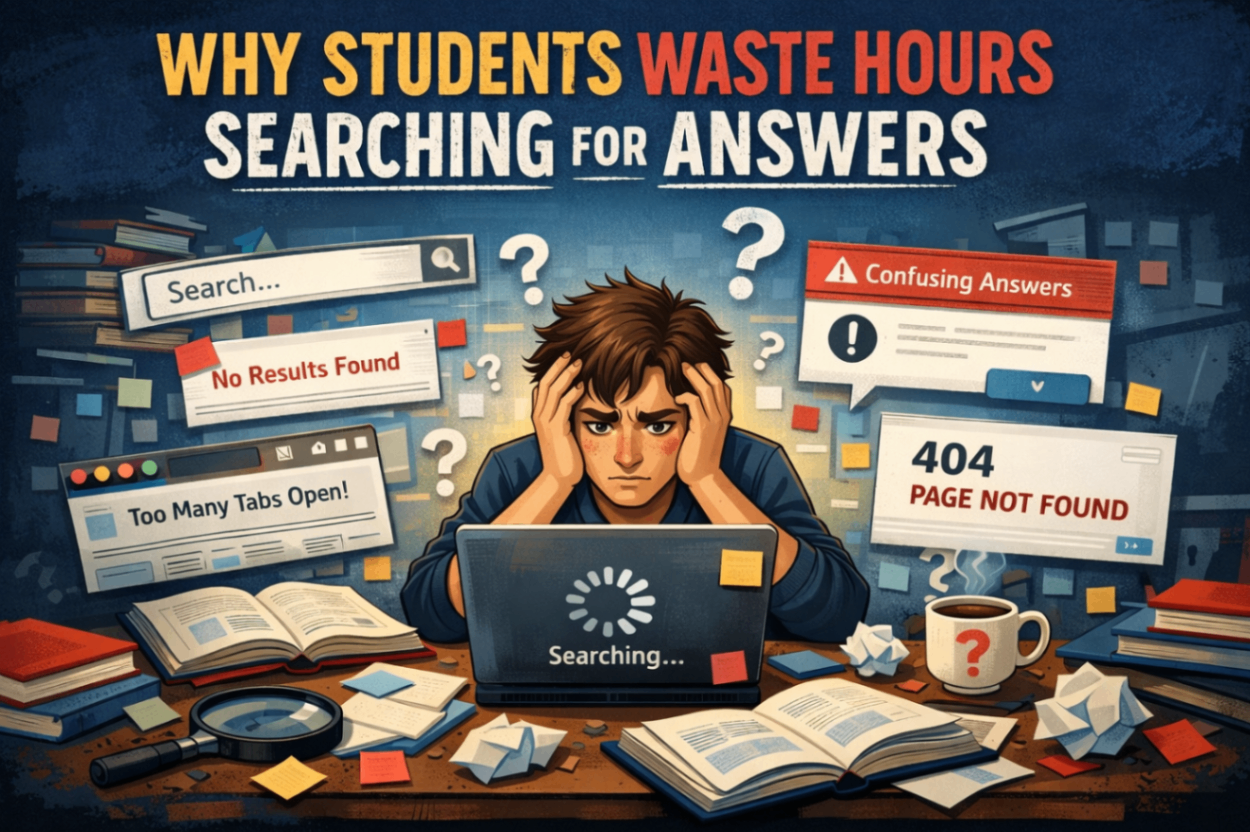

A lot of students don't have trouble with homework because it's too hard; they have trouble because it's too spread out. There is one tab for math help, one for science definitions, one for essay tools, and one for checking grammar. You haven't answered a single question in twenty minutes by the time you've loaded your fifth app.
You're not the only one who has heard this before. The good news is that there is a much better way. This guide shows you exactly how to do mixed-subject homework without using a lot of apps. This will save you time, stop you from getting frustrated, and help you get things done.
Why Students End Up Using Too Many Apps for Homework
When you have to do homework for four different subjects in one night, your first instinct is to find the "best tool" for each one. An app that helps you do math. An English dictionary. A tool for learning history with flashcards. A chemistry reference for formulas. Soon, the homework session is less about learning and more about keeping track of tools.
The main issue is that most students don't study just one subject anymore. Most evenings, I have to do homework in science, the humanities, and math all at once. This makes switching apps not only annoying, but it really breaks my focus and flow.
The Hidden Cost of Switching Between Homework Tools
Cognitive science calls the mental cost you pay every time you switch between tasks or tools "context switching." When you close one app and open another, your brain has to get used to the new interface, remember where you left off, and get back on track. This change takes up real time and mental energy. Multiply that across a two-hour study session involving five different subjects, and a significant portion of your evening disappears into friction rather than learning. Students who have to deal with more than one subject often say they feel more overwhelmed at the end of a session than they did at the beginning. This isn't because the work was hard, but because the workflow was messy.
When Managing Multiple Subjects Becomes Overwhelming
Using more than one app makes it harder to stay organized, and it also wastes time. Due dates for homework get mixed up, notes get spread out over different platforms, and it's easy to forget what you've done. The more tools you use, the more mental space you need to keep track of everything. This is space that should be used to learn the material.
How to Solve Mixed-Subject Homework Without Using Multiple Apps
Finding better apps for each subject isn't the answer. It's to get rid of the need to juggle them in the first place. This is a useful method that works for any combination of grades and subjects.
Use a Single AI-Powered Homework Tool for All Subjects
The best thing you can do is switch to one AI-powered tool that can handle many subjects on its own. A good Answer Generator AI can answer all of your questions about math, biology, and essay structure from the same interface, so you don't have to search for them on different platforms.
You don't have to know what "category" your question falls into for a subject-agnostic tool to work. You just ask, and it answers, whether the question is about quadratic equations, the causes of the French Revolution, or how to make your English paper's thesis better.
Prioritize All Assignments Before You Open Any Tool
Before you use any app or tool, take five minutes to write down all the work you have to do that night. Put them in order of how hard they are and when they are due. This habit stops students from getting stuck in "where do I even start?" mode, which leads to procrastination and unnecessary tool-hopping.
Once you have a clear list, go through the topics one by one instead of jumping around. Start with the hardest or most urgent subject first, when you are most focused.
Apply Time Blocking to Protect Your Focus Across Subjects
Give each subject a certain amount of time, like 30 minutes for math, 25 minutes for history, and 20 minutes for English. Set a timer and promise to stay on that topic until the block is over. This method, which is often called "time-blocking," stops you from wanting to do more than one thing at once and keeps your work flow going in a straight line.
The useful thing is that you only need one tool open at a time. When you're in math mode, you're asking math questions and getting math answers. You can move on to the next subject without losing the context when the block is over.
Smart Study Habits That Make Single-App Homework Easier
Picking the right tool is the most important step, but a few good habits can make the single-app approach much more useful.
Put all of your notes in one place. If you like using a notebook or a notes app, putting everything in one place will save you time looking through different platforms for something you wrote down earlier.
As you think of them, write down your questions. If you don't understand something while you're working on an assignment, write down the question instead of switching apps. Save all lookups for the designated AI tool time within that subject block.
At the end, do one last check. Instead of proofreading your essay while also cross-referencing history notes, finish all subjects first and then review your work in one pass. This keeps your mind in a consistent mode rather than constantly shifting gears.
For additional strategies on getting subject-specific help without the overhead of hiring outside help, check out the Best Way to Get Help on Difficult Homework Without Hiring a Tutor - a practical guide to navigating tough assignments independently.
Why One Unified Homework Tool Outperforms Five Specialized Ones
It might not make sense at first, but a tool made just for chemistry would be better than a general one. In real life, though, the opposite is usually true for everyday homework situations. Specialized tools often need separate accounts, interfaces that are hard to understand, and question histories that are only available to them. One powerful AI tool gives you good answers on a wide range of topics while keeping all of your session context in one place.
It's not just about saving time; it's also about saving mental energy. Every choice you don't have to make (like which app to open or how to phrase a question for that tool's format) frees up mental resources for real understanding. And that's what homework is really meant to do.
Conclusion
You don't have to switch between five different apps and lose your focus every ten minutes to do mixed-subject homework. You can get through a lot of different subjects in one clean, efficient session by using only one AI-powered tool, planning your work ahead of time, and blocking out time to focus. It's not about using more tools; it's about using the right one well.
Frequently Asked Questions
1.Can one AI homework tool really handle questions from different subjects?
Yes. AI homework tools that are up to date can answer questions from a wide range of subjects, such as math, science, history, and English, all in one session. You don't have to switch platforms based on the subject. Just type in your question and get a correct, subject-appropriate answer.
2.How should I organize my assignments when I have multiple subjects due on the same night?
Before you open any tools or apps, write down all of your assignments. Put them in order of due date and how much work each one needs. Instead of going back and forth, work through them one at a time. You won't get tired of making decisions if you have a clear plan before you start. This will help you keep track of what you've done and keep moving forward.
3.What is the best order to tackle homework across multiple subjects?
A good way to start is with the subject that is due the soonest or that takes the most mental effort. You do better work when you do your hardest task first thing in the morning. Save easier or more familiar topics for later in the session, when you start to feel tired.
4.Does studying multiple subjects in one session hurt understanding of each subject?
It can, but only if you keep switching between them. The most important thing is to not mix subjects in the same time block. Set aside structured time blocks for each subject and give each one your full
5.How do I avoid procrastinating when my homework spans too many subjects?
Making a written list of your tasks with a clear order makes them seem a lot less overwhelming than just looking at a pile of "stuff to do." Add a single, dependable tool you trust to help with any subject, and the amount of energy you need to get started goes down a lot. The hardest part of a task is usually the first five minutes. After that, things start to move.